recovery
Your illness does not define you. It's your resolve to recover that does.
What Happens To Your Brain When You Stop Multitasking. Top Story - February 2026.
Digital technology is the culprit that is causing us to doom scroll when tired, disengaged and unmotivated with the content that motivated you to log onto your device to consume in the first place. That is only the beginning. In the modern workplace (and even when filing cabinets were around, I confirmed this with my adopted parents to get my facts right); reading files while you are supposed to be present to the caller on the other end of the phone line is another classic example of multitasking that causes your brain (although adaptable and intelligent) to lose focus and concentration.
By Justine Crowley18 days ago in Psyche
...And I'm Back!. Content Warning.
I missed this. I missed this site and this community and I really, really missed writing. My last post was 2 years ago. A lot has happened since then, personally and globally. I’m not an expert on the latter, but I can share with you parts of my story since I was last here.
By Tasha McIntosh20 days ago in Psyche
Learning to Be Alone Changed Me More Than Any Relationship
No one teaches you how to be alone. They only tell you to find people, find love, find noise. From a young age, we are taught that happiness is something external. That it lives in friendships, relationships, crowds, attention, and validation. We’re told that being surrounded by people means we are doing life correctly. And if we’re alone for too long, something must be wrong.
By Francis E Kemoh21 days ago in Psyche
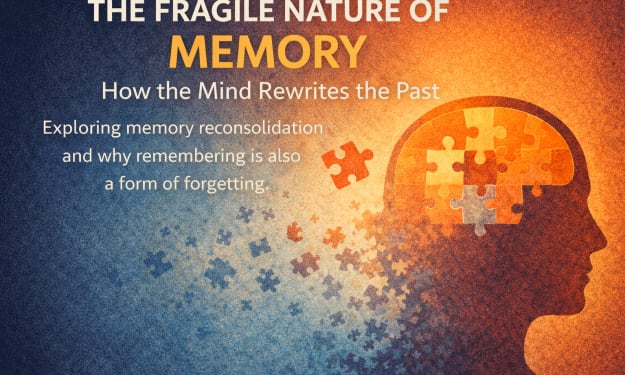
The Fragile Nature of Memory: How the Mind Rewrites the Past
We often view memory as a recording device. Something happens, and the brain stores it. Later, we recall it unchanged, like opening a file. Psychology presents a different picture. Memory is not fixed; it is fluid, reconstructive, and surprisingly fragile. One interesting aspect of cognitive psychology is memory reconsolidation, which is the process that alters our memories every time we recall them. This instability is not a flaw; it shows how our minds adapt, protect themselves, and reshape our identity over time.
By Kyle Butler23 days ago in Psyche
When Thinking Feels Like Action
There is a particular satisfaction that comes from understanding something clearly after wrestling with it for a long time. The mind settles. Tension releases. Pieces line up. In that moment, it can feel as though real movement has occurred, as though something meaningful has been accomplished. That feeling is not imagined. Cognitive resolution is a real event. The danger appears when that internal resolution is quietly mistaken for external change, and thinking begins to substitute for action rather than prepare the way for it.
By Peter Thwing - Host of the FST Podcast23 days ago in Psyche
The Memory of Icicles. Content Warning.
I'm going to tell you a story that I have never shared with anyone. I hope that it will bring healing to the reader, or at least the knowledge that you and I might share a common bond. A quote attributed to C.S. Lewis states, "We read to know we are not alone." Isolation and shame are hallmarks of domestic violence. So, I share my story to bring it to the light, and hopefully remove some of it's sting.
By Kathleen Anderson 23 days ago in Psyche