disorder
The spectrum of Mental Health disorders is incredibly vast; we showcase the multitude of conditions that affect mood, thinking and behavior.
Life with Co-Occurring Disorders
As a child, I never seemed to feel as if I fit in. I always seemed to be the odd man out. I remembered being incredibly sad and depressed even as a pre-teen. When a “friend” (let’s use that term loosely) decided she hated me and that everyone should too, I started planning my suicide. I was only 11. My mother knew I was always lashing out, always crying, or always anxious, but we all thought it was a phase. Looking back, I could see why. I don’t hate my parents for thinking that.
By rachel west5 years ago in Psyche
Freshman Year
TW: suicidal ideation, depression, trauma, I was staring at the wall riding a bus home, and I cannot for the life of me stop thinking about all the ways I could attempt suicide, a task I tried nightly, failing every time. I had found myself in a cycle of self hatred, waking to the nagging voice reminding me you failed again, can't do anything right. I tried to shake myself free of the intrusive thoughts that cluttered my every thought until it completely died out. Leaving only the intrusive thought, leaving only plots of suicide.
By L.D. Malachite 5 years ago in Psyche
Eating with an eating disorder
Let's start from the beginning, lets start with my mother's eating disorder. My mother was a woman who did not eat due to the traumas imparted on her by her grandparents, people I had never met. Mom was told she was fat from her hospital bed as a teen when she passed out because she was so underweight. She had no clue when she was with child how often children ate, as she didn't consume on a daily basis, asking my grandma "do babies have to eat every day?". The news rippled across my family as people realized with a start that she was in no way fit or prepared to be a parent.
By L.D. Malachite 5 years ago in Psyche
Forever Goodbye ED
Dear Ed, This is going to be hard to say but i think its time we part ways. You have been by my side ever since grade school when my nickname was baby hippo and i am now 3 years out of high school. You have been to hell and back with me, but i cant have you be apart of me anymore. You have been noting but negative, a liar and a terrible "friend". everything you have told me throughout the past 9 years have been complete lies: "you're too fat you cant eat that", d0nt even think about laying down go out and exercise you need to lose weight", "you'll get fat if you have that piece of cheesecake". I know this isn't true, well now I do.
By Zoey Raffay5 years ago in Psyche
Living on the fucking border(line).
Now I am not talking about upstate New York. Or down south in El Paso, Texas. I am talking about a personality disorder so confusing, even the title leaves many people confused. Borderline. Teetering on the edge of something. Almost there. Well yes, but in actuality, quite the opposite. The term “borderline” was first introduced in the United States in 1938. It was a term used by early psychiatrists to describe people who were thought to have a tendency to regress into “borderline schizophrenia” in certain situations. At the time, people with neurosis were believed to be treatable, whereas people with psychoses were deemed untreatable. These patients were especially confusing. They didn’t quite fit into the the category of neurotic personality. Or psychotic. Ultimately, where these patients inhabited is somewhere in purgatory – no man’s land if you will. Somewhere on the borderline between neurosis and psychosis.
By Christina K. Pierce5 years ago in Psyche
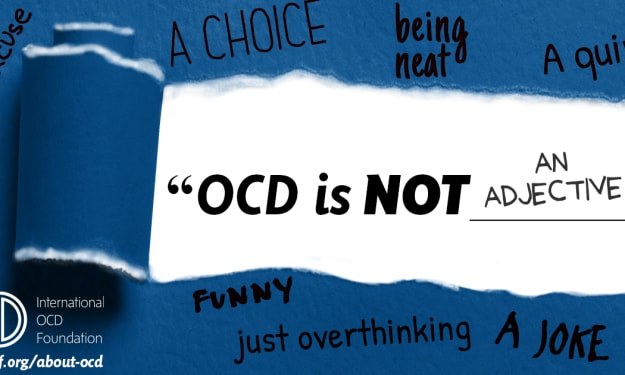
Streptococcal Infection and Obsessive Compulsive Disorders
For most preschoolers, going to the doctor’s office meant a general check-up, the occasional “I don’t want a shot” tantrum, and a few free stickers and a lollipop after the visit. When I went to the doctor’s office in preschool, it usually meant throat cultures, blood draws and another antibiotic prescription. At around age 4, I began contracting strep throat at least twice per year even with minimal exposure.. When I contracted my first streptococcal infection, I presented with normal symptoms--sore/irritated throat, nausea, and a fever. However, as I continued to contract this bacterial infection repeatedly, I began to show uncommon strep symptoms that presented more like the common cold. Due to this, it became increasingly difficult for my parents and caretakers to recognize the infection. It was perplexing for my family and doctors. They monitored my symptoms closely each time I became sick and I was tested multiple times to determine if I was a carrier for the streptococcal bacteria. However, even with the close monitoring of infections I developed, it was sometimes impossible to tell.
By Abigail Thayer5 years ago in Psyche
Maladaptive Daydreaming
I noticed a change in me, about eight years ago. At that time I was a sophomore in high-school and I found it extremely hard to concentrate in class. I was daydreaming or at the time I thought that’s what I was doing. At a moments of notice I would dream about another world and role play in my head of this world. It was an intense dream and I’ll always have vivid pictures in my head of what the people looked like and their names.
By Khadijah Jackson5 years ago in Psyche
Here's Why ADHD Patients Have Such Different Experiences
According to a 2016 CDC survey, around 6.1 million or 9.4% of children have been diagnosed with ADHD, which may not seem like much compared to the general population, but is definitely more than we might expect (CDC). Almost everyone knows at least one person with ADHD, and interestingly enough, each of these people has experiences and symptoms that are unique to them. For example, one person with ADHD may struggle with paying attention during class, another person may struggle more with tics and excessive talking, and yet another patient may have issues with all of the above. But why, you might wonder, do these differences occur? Studies have shown that there are many reasons why the ADHD experience may be different for each patient, including the different types of ADHD, a genetic predisposition for certain symptoms, comorbidities that may go along with ADHD, and traumatic events experienced during key times of brain development.
By Celia Pyburn5 years ago in Psyche