
Yajuj and Majuj (Gog and Magog) and the Concept of the “Barrier” That Holds Them Back
Myth, Revelation, and the Wall of Dhul-Qarnayn in Islamic Eschatology

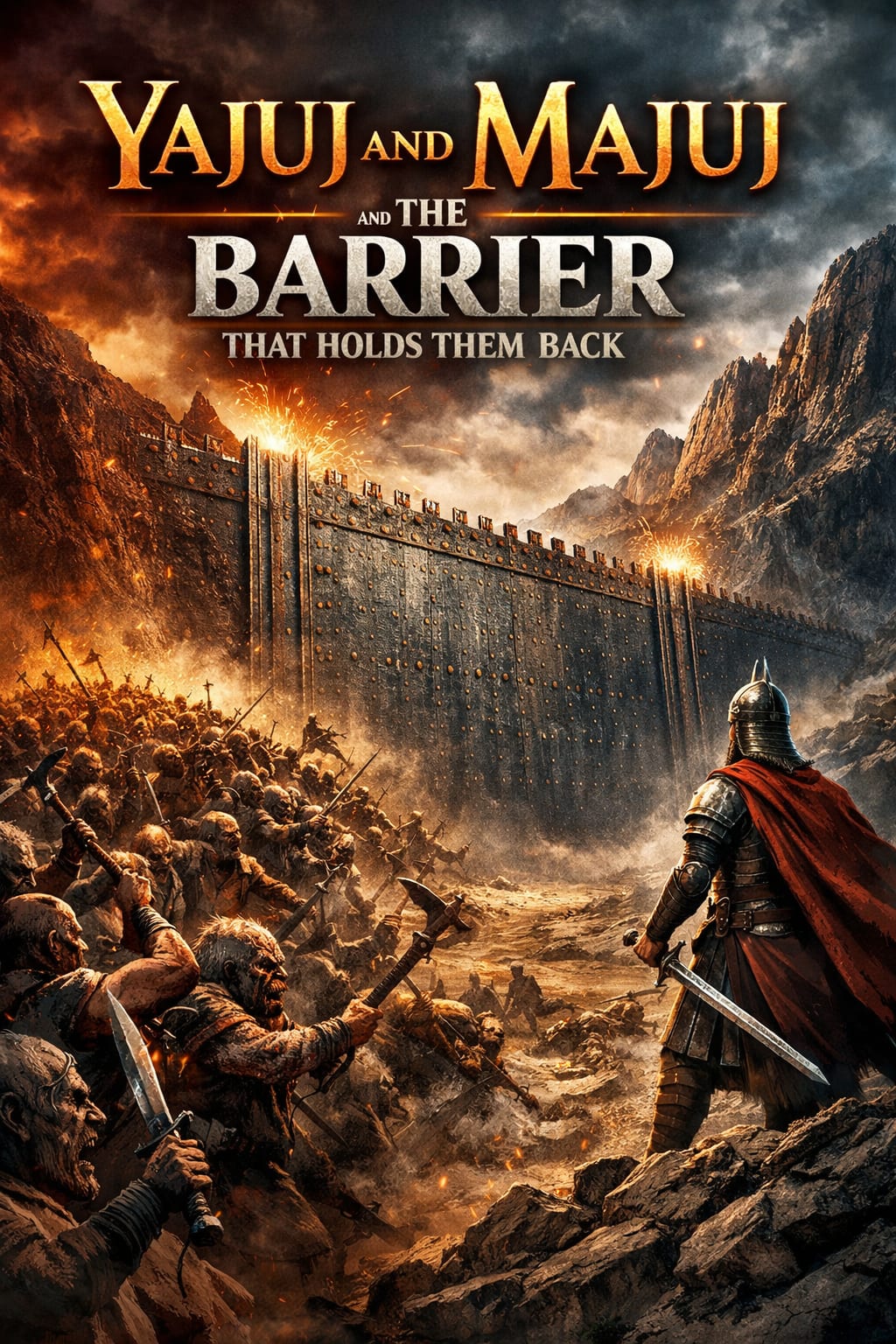
The story of Yajuj and Majuj—known in English as Gog and Magog—occupies a powerful place in Islamic eschatology. These mysterious tribes are mentioned in the Qur’an and Hadith as forces of chaos who will emerge near the end of times. Central to their narrative is the construction of a massive barrier built by the righteous ruler Dhul-Qarnayn, a wall designed to restrain their corruption until a divinely appointed time. This article explores who Yajuj and Majuj are, the meaning of the barrier, and how the concept has been understood historically and symbolically.
## Qur’anic Foundation of the Story
The primary Qur’anic account appears in Surah Al-Kahf (18:83–98). In these verses, Dhul-Qarnayn travels to distant lands and encounters a community that suffers from the destructive raids of Yajuj and Majuj. The people request his help, offering tribute in exchange for protection. Dhul-Qarnayn refuses payment but agrees to build a fortification.
Using iron and molten copper, he constructs a massive wall between two mountains, effectively sealing off Yajuj and Majuj. The Qur’an states that they were unable to scale or pierce it. However, Dhul-Qarnayn declares that when God’s promise comes to pass, the barrier will crumble, and Yajuj and Majuj will surge forth.
Yajuj and Majuj are also mentioned in Surah Al-Anbiya (21:96–97), where their release is described as one of the major signs preceding the Day of Judgment. Their emergence symbolizes widespread disorder and the collapse of worldly stability.
## The Identity of Yajuj and Majuj
Islamic scholars have debated the identity of Yajuj and Majuj for centuries. Some classical commentators speculated that they were ancient nomadic tribes, possibly linked to Central Asian peoples known for invasions and warfare. Others connected them to historical groups like the Mongols due to similarities in descriptions of mass destruction and overwhelming numbers.
However, Islamic theology emphasizes that their true identity is ultimately known only to God. The focus is less on pinpointing their ethnicity and more on understanding their symbolic role as agents of widespread corruption (fasad) on earth.
The concept of Gog and Magog is not unique to Islam. They also appear in the Bible, particularly in the Book of Ezekiel and the Book of Revelation, as apocalyptic forces opposing divine order. This shared motif suggests a broader Near Eastern tradition of portraying chaotic tribes from distant lands as instruments of end-time upheaval.
## Dhul-Qarnayn and the Barrier
The figure of Dhul-Qarnayn has also been widely discussed. Some historians have associated him with Alexander the Great, while others reject this identification and propose alternative historical rulers. The Qur’an, however, does not explicitly name him, instead highlighting his qualities: justice, faith, and reliance on divine guidance.
The barrier he constructs is described as extraordinarily strong, made of iron blocks fused with molten copper. This vivid imagery conveys technological mastery and divine assistance. Importantly, Dhul-Qarnayn attributes the barrier’s strength to God’s mercy and acknowledges that it will not last forever. When the appointed time arrives, the wall will be reduced to dust.
The “barrier” therefore represents both physical restraint and divine decree. It signifies that chaos is temporarily contained by God’s will, but history moves toward a climax that cannot be permanently delayed.
## Eschatological Significance
In Islamic eschatology, the release of Yajuj and Majuj is one of the major signs of the Last Day. According to authentic Hadith, after the return of Prophet Isa (Jesus), peace will briefly prevail. Then Yajuj and Majuj will break through the barrier and spread across the earth in vast numbers, consuming resources and causing devastation.
Ultimately, they will be destroyed not by human power but by divine intervention. God will send a form of disease or pestilence that eliminates them, demonstrating that ultimate authority belongs to Him alone.
This sequence reinforces a key theological principle: human efforts, no matter how advanced, cannot override divine destiny. The barrier’s collapse marks the transition from worldly order to final accountability.
## Symbolic and Contemporary Interpretations
While many Muslims understand the story literally, some modern scholars explore symbolic interpretations. The barrier can be viewed as representing the limits placed on destructive human tendencies—greed, violence, and corruption. Yajuj and Majuj may symbolize collective forces that overwhelm moral restraint when ethical boundaries collapse.
In this view, the narrative functions as a warning: societies that neglect justice and spiritual values risk unleashing forces of chaos. The eventual destruction of Yajuj and Majuj underscores hope—that corruption will not prevail indefinitely.
## Conclusion
The story of Yajuj and Majuj and the barrier built by Dhul-Qarnayn is a profound element of Islamic belief about the end of times. Rooted in Qur’anic revelation and elaborated through Hadith tradition, it presents a dramatic vision of restraint, release, and divine justice. Whether approached literally or symbolically, the narrative highlights the tension between order and chaos, human effort and divine will. Ultimately, it reminds believers that history unfolds according to a higher plan, and that even the most formidable forces are subject to God’s command.
About the Creator
Irshad Abbasi
Ali ibn Abi Talib (RA) said 📚
“Knowledge is better than wealth, because knowledge protects you, while you have to protect wealth.
Keep reading
More stories from Irshad Abbasi and writers in History and other communities.
Harut and Marut The Story of the Angels Sent Down to Babylon
The story of Harut and Marut is one of the most intriguing and debated narratives in Islamic tradition. Mentioned briefly in the Qur’an, elaborated upon in later Islamic exegesis, and paralleled by certain themes in Jewish and biblical traditions, the account of these angels sent to Babylon explores themes of temptation, free will, magic, and divine testing. While the Qur’an provides a concise reference, Jewish apocryphal literature and later interpretations offer additional context that has shaped understanding across centuries.
By Irshad Abbasi 2 days ago in History
I was in a Toxic Relationship, with my Workplace
“You got that?” My ex yelled. His hands were balled into fists at his side. At six foot three, he towered over me. A normal person would have been afraid, but I looked up a video of George Lopez repeatedly saying, “I got this,” and showed it to him. I had grown used to this treatment, so much so that I didn’t blink when he ripped the phone from my hand and threw it across the room.
By Jade M.5 days ago in Confessions



Comments (1)
A thin conclusion, would need answers-the return of Isa is for what purpose and in what form - touristic or divine revelation, proving His teaching called the Christian gospel?? Thank you for trouble explaining me