
The World’s Most Contested City
Exploring the Religious, Historical, and Political Significance of Jerusalem in Global Conflicts

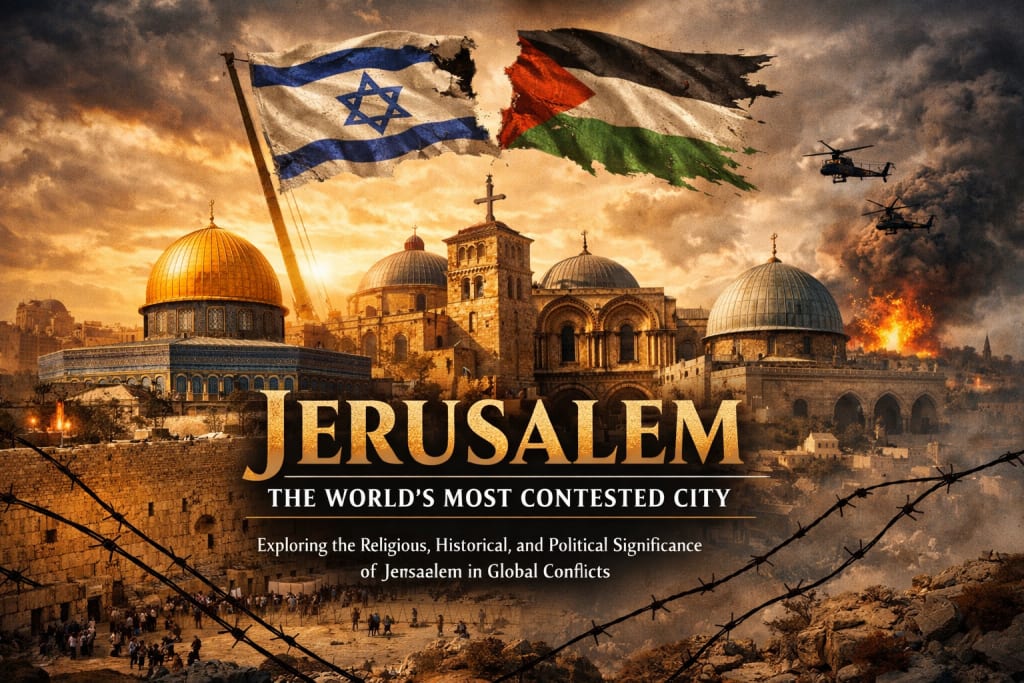
Jerusalem, one of the oldest cities in the world, has long held a unique place in the hearts of billions. Its significance spans religions, cultures, and empires, making it both a spiritual beacon and a geopolitical hotspot. Known for its sacred sites, historic monuments, and rich cultural heritage, Jerusalem is also the epicenter of one of the most enduring conflicts in modern history. The city’s contested status stems from its deep religious significance, complex historical legacy, and the political disputes that continue to shape the Middle East.
Religious Significance
Jerusalem is sacred to three of the world’s major monotheistic religions: Judaism, Christianity, and Islam. For Jews, it is the site of the ancient Temple, the holiest place in Judaism, where the Western Wall still stands as a place of prayer and pilgrimage. Christians revere the city as the location of Jesus Christ’s crucifixion, resurrection, and ministry, with the Church of the Holy Sepulchre marking these central events. For Muslims, Jerusalem is home to the Al-Aqsa Mosque, the third holiest site in Islam, believed to be the place from which Prophet Muhammad ascended to heaven during the Night Journey.
This overlapping religious importance has made Jerusalem a spiritual center for centuries. Each faith’s attachment to the city is profound, creating a situation where competing religious narratives are deeply intertwined with identity and devotion. These spiritual connections are not just symbolic; they influence politics, diplomacy, and daily life, making compromise exceedingly difficult.
Historical Layers and Conquests
Jerusalem’s strategic location at the crossroads of Africa, Asia, and Europe has made it a coveted prize for empires throughout history. From ancient Israelite kingdoms to Roman, Byzantine, Islamic, Crusader, Ottoman, and British rule, the city has changed hands numerous times. Each ruler left a mark—architectural, cultural, and political—contributing to Jerusalem’s complex identity.
The long history of conquest has created layers of claims, with historical narratives being invoked to justify modern political stances. Jewish historical claims often refer to ancient kingdoms and temples, while Islamic claims emphasize centuries of Muslim governance. Christian perspectives highlight Jerusalem as a central element of biblical history. The intertwining of history and faith creates a unique tension, as each claim carries deep cultural and emotional weight.
Political Conflict
The modern conflict over Jerusalem is primarily rooted in the Israeli-Palestinian dispute. Following the creation of Israel in 1948, Jerusalem was divided: West Jerusalem under Israeli control and East Jerusalem, including the Old City, under Jordanian rule. The Six-Day War of 1967 resulted in Israel capturing East Jerusalem and declaring the city its undivided capital, a move not recognized internationally. Palestinians view East Jerusalem as the capital of a future Palestinian state, leading to a political stalemate that resonates globally.
Internationally, Jerusalem’s status is controversial. The United Nations and most countries do not formally recognize Israel’s claim over the entire city, maintaining that final status should be determined through negotiations. The city’s division is a central obstacle in peace talks, as its symbolic and practical significance makes compromise highly sensitive.
Social and Cultural Dimensions
Jerusalem is not just a battleground of faith and politics; it is also a living city with diverse communities. Jewish, Muslim, and Christian populations coexist, albeit often amid tension and segregation. Cultural heritage, language, and daily life are shaped by this mosaic, yet the ongoing conflict affects access to housing, education, and religious practices. Pilgrimages, tourism, and local traditions continue to thrive, but they are invariably influenced by security concerns and political restrictions.
Global Implications
Jerusalem’s contested status resonates far beyond the Middle East. International diplomacy, religious advocacy, and global media often focus on the city, making it a symbol of broader conflicts involving sovereignty, human rights, and religious freedom. Decisions regarding embassies, tourism policies, or international agreements frequently spark debates, protests, and sometimes violence, reflecting the city’s extraordinary global significance.
Conclusion
Jerusalem’s status as the world’s most contested city is rooted in a combination of religious reverence, historical complexity, and political disputes. Its sacred sites, deep historical legacy, and symbolic significance make it a city unlike any other—one that evokes profound devotion, passionate claims, and persistent conflict. Resolving Jerusalem’s future remains one of the most challenging diplomatic tasks in modern history, as the city continues to embody both humanity’s shared heritage and its divisions.
The story of Jerusalem is, therefore, not only about bricks and stones but also about identity, faith, and the enduring struggle for peace in a region where the past and present are inseparably intertwined.
About the Creator
Irshad Abbasi
Ali ibn Abi Talib (RA) said 📚
“Knowledge is better than wealth, because knowledge protects you, while you have to protect wealth.
Keep reading
More stories from Irshad Abbasi and writers in History and other communities.
The Sacred Cave of Safrawadi: Indonesia’s Mysterious Tunnel to Mecca
Hidden among the lush landscapes and volcanic highlands of Indonesia lies a cave shrouded in mystery, devotion, and folklore. Known locally as “Safrawadi,” this sacred site has become the center of a captivating legend: that deep within its shadowy chambers exists a hidden tunnel leading all the way to Mecca, the holiest city in Islam. While historians and geologists approach the claim with skepticism, for many believers the cave represents something far more profound than a physical passage — it symbolizes spiritual connection, faith, and longing.
By Irshad Abbasi about 11 hours ago in History
When the Shelter Closes
Across the street from my house, a man slept under a tree, his dog by his side. My first, naive thought: he must be traveling through. But he kept coming back, often sleeping there during the day. Then it hit me—that person might not have a home.
By Bride of Sound6 days ago in Humans


Comments
There are no comments for this story
Be the first to respond and start the conversation.