
The Sacred Cave of Safrawadi: Indonesia’s Mysterious Tunnel to Mecca
Exploring the legend of a holy cavern said to hide a secret passage leading directly to Islam’s holiest city


Hidden among the lush landscapes and volcanic highlands of Indonesia lies a cave shrouded in mystery, devotion, and folklore. Known locally as “Safrawadi,” this sacred site has become the center of a captivating legend: that deep within its shadowy chambers exists a hidden tunnel leading all the way to Mecca, the holiest city in Islam. While historians and geologists approach the claim with skepticism, for many believers the cave represents something far more profound than a physical passage — it symbolizes spiritual connection, faith, and longing.
Indonesia, the world’s largest Muslim-majority nation, has a rich tradition of blending Islamic teachings with local culture and ancient myths. Stories of sacred mountains, holy wells, and mystical caves are common throughout the archipelago. The tale of Safrawadi fits seamlessly into this cultural tapestry. According to local tradition, centuries ago a pious scholar or saint discovered the cave during meditation. While praying inside, he reportedly experienced a divine vision revealing a secret underground route that spiritually connected the cave to Mecca.
The legend suggests that this hidden tunnel was not meant for ordinary travelers. Only the spiritually pure, it is said, could traverse the passage — and even then, the journey was believed to occur in a miraculous or metaphysical manner rather than as a physical trek. Some stories claim that saints were able to enter the cave and emerge in Mecca within moments, bypassing the vast distance between Southeast Asia and the Arabian Peninsula.
For centuries, pilgrims have visited the cave seeking blessings, healing, and spiritual closeness to God. Many come to pray, recite verses from the Quran, and reflect in solitude. The cave’s atmosphere — cool, dimly lit, and echoing with dripping water — adds to its aura of mystery. Visitors often describe a sense of calm and reverence upon entering, as though stepping into a sacred realm suspended between earth and heaven.
From a scientific perspective, however, there is no geological evidence supporting the existence of a tunnel stretching thousands of kilometers beneath oceans and continents. Indonesia sits along the Pacific “Ring of Fire,” a region known for its volcanic activity and complex underground formations. While caves formed by lava flows and erosion are common, a continuous passage leading to the Arabian Peninsula would defy known geological principles.
Historians also note that stories of miraculous journeys are deeply rooted in Islamic tradition. One of the most significant examples is the Isra and Mi’raj — the miraculous night journey of the Prophet Muhammad from Mecca to Jerusalem and his ascension to the heavens. Such narratives emphasize spiritual travel rather than physical movement. In this context, the Safrawadi legend may symbolize spiritual proximity to Mecca rather than a literal underground route.
The cave’s growing popularity has also raised questions about commercialization and preservation. As more visitors arrive — some out of faith, others out of curiosity — local authorities face the challenge of maintaining the site’s sanctity while ensuring safety and environmental protection. Small vendors, guided tours, and social media exposure have transformed what was once a quiet devotional space into a modest tourist attraction.
Yet despite skepticism and modernization, the story endures. For many Indonesians, the cave is not about geology but about devotion. Mecca represents the spiritual heart of Islam — the direction of daily prayers and the destination of the Hajj pilgrimage. For believers who may never have the financial means to travel there, the idea of a sacred connection within their own homeland offers comfort and hope.
Anthropologists often interpret such legends as expressions of spiritual longing. In a vast archipelago thousands of kilometers from the Middle East, stories like Safrawadi’s help bridge the physical distance between Indonesia and Islam’s birthplace. They localize the sacred, making it accessible and intimate. Rather than diminishing faith, these narratives strengthen communal identity and reinforce shared beliefs.
At the same time, Islamic scholars generally caution against attributing supernatural powers to physical places without clear religious evidence. They emphasize that spiritual closeness to God does not depend on hidden tunnels or mystical geography but on sincere prayer, righteous conduct, and devotion.
Ultimately, the mystery of Safrawadi cave lies not in whether a tunnel truly reaches Mecca, but in why the story continues to resonate. It speaks to humanity’s universal desire for connection — to faith, to history, and to the divine. Whether viewed as folklore, metaphor, or miracle, the legend remains a fascinating example of how culture and religion intertwine.
In the end, the sacred cave stands as a testament to the power of belief. Its dark chambers may not physically lead to Mecca, but for many who enter with faith in their hearts, the journey feels just as real.
About the Creator
Irshad Abbasi
Ali ibn Abi Talib (RA) said 📚
“Knowledge is better than wealth, because knowledge protects you, while you have to protect wealth.
Keep reading
More stories from Irshad Abbasi and writers in History and other communities.
A Timeless Tale of Faith, Mystery, and Divine Protection
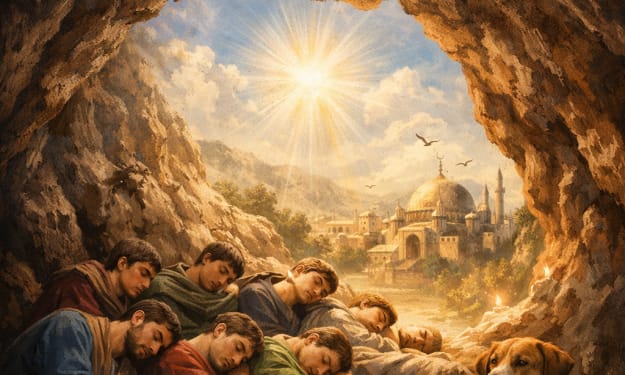
The story of the “Sleepers of the Cave,” known in Islamic tradition as Ashab al-Kahf, is one of the most fascinating and enduring narratives shared between Christianity and Islam. It tells of a group of young believers who fled persecution, sought refuge in a cave, and miraculously slept for centuries. Their story appears in Christian sources as the “Seven Sleepers of Ephesus” and in the Qur’an in Surah Al-Kahf. Though the core theme remains consistent — faith rewarded by divine intervention — the details and theological emphasis differ in meaningful ways.
By Irshad Abbasi about 2 hours ago in History
When the Shelter Closes
Across the street from my house, a man slept under a tree, his dog by his side. My first, naive thought: he must be traveling through. But he kept coming back, often sleeping there during the day. Then it hit me—that person might not have a home.
By Bride of Sound5 days ago in Humans


Comments
There are no comments for this story
Be the first to respond and start the conversation.