
Lion of the Desert: Who Was Omar Mukhtar?
The humble teacher who became the fearless symbol of Libya’s resistance against Italian colonial rule

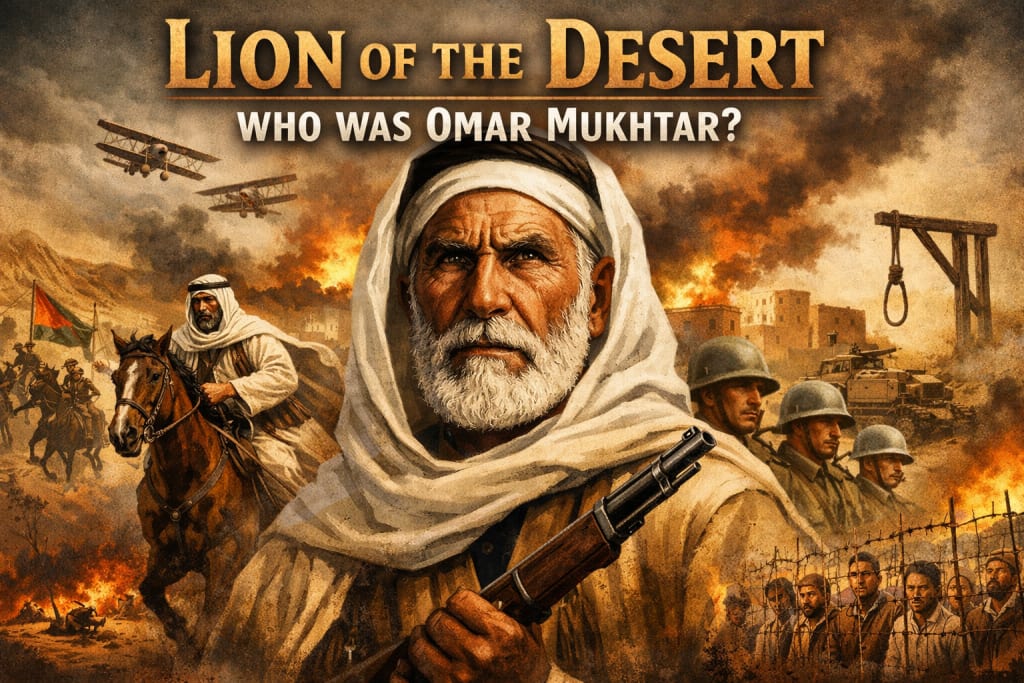
In the early 20th century, when European colonial powers were carving up Africa, one elderly man on horseback became the face of defiance in the deserts of North Africa. His name was Omar Mukhtar, and to the people of Libya, he was not just a fighter—he was a symbol of faith, courage, and unbreakable resistance. Known as the “Lion of the Desert,” Omar Mukhtar led a long and determined struggle against Italian colonial forces, proving that even the most powerful empires can be challenged by unwavering belief and determination.
Early Life and Religious Roots
Omar Mukhtar was born in 1862 in Cyrenaica, a region in eastern Libya. He grew up in a modest family and received his education in Islamic studies. From a young age, he became associated with the Senussi Order, a religious and reformist Islamic movement that played a central role in Libyan society. The Senussi Order emphasized spiritual discipline, education, and social justice. Mukhtar eventually became a respected teacher of the Quran.
For many years, he lived a simple life as a religious scholar and teacher. No one could have imagined that this quiet man would one day become the leader of a national resistance movement.
Italian Invasion of Libya
In 1911, the Kingdom of Italy invaded Libya, then part of the weakening Ottoman Empire. Italy sought to expand its colonial empire and saw Libya as an opportunity. The invasion marked the beginning of decades of violence and oppression for the Libyan people.
When Italy formally took control, Libyans refused to surrender their land easily. Armed resistance began almost immediately, particularly in the eastern region of Cyrenaica. It was during this turbulent time that Omar Mukhtar stepped forward to lead.
Although he was already nearly 50 years old when the resistance intensified, Mukhtar proved to be a brilliant strategist. He understood the harsh desert terrain better than the Italian soldiers and used guerrilla warfare tactics to his advantage. Small, mobile groups of fighters would launch surprise attacks on Italian outposts and disappear into the vast desert before the enemy could respond.
Guerrilla Warfare and Leadership
For nearly 20 years, Omar Mukhtar led the Libyan resistance against a much stronger and better-equipped Italian army. His leadership was based not only on military strategy but also on moral principles. He insisted that prisoners be treated humanely and that civilians be protected as much as possible.
Italy, frustrated by its inability to defeat the resistance, responded with brutal measures. Under the fascist regime of Benito Mussolini, Italy intensified its campaign in Libya during the 1920s. Concentration camps were established, thousands of Libyans were forcibly relocated, and harsh punishments were imposed on villages suspected of supporting the المقاومة.
Despite these extreme measures, Omar Mukhtar refused to surrender. Even in his 60s and 70s, he continued riding across the desert, inspiring young fighters with his determination and faith. His age did not weaken his spirit; instead, it strengthened his legend.
Capture and Execution
In 1931, after years of relentless fighting, Omar Mukhtar was finally captured by Italian forces during a battle. He was wounded and taken prisoner. The Italians quickly organized a military trial, hoping to crush the spirit of the Libyan resistance once and for all.
The trial was brief and predetermined. Mukhtar was sentenced to death by hanging. On September 16, 1931, in front of thousands of Libyans who were forced to watch, Omar Mukhtar was executed in the town of Suluq.
He was 69 years old.
Before his execution, he reportedly recited verses from the Quran, showing remarkable calmness and faith. His death was meant to intimidate the population—but instead, it transformed him into a martyr and eternal symbol of resistance.
Legacy and Global Recognition
Although the armed resistance weakened after his execution, the spirit of freedom he embodied never disappeared. Libya eventually gained independence in 1951, and Omar Mukhtar became a national hero.
His story reached global audiences decades later, especially through the 1981 film Lion of the Desert, in which actor Anthony Quinn portrayed him. The film depicted his struggle and highlighted the brutality of colonial rule, introducing his story to a new generation.
Today, Omar Mukhtar’s image appears on Libyan currency, in school textbooks, and in public squares. Streets and institutions are named after him. But beyond monuments and films, his true legacy lies in the values he represented: faith, justice, dignity, and resistance against oppression.
A Symbol Beyond Borders
Omar Mukhtar’s story is not just a chapter in Libyan history. It is a reminder that leadership does not always come from wealth or power. Sometimes, it comes from a simple teacher with deep conviction and love for his land.
In a world where powerful nations often dominate weaker ones, the story of the Lion of the Desert continues to inspire those who struggle for justice and freedom. Omar Mukhtar proved that even in the face of overwhelming force, the human spirit can remain unconquered.
His life was a testament to courage—and his death ensured that his name would live forever in the sands of history.
About the Creator
Irshad Abbasi
Ali ibn Abi Talib (RA) said 📚
“Knowledge is better than wealth, because knowledge protects you, while you have to protect wealth.
Keep reading
More stories from Irshad Abbasi and writers in History and other communities.
Escobar’s Paradox: The Poorest City in the World’s Richest Nation
The story of Escobar is not just the story of one man; it is the story of a city, a country, and a paradox. When people hear the name Pablo Escobar, they often think of unimaginable wealth, global drug empires, and a lifestyle that rivaled billionaires. Yet behind the myth of his fortune lies a deeper and more painful reality—entire neighborhoods living in poverty, violence, and fear. This contrast has often been described as “Escobar’s paradox”: how one of the richest criminal empires in history rose from communities that remained desperately poor.
By Irshad Abbasi about 15 hours ago in History
The Tidewater Creole People
The Tidewater Creole people are descendants of early Black communities of the Tidewater Region from the 1620s and onwards into the future in coastal Virginia, the Carolina Coast, coastal Georgia, coastal Maryland and Delaware, and the Southern New Jersey Shore.
By Gracebelle White7 days ago in History



Comments
There are no comments for this story
Be the first to respond and start the conversation.