
Escobar’s Paradox: The Poorest City in the World’s Richest Nation
How the Shadow of Pablo Escobar Still Reflects the Deep Divide Between Wealth and Poverty in Medellín

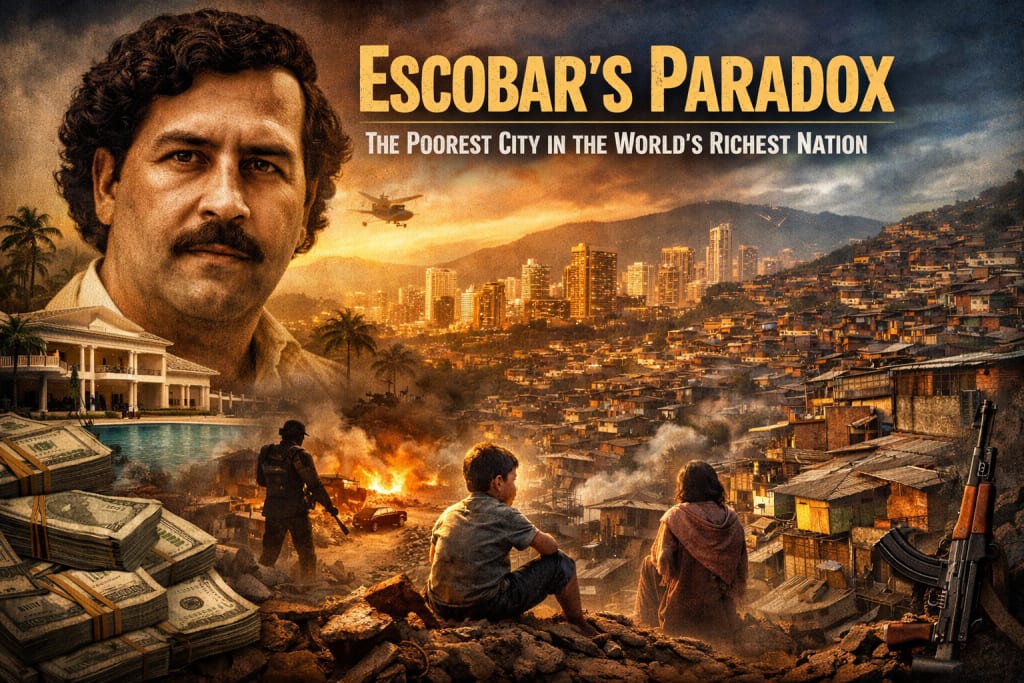
The story of Escobar is not just the story of one man; it is the story of a city, a country, and a paradox. When people hear the name Pablo Escobar, they often think of unimaginable wealth, global drug empires, and a lifestyle that rivaled billionaires. Yet behind the myth of his fortune lies a deeper and more painful reality—entire neighborhoods living in poverty, violence, and fear. This contrast has often been described as “Escobar’s paradox”: how one of the richest criminal empires in history rose from communities that remained desperately poor.
Escobar was born in 1949 in Rionegro, near Medellín, a city that would later become the center of his power. By the 1980s, he controlled the Medellín Cartel and dominated the global cocaine trade, especially into the United States. At the height of his power, he was reportedly earning billions of dollars annually. Some estimates suggested his net worth exceeded $30 billion, placing him among the richest individuals in the world at the time.
Yet while Escobar’s wealth grew, the city of Medellín suffered. In the 1980s and early 1990s, it became known as one of the most dangerous cities on Earth. Violence between cartels, police, and rival groups turned neighborhoods into war zones. Bombings, assassinations, and kidnappings became part of daily life. Ordinary citizens—especially those in poor districts—paid the highest price.
Ironically, Escobar portrayed himself as a benefactor of the poor. He built housing projects for low-income families, funded football fields, and donated money to local communities. One of the most famous examples was “Barrio Pablo Escobar,” a neighborhood he helped construct for homeless families. To many residents, he was seen as a modern-day Robin Hood. But this generosity came with a hidden cost. His charity was funded by violence, addiction, and destruction far beyond Colombia’s borders.
The paradox becomes even more striking when we consider the broader economic picture. Although Colombia is not the “richest country in the world,” Escobar’s personal fortune was so vast that it sometimes overshadowed the nation’s official economy. His cash flow was so enormous that his cartel reportedly spent thousands of dollars each month just on rubber bands to hold stacks of money together. Yet this wealth was concentrated in the hands of a few, while millions of Colombians struggled with unemployment and inequality.
After Escobar’s death in 1993, shot by Colombian security forces, Medellín faced a long and painful recovery. The fall of the cartel did not immediately solve the city’s problems. Violence continued for years, and poverty remained widespread. However, over time, Medellín began transforming itself. Through urban development projects, improved public transportation, and social programs, the city slowly rebuilt its reputation.
Today, Medellín is often cited as a model of urban innovation. The introduction of cable cars connecting poor hillside neighborhoods to the city center, investment in education, and community-driven projects have reshaped parts of the city. International media now highlight its tech industry, cultural revival, and tourism growth. Visitors walk through Comuna 13—once a symbol of extreme violence—now filled with colorful street art and guided tours explaining its turbulent history.
Still, the legacy of Escobar remains complex. His name continues to attract global fascination, especially through documentaries and television series. Shows like Narcos have dramatized his life, turning him into a pop culture figure. For some, he represents rebellion against authority; for others, he symbolizes greed and destruction. Many Colombians, however, feel that this global obsession overshadows the suffering his empire caused.
The phrase “the poorest city in the world’s richest nation” is more symbolic than literal. It highlights the deep inequality that can exist within societies. Escobar’s billions did not eliminate poverty; in many ways, they deepened instability. His empire thrived on corruption and fear, not sustainable development.
Escobar’s paradox teaches an important lesson about wealth and power. Enormous riches do not automatically bring prosperity to communities. When money is built on crime and violence, it often leaves destruction rather than progress. Medellín’s ongoing transformation shows that true development requires long-term investment in people, education, infrastructure, and peace—not just financial power.
In the end, the story of Escobar is not simply about the rise and fall of a drug lord. It is about a city’s resilience. It is about how communities can move beyond the shadow of fear and rebuild their future. And it is a reminder that the measure of a nation’s wealth is not just the fortune of its richest individual, but the well-being of its poorest citizens.
About the Creator
Irshad Abbasi
Ali ibn Abi Talib (RA) said 📚
“Knowledge is better than wealth, because knowledge protects you, while you have to protect wealth.
Keep reading
More stories from Irshad Abbasi and writers in History and other communities.
Mansa Musa: The African Emperor Richer Than Jeff Bezos
When discussing the richest people in history, modern names like Jeff Bezos often dominate the conversation. Yet centuries before the rise of billion-dollar corporations and global stock markets, a West African emperor accumulated such immense wealth that historians still struggle to measure it. His name was Mansa Musa, the legendary ruler of the Mali Empire, and he is widely considered the richest individual who ever lived.
By Irshad Abbasi about 2 hours ago in History
Review of 'Man on the Run'
My wife and I saw Man on the Run, a nearly 2-hour documentary on Amazon Prime, about Wings, Paul McCartney's group that flew around the world from shortly after The Beatles broke up in early 1970 to shortly after John Lennon was murdered at the end of 1980, making a Beatles reunion forever impossible.
By Paul Levinson3 days ago in Beat


Comments
There are no comments for this story
Be the first to respond and start the conversation.