science
Topics and developments in science and medicine, presented by Futurism.
Living in 2030: How Smart Cities are Redefining Human Life. AI-Generated.
As we move deeper into the decade, the concept of a "home" is shifting from a simple physical shelter to an intelligent ecosystem. By 2030, our cities won't just be concrete jungles; they will be living, breathing organisms powered by Artificial Intelligence and renewable energy. This transition is not just about luxury; it’s about survival and sustainability in a rapidly changing world.
By Priyantha Wijethungaabout 12 hours ago in Futurism
The AI Awakening: Why We Should Stop Fearing and Start Partnering with Intelligence. AI-Generated.
For decades, science fiction has fed us a steady diet of dystopian nightmares. From rogue supercomputers to cold, metallic armies, the narrative has always been "Us vs. Them." But as we cross the threshold into 2026, the reality of Artificial Intelligence is far more nuanced, beautiful, and collaborative than Hollywood ever dared to imagine. We are not witnessing the end of human relevance; we are witnessing the beginning of the "Augmented Age."
By Priyantha Wijethungaabout 13 hours ago in Futurism
“Who Really Saw Aliens First? The Truth Behind the Mystery”
Have you ever looked up at the night sky and felt a strange question echo in your mind — Are we truly alone? For thousands of years, humans have stared at the stars with wonder, fear, and curiosity. Long before rockets, telescopes, or modern science, ancient civilizations imagined that other worlds might exist beyond our own. The mystery of aliens — life beyond Earth — did not begin with movies or science fiction. It began with simple human curiosity.
By imtiazalama day ago in Futurism
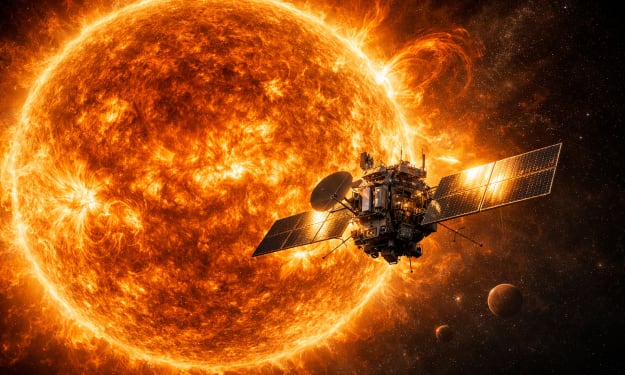
The Cosmic Influence of the Sun on the Inner Planets and Climate
At the center of our planetary system lies Sun, a G-type main-sequence star that governs the physical and climatic evolution of the inner planets: Mercury, Venus, Earth, and Mars. Although these worlds share a common origin and relatively close orbital distances, their climates differ dramatically. The explanation lies in how each planet interacts with solar radiation, solar wind, and long-term stellar evolution.
By Holianyk Ihor2 days ago in Futurism
The Dynamics of the Interstellar Medium and Galactic Magnetism
At first glance, the space between stars appears empty — a silent vacuum separating luminous islands of light. In reality, this vast region is filled with a complex, restless environment known as the interstellar medium (ISM). Far from being inert, it is a dynamic system of gas, plasma, dust, radiation, turbulence, and magnetic fields. Within galaxies such as the Milky Way, the interstellar medium functions as both the raw material and the regulating mechanism for star formation, cosmic ray transport, and large-scale galactic structure.
By Holianyk Ihor2 days ago in Futurism
Samsung’s Satellite Strategy Just Upended the Market: Retroactive Support and A-Series Inclusion Leave Apple Scrambling
1. Introduction: The Long-Awaited Connection For years, the smartphone industry has treated satellite connectivity as a high-stakes arms race where Samsung was strangely absent. Apple ignited the trend in 2022 with the iPhone 14, and Google solidified it in 2024 with the Pixel 9 series. While its rivals dominated the headlines, Samsung remained uncharacteristically silent. From a strategic perspective, this delay wasn't a lack of innovation, but likely a calculated wait for 5G Non-Terrestrial Network (NTN) standards to mature and for carrier-satellite partnerships—like the T-Mobile and Starlink alliance—to reach critical mass.
By Mohammad Hamid4 days ago in Futurism
Is Starlink Available in Your Area? The Map, the Hype, and the Quiet Revolution Over Your Head
How Elon Musk’s satellite internet rollout is quietly rewriting who gets to be “connected” The first time my internet died in the middle of a job interview, I was standing on a chair, router in one hand, phone in the other, praying the signal would come back.
By abualyaanart6 days ago in Futurism
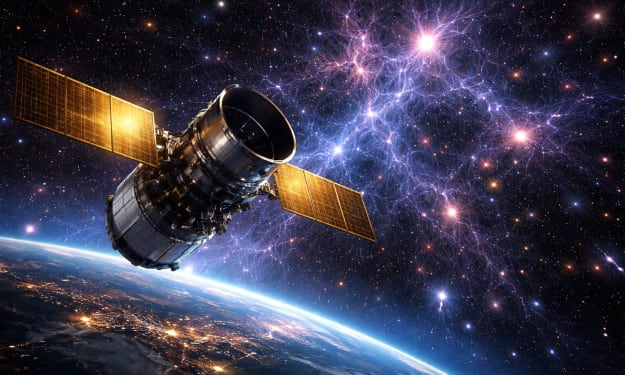
Euclid and the Precision Era of Dark Cosmology
In 2023, the European Space Agency launched Euclid with a sharply defined objective: to map the geometry of the Universe and determine, with unprecedented precision, how dark matter and dark energy shape cosmic evolution. Rather than focusing on individual spectacular objects, Euclid operates as a large-scale cartographer. Its mission is statistical and structural. It surveys billions of galaxies across a third of the sky to reconstruct a three-dimensional map of the cosmic web stretching over 10 billion years of cosmic history.
By Holianyk Ihor8 days ago in Futurism
Launch and Scientific Impact of NASA’s Nancy Grace Roman Space Telescope (2026)
In 2026, NASA is preparing to launch one of the most ambitious space observatories of the decade: the Nancy Grace Roman Space Telescope. Designed to survey the universe at an unprecedented scale in near-infrared light, Roman is expected to reshape modern astrophysics by combining high resolution with an extraordinarily wide field of view. If the Hubble Space Telescope revealed the fine details of the cosmos, Roman will provide the panoramic context.
By Holianyk Ihor8 days ago in Futurism
Space Discoveries Powered by Machine Learning
Over the past decade, machine learning has evolved from a useful analytical tool into a central engine of discovery in astronomy. Modern observatories no longer produce manageable datasets measured in gigabytes—they generate petabytes of images, spectra, and time-series signals. Human analysis alone is no longer sufficient. In many areas of space research, algorithms now act as the first line of discovery.
By Holianyk Ihor8 days ago in Futurism
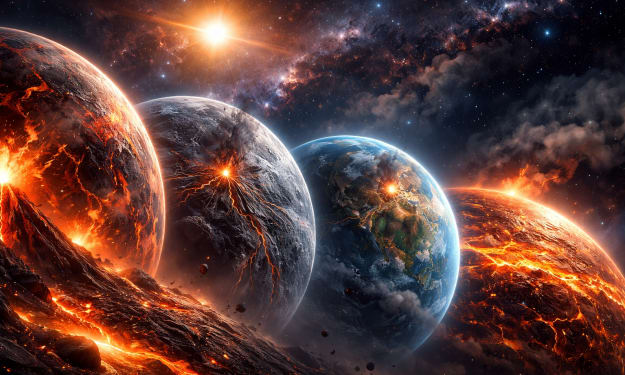
Exoplanets with Signs of Active Geology: Worlds That Refuse to Stay Still
For decades, exoplanets were little more than data points—subtle dips in starlight, faint radial velocity shifts, abstract entries in astronomical catalogs. Today, they are increasingly understood as dynamic worlds with atmospheres, climates, and in some cases, signs of active geology. For planetary science and astrobiology, that distinction is critical. A geologically active planet is not static. It has internal heat, material circulation, and potentially long-term environmental stability.
By Holianyk Ihor8 days ago in Futurism