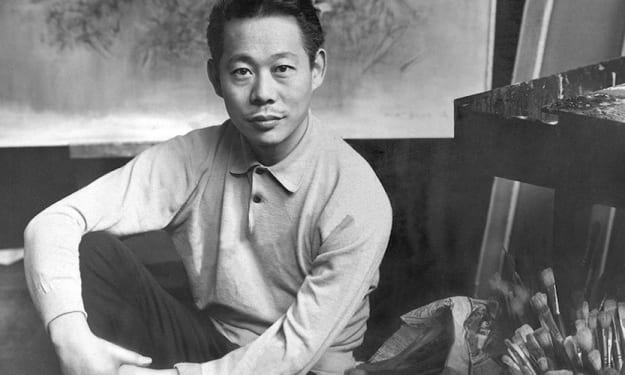
LUCCIAN LAYTH
Bio
L.LUCCIAN is a writer, poet and philosopher who delves into the unseen. He produces metaphysical contemplation that delineates the line between thinking and living. Inever write to tellsomethingaboutlife,but silences aremyway ofhearing it.
Stories (36)
Filter by community
Diaries to Nietzsche
"He who lives with a void can forge his own why, and from it shape any how." Yet while the world is consumed by distraction, a man sits crafting his soul with his mind. What they call madness becomes an explosion — and that explosion becomes the evolution of a century.
By LUCCIAN LAYTH2 days ago in Poets
One Minute — Nine O’Clock
Quietful mystique — a feeling, perhaps mistaken — the moment I took for too long. The mystery of the soul and the brain. Brown eyes I was born with, a degree. Why aren't we free — a realm of questioning, reasoning about who is real? Are we?
By LUCCIAN LAYTH5 days ago in Poets
What in Me Refuses Silence
On Earth, what seems earthly — a place and a being — appears logical. Yet what could it have sworn to remain, if even words eventually change? What seems like solid land may slide away; the earth itself may become none — not absent, but nonexistent in the way only believed things can become nonexistent.
By LUCCIAN LAYTH14 days ago in Confessions
Diaries to Nietzsche. Top Story - January 2026.
Quotation from Friedrich Nietzsche "He who wrestles long with monsters should beware lest he himself become a monster. And if you gaze long into an abyss, the abyss also gazes into you. Man is not destroyed by suffering, but by the meaning he makes of it."
By LUCCIAN LAYTH19 days ago in Critique
Letter III — On What Reorders Us Without Asking
Letter III — On What Reorders Us Without Asking The Void, beyond the 22nd century Aida, I am not writing to explain anything to you. Nor to convince. Nor to teach. I am writing because some encounters do not add ideas to us— they rearrange us. Most of our lives are built on a quiet assumption: that we are the center. That we read, choose, enter, and exit meanings at will. That texts stand before us, waiting to be interpreted. But there are words that do not stand before consciousness. They relocate it. The Qur'an does not position itself before your awareness. It repositions your awareness itself. It does not offer itself as an object of reflection, but acts as a force of gravity. You do not move around it untouched. You are moved. What I have learned slowly, unwillingly is that human beings do not live inside ideas. They live around centers. Every self revolves around something: a desire it cannot release, a fear it cannot face, an image it must protect, a future it keeps postponing itself toward, a past it secretly obeys. These centers shift. They compete. They collapse. And when consciousness expands—through thinking, ambition, imagination, abstraction, it often mistakes dispersion for growth. It believes it is becoming freer, while quietly losing its axis. Expansion without a center does not liberate. It fragments. There is a reason instability feels modern. Not because we think too little, but because we orbit too much.
By LUCCIAN LAYTH23 days ago in Confessions
Why Most Productivity Apps Fail to Improve Focus
Why Most Productivity Apps Fail to Improve Focus Productivity apps promise clarity. They offer systems, dashboards, timers, checklists, and endless customization. Yet despite their abundance, distraction remains the defining condition of modern work. This failure isn't accidental—it's a design problem rooted in many, though not all, productivity tools.
By LUCCIAN LAYTHabout a month ago in 01