
Why Oil and Gas Prices Are Rising and Stock Markets Are Falling Amid Middle East Tensions
How Energy Supply Risks, Higher Shipping Costs, and Inflation Could Impact the Global Economy

Gas prices surged and global stock market indices fell sharply as the conflict in the Middle East intensified and concerns grew about the prolonged nature of the crisis.
After a sharp rise on Monday, UK gas prices jumped more than 46% to reach their highest level in three years, while Brent crude briefly climbed above $85 per barrel.
In the United States, the Dow Jones Industrial Average fell by nearly 900 points in early trading. The S&P 500 and Nasdaq also declined following steep losses in European markets.
Since the start of Israeli and US attacks on Iran and the country’s retaliatory response, investors have been assessing the potential economic consequences, including impacts on inflation and interest rates.
There are concerns that the price increases could have a similar effect to Russia’s large-scale invasion of Ukraine four years ago, which drove up energy prices and raised costs for businesses and consumers worldwide.
On Tuesday, UK gas prices rose above 165 pence per cubic meter (2.83 cubic meters of natural gas), a level last seen a year after the start of the Ukraine war. By early afternoon, the price had fallen back to 146 pence.
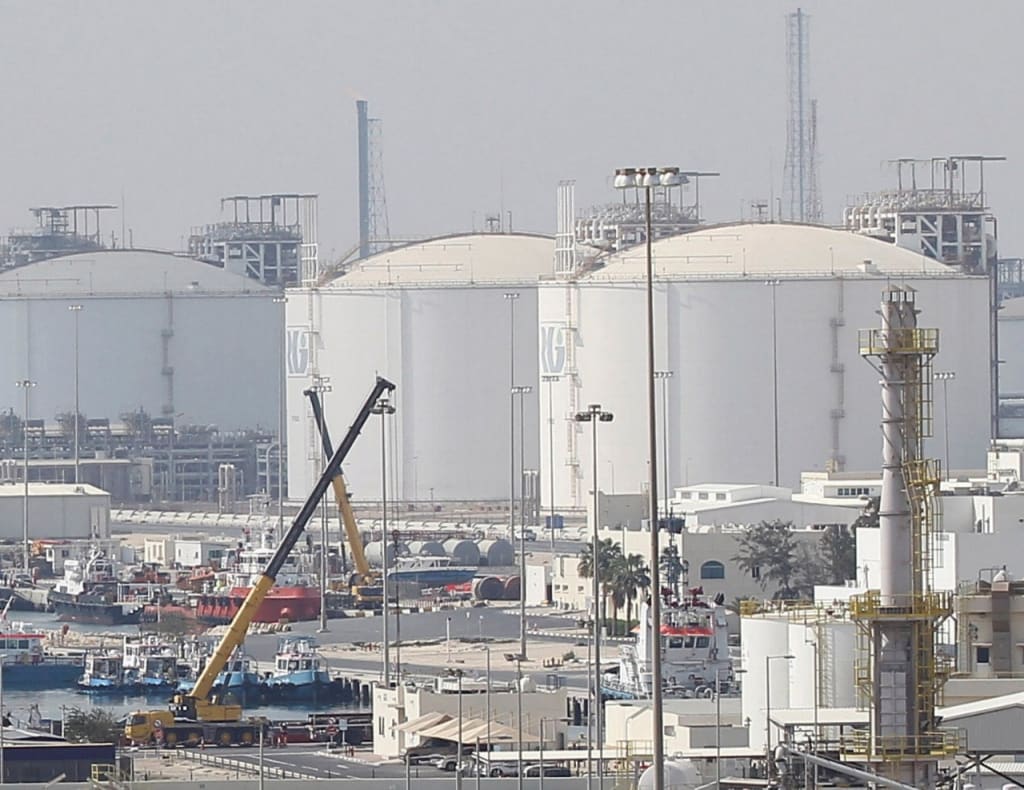
The surge in gas prices came after QatarEnergy, one of the world’s largest exporters, halted production following “military attacks” on its facilities. The company later announced it would also suspend production of other materials including aluminum, methanol, and urea (used in fertilizer).
UK gas prices have now doubled since a wave of US and Israeli airstrikes on Iran began over the weekend.
Rising gas prices could put pressure on household energy bills, although in the UK any increase will not be felt until July due to the “price cap.”
Oil prices have not risen as sharply as gas prices because there is greater flexibility in sourcing crude oil from alternative suppliers compared with gas.
However, Brent crude remains 17% higher than its closing price on Friday. Rising oil prices could still impact the economy by making items such as car fuel, transportation, and food more expensive.
If inflation (the rate of price increases) accelerates, it would reduce the likelihood that central banks will cut interest rates in the coming months.
In the UK, the FTSE 100 fell nearly 2.6%. Germany’s DAX dropped 3.6%, while France’s CAC-40 fell 2.9%.
Shipping through the Strait of Hormuz is vital to the global economy, with about 20% of the world’s oil and gas passing through the waterway. However, maritime traffic in the area has effectively come to a halt in recent days following several attacks on vessels.
A senior adviser to the commander-in-chief of Iran’s Revolutionary Guard told Iranian television that ships should not enter the area and would “certainly face our severe response.”
In addition to rising prices in global energy markets, the conflict has also driven up the cost of transporting oil.
According to data from the London Stock Exchange Group, the cost of chartering a supertanker to carry oil from the Middle East to China reached a record $400,000 per day on Monday, nearly double the cost of the previous week.
He said this was partly because shipping companies are unwilling to take risks, but also because “insurance companies are not prepared to cover the risk.”
Sanne Manders also said shipping companies are likely to begin raising freight rates “for all maritime cargo worldwide” due to expected increases in fuel prices.
Donald Trump is facing concerns that conflicts in the Middle East could increase the cost of living.
Sinivasan Balakrishnan of risk research firm Avalon Intelligence said that if disruptions to maritime cargo continue, crude oil prices could exceed $100 per barrel. He predicted that if prices remain at that level, gasoline prices in the US could rise by up to 25 cents per gallon.
US Secretary of State Marco Rubio said Washington would announce its plans on Tuesday to address rising energy prices: “We knew there would be consequences to entering this conflict. You will see that we are taking various measures to mitigate these effects.”
According to Alasdair Locke, chairman of Motor Fuel Group (the UK’s largest independent petrol station operator), fuel prices in the UK are likely to rise if oil prices remain high.
“As oil prices rise, it will inevitably lead to increases at the pump in due course. How much fuel prices rise will depend on how long and at what level oil prices remain elevated,” he said.
In Asia, Japan’s Nikkei index closed down 3.3%, with export-dependent companies such as Toyota, Panasonic, and Sony among the hardest hit.
Hong Kong’s Hang Seng index and mainland China’s Shanghai Composite index also fell. South Korea’s KOSPI, which had been closed on Monday for a public holiday, dropped more than 7%.
About the Creator
Keep reading
More stories from Real content and writers in Trader and other communities.
What is the reason for the sudden 11% decline in the Pakistan Stock Exchange after a record rise?
Is the 11 percent decline in the Pakistan Stock Exchange’s 100 Index over a short period merely a market “correction,” or is it a sign of an impending market crash? This is the question currently circulating in the minds of many investors.
By Real content8 days ago in Trader
Global Semiconductor Market Size & Forecast 2026–2034
The global semiconductor industry is entering a transformative decade. According to Renub Research, the Semiconductor Market is projected to increase from US$ 702.43 billion in 2025 to US$ 1,273.04 billion by 2034, expanding at a CAGR of 6.83% during 2026–2034.
By shibansh kumar2 days ago in Trader
Review of 'Man on the Run'
My wife and I saw Man on the Run, a nearly 2-hour documentary on Amazon Prime, about Wings, Paul McCartney's group that flew around the world from shortly after The Beatles broke up in early 1970 to shortly after John Lennon was murdered at the end of 1980, making a Beatles reunion forever impossible.
By Paul Levinson3 days ago in Beat




Comments
There are no comments for this story
Be the first to respond and start the conversation.