
Global Semiconductor Market Size & Forecast 2026–2034
Rising Demand from AI, EVs, Data Centers, and 5G to Propel Market to US$ 1,273.04 Billion by 2034

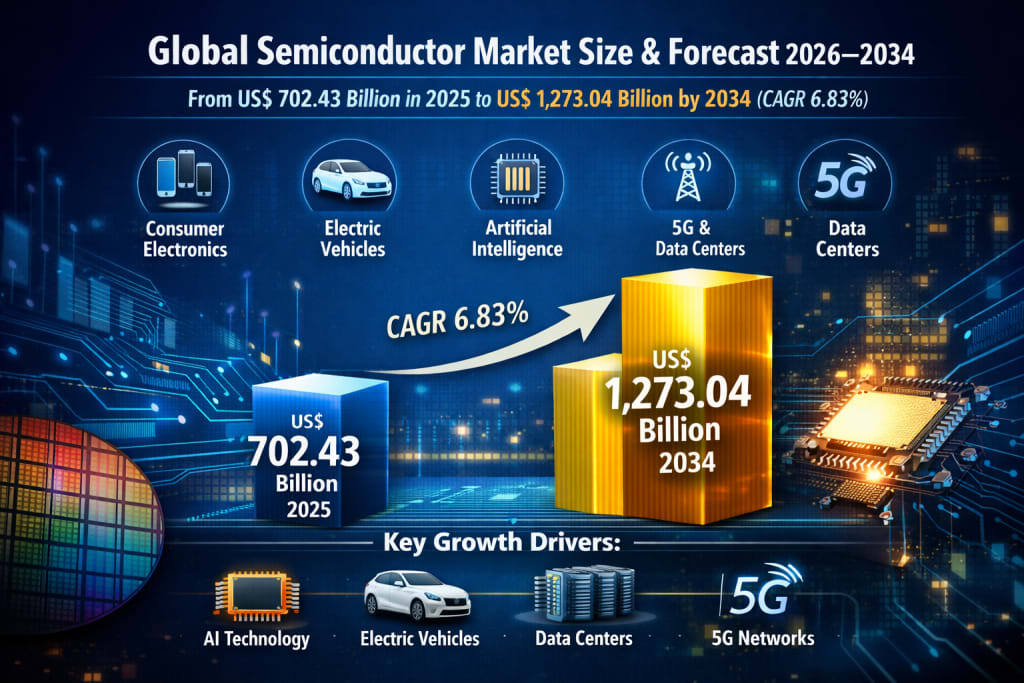
The global semiconductor industry is entering a transformative decade. According to Renub Research, the Semiconductor Market is projected to increase from US$ 702.43 billion in 2025 to US$ 1,273.04 billion by 2034, expanding at a CAGR of 6.83% during 2026–2034.
This impressive growth trajectory reflects not only rising consumer demand but also the structural digital transformation of global economies. From smartphones and electric vehicles to artificial intelligence (AI) systems and 5G infrastructure, semiconductors have become the invisible engines powering the modern world.
Global Semiconductor Market Outlook
A semiconductor is a material whose electrical conductivity lies between that of a conductor and an insulator. Silicon remains the most widely used semiconductor material, alongside germanium and gallium arsenide. What makes semiconductors unique is their ability to control electric current through doping — the introduction of impurities to alter electrical properties.
Semiconductors form the foundation of integrated circuits, microprocessors, memory chips, sensors, and power devices. These components power virtually every electronic device used today. As digital ecosystems expand across industries, semiconductor innovation has become synonymous with economic advancement.
The global push toward digitalization, smart connectivity, and automation is intensifying demand. Emerging sectors such as artificial intelligence, cloud computing, electric mobility, robotics, and smart healthcare rely heavily on advanced chips. Governments worldwide are also investing heavily in domestic semiconductor manufacturing to reduce supply chain vulnerabilities and strengthen strategic autonomy.
Growth Drivers in the Semiconductor Market
Rising Demand from Consumer Electronics and Smart Devices
Consumer electronics remain a primary growth engine for the semiconductor market. Smartphones, tablets, laptops, wearables, smart TVs, and connected appliances all require sophisticated chipsets for processing, memory, connectivity, and energy efficiency.
As internet penetration increases globally, particularly in emerging economies, the appetite for smart devices continues to expand. Consumers now demand higher processing speeds, better camera performance, AI integration, and longer battery life — all of which depend on advanced semiconductor design.
In March 2023, Samsung Electronics Co. Ltd. announced a massive investment of approximately USD 230 billion to develop the world’s largest semiconductor production base in South Korea over the next 20 years. Such large-scale commitments underscore the strategic importance of semiconductor manufacturing in meeting global demand.
AI-enabled devices, edge computing, and IoT applications are also expanding chip complexity, further driving revenue growth across the value chain.
Expansion of Automotive Electronics and Electric Vehicles
The automotive industry is undergoing a digital revolution. Modern vehicles incorporate hundreds — and sometimes thousands — of semiconductor components for powertrain control, safety systems, infotainment, connectivity, and advanced driver assistance systems (ADAS).
Electric vehicles (EVs) consume significantly more semiconductors than traditional internal combustion engine vehicles. Power semiconductors, battery management systems, and motor control units are essential for EV efficiency and safety.
In November 2025, iDEAL Semiconductor launched its SuperQ MOSFET designed to enhance safety and efficiency in high-voltage battery systems for EVs. Innovations like these are accelerating the automotive semiconductor segment.
Government policies encouraging EV adoption, emission reduction targets, and autonomous vehicle development are further amplifying semiconductor demand in this sector.
Growth of Data Centers, AI, and 5G Infrastructure
Cloud computing, big data analytics, and artificial intelligence are reshaping enterprise IT landscapes. The exponential growth in data generation requires high-performance processors, memory modules, and networking chips optimized for speed and low power consumption.
The rollout of 5G networks globally is another critical growth driver. Advanced communication semiconductors, RF components, and network processors are essential for 5G infrastructure.
In November 2025, Sutherland partnered with Celona to launch an AI-enabled private 5G and autonomous network solution. Such developments highlight the deep interconnection between telecom innovation and semiconductor demand.
The expansion of hyperscale data centers and AI computing clusters will remain central to semiconductor revenue growth over the next decade.
Challenges in the Semiconductor Market
Supply Chain Complexity and Geopolitical Risks
Semiconductor manufacturing is highly globalized. Raw materials may be sourced from one region, wafers fabricated in another, and assembly and testing performed elsewhere. This intricate supply chain makes the industry vulnerable to geopolitical tensions, trade restrictions, and natural disruptions.
Export controls, trade disputes, and regional conflicts can disrupt supply continuity. These risks affect not only chip manufacturers but also downstream industries such as automotive, electronics, and defense.
Diversification of supply chains and regional manufacturing expansion are becoming strategic priorities worldwide.
High Capital Investment and Technological Complexity
Semiconductor fabrication plants (fabs) require multi-billion-dollar investments. Advanced process nodes demand cutting-edge equipment, precision engineering, and sustained R&D spending.
The shrinking of transistor sizes, increasing energy efficiency requirements, and sustainability concerns add further complexity. Only a handful of global players possess the financial and technical capacity to operate at leading-edge nodes.
Balancing innovation speed, cost management, and environmental responsibility remains a central challenge for industry participants.
Segment Insights
Integrated Circuits (IC) Semiconductor Market
Integrated circuits (ICs) are fundamental to modern electronics. By integrating transistors, resistors, and capacitors onto a single chip, ICs enable compact and efficient electronic solutions.
Applications span consumer electronics, industrial automation, computing, and telecommunications. Ongoing miniaturization and improved performance are expanding IC usage in IoT and smart devices.
Memory Semiconductor Market
Memory semiconductors, including DRAM and NAND flash, play a vital role in data storage and rapid access. Growing reliance on cloud computing, AI, and digital services is fueling strong demand for high-capacity, energy-efficient memory chips.
Despite periodic pricing fluctuations, long-term demand fundamentals remain strong.
Micro Semiconductor Market
Microprocessors and microcontrollers serve as the “brains” of electronic devices. These components enable computing, automation, and intelligent decision-making in consumer electronics, industrial systems, and IoT applications.
Innovation is increasingly focused on integrating AI capabilities directly into microchips, reducing latency and improving performance at the edge.
Automotive Semiconductor Market
Automotive semiconductors support power management, safety systems, ADAS, infotainment, and connectivity. EVs and autonomous vehicles are significantly increasing semiconductor content per vehicle.
Regulatory mandates related to emissions and vehicle safety further reinforce long-term growth.
Aerospace and Defense Semiconductor Market
High-reliability semiconductors are essential for radar systems, avionics, satellite communications, and defense electronics. Though smaller in volume, this segment carries high strategic importance.
Defense modernization programs and satellite deployment initiatives continue to drive demand for radiation-resistant and mission-critical chips.
Regional Insights
United States Semiconductor Market
The United States remains a global innovation leader in semiconductor design and advanced research. Major players such as Intel Corporation, Broadcom Inc., and Micron Technology Inc. contribute significantly to global chip architecture and memory development.
Government initiatives aimed at strengthening domestic manufacturing and reducing import dependency are supporting further growth. AI infrastructure expansion and EV adoption are additional demand catalysts.
United Kingdom Semiconductor Market
The United Kingdom is recognized for chip design expertise and compound semiconductor research. Companies such as NXP Semiconductors N.V. maintain strong European operations.
The UK government has introduced targeted funding initiatives to enhance semiconductor innovation, particularly in EV, 5G, and defense applications.
India Semiconductor Market
India’s semiconductor market is expanding rapidly, driven by strong consumer electronics demand, digital infrastructure development, and rising EV adoption.
Engineering design services have grown significantly, even as large-scale fabrication capacity is still developing. Strategic international collaborations are supporting ecosystem growth.
Saudi Arabia Semiconductor Market
Saudi Arabia is strengthening its digital infrastructure under broader economic diversification initiatives. In February 2025, EdgeCortix Inc. joined the Kingdom’s National Semiconductor Hub program to establish advanced semiconductor engineering capabilities.
Increasing investments in data centers, smart cities, and industrial automation are creating new demand opportunities.
Competitive Landscape
The global semiconductor market remains highly competitive and innovation-driven. Key companies covered include:
Broadcom Inc.
Infineon Technologies AG
Intel Corporation
Micron Technology Inc.
NXP Semiconductors N.V.
Samsung Electronics Co. Ltd.
Toshiba Corporation
Each company is evaluated across five viewpoints: overview, key persons, recent developments & strategies, product portfolio, financial insights, and company analysis.
Final Thoughts
The global semiconductor industry stands at the heart of the digital economy. With projected growth from US$ 702.43 billion in 2025 to US$ 1,273.04 billion by 2034, the sector is poised for sustained expansion at a CAGR of 6.83%.
Artificial intelligence, electric mobility, 5G infrastructure, industrial automation, and cloud computing will continue reshaping semiconductor demand. While geopolitical risks and high capital intensity remain challenges, innovation and government-backed investments are building a resilient foundation for the future.
About the Creator
Keep reading
More stories from shibansh kumar and writers in Trader and other communities.
Clinical Trial Supplies Market Size & Forecast 2026–2034
The global Clinical Trial Supplies Market is entering a transformative decade. According to Renub Research, the market is projected to grow from US$ 2.94 billion in 2025 to US$ 5.37 billion by 2034, expanding at a CAGR of 6.93% during 2026–2034.
By shibansh kumara day ago in Trader
Low Voltage Switchgear Market Overview, Size, Share & Forecast
Low Voltage Switchgear Market Overview Low voltage switchgear refers to assembly or combination of electrical disconnect switches, circuit breakers, fuses, relays, and protection devices designed to control and protect electrical systems operating at voltages up to 1,000 V. These systems serve as a critical interface between power sources and end-equipment, ensuring safety, reliability, and efficient distribution of electricity across applications such as industrial plants, commercial buildings, residential complexes, transportation systems, renewable energy installations, and utility networks.
By James Smith7 days ago in Trader
India Frozen Food Market Size & Forecast 2026–2034
The India Frozen Food Market is entering a transformative phase, driven by urbanization, lifestyle shifts, and expanding cold chain infrastructure. According to Renub Research, the market is projected to grow significantly at a CAGR of 12.32% from 2026 to 2034, reaching US$ 561.47 Million by 2034, up from US$ 197.34 Million in 2025.
By Sakshi Sharma4 days ago in Trader
Trickle Them Down, But Not Out
The thing about smart people is that they should know better, but alas, intelligence is not the same as wisdom. Not only do the mistakes of experts too short on vision—when they are not corrected—have the potential to do great and far-reaching damage, but they also undermine public confidence in the very notion of expertise. This is particularly so when expertise is wielded in defence of the rich and powerful as a cudgel against those laid low. As an academic, this lack of faith in “so-called experts” is painful to see as it plays out in the spread of dis-/misinformation, conspiracy theories, and anti-intellectualism writ large. But it is also an understandable impulse given the catastrophic failure of an economic ideology pushed by certain economic experts. Supply-side economics has shaped a broken system for the last half-century and has arguably done more to undermine the fabric of the American Dream than any policy framework of the past century.
By Cory Wright-Maley7 days ago in Humans




Comments
There are no comments for this story
Be the first to respond and start the conversation.