
Tilapia Market Size and Forecast 2026–2034
Affordable Protein, Expanding Aquaculture, and Global Trade to Drive Steady Industry Growth

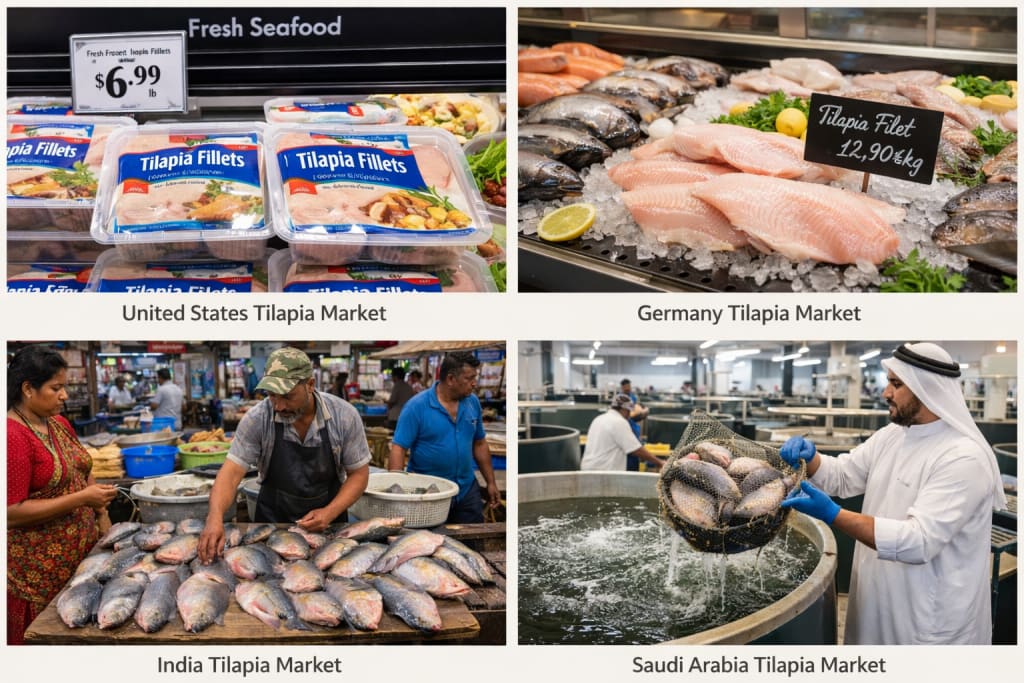
The global tilapia market is poised for consistent expansion over the coming decade, reflecting its central role in the evolving global protein economy. According to Renub Research, the Tilapia Market is expected to reach US$ 12.06 billion by 2034, rising from US$ 9.21 billion in 2025, registering a CAGR of 3.04% from 2026 to 2034.
This steady growth trajectory is being shaped by a combination of rising demand for affordable high-protein food, government-backed aquaculture policies, expanding export opportunities, and technological innovation in fish farming. Often referred to as the “aquatic chicken,” tilapia has emerged as one of the most important farmed fish species globally due to its adaptability, efficient feed conversion, and mild flavor profile that appeals to diverse consumer markets.
As food security concerns intensify and global protein consumption rises, the tilapia industry is steadily expanding its footprint across continents.
Tilapia Industry Overview
Tilapia represents one of the largest segments within global aquaculture. Unlike wild-caught fisheries, tilapia production is predominantly farm-based, enabling greater control over output, quality, and supply chain consistency.
The industry encompasses diverse farming systems ranging from extensive pond culture to high-density cage farming and advanced recirculating aquaculture systems (RAS). These varied production methods allow tilapia cultivation across developing and developed markets alike.
Asia leads global tilapia production, particularly China, which serves as both the largest producer and exporter. Other important producing regions include Southeast Asia, Latin America, and Africa, where tilapia contributes significantly to rural employment and domestic food supply.
Tilapia products are marketed in several formats:
Frozen whole fish
Fresh fillets
Frozen fillets
Value-added breaded or marinated portions
International trade is largely centered around frozen fillets and whole frozen fish, with major import demand coming from North America and Europe.
Despite strong fundamentals, the industry faces challenges such as disease outbreaks, feed price volatility, environmental concerns, and sustainability scrutiny. Nevertheless, ongoing innovation in breeding, feed formulation, and digital aquaculture management is improving resilience and profitability.
Overall, tilapia continues to strengthen its position as a cornerstone of affordable seafood supply worldwide.
Key Growth Drivers of the Tilapia Market
1. Rising Global Demand for Affordable Protein
One of the primary drivers of tilapia market growth is the expanding need for cost-effective animal protein. Rapid urbanization, population growth, and income expansion in emerging economies are transforming dietary preferences toward protein-rich foods.
Tilapia offers several advantages:
Lower production cost compared to beef and many other fish species
Mild taste suitable for diverse cuisines
Reliable supply from aquaculture rather than wild fisheries
High feed conversion efficiency
In developing nations, tilapia is increasingly promoted by governments and development agencies as a strategic food security solution. Its affordability ensures accessibility to lower- and middle-income populations.
As global protein consumption rises steadily, tilapia’s role as a scalable and economical solution will remain central to industry expansion.
2. Technological Advancements in Aquaculture
Technological progress is reshaping tilapia farming worldwide. Improvements in selective breeding have led to faster-growing and disease-resistant strains. Feed innovation has reduced dependence on traditional fishmeal, lowering production costs and improving sustainability metrics.
Advanced farming systems such as:
Biofloc technology
Cage culture
Recirculating aquaculture systems (RAS)
are enabling production in water-constrained and urban environments.
Digital tools for water quality monitoring, automated feeding, and real-time farm management are enhancing efficiency and reducing operational risk. These innovations make tilapia farming more attractive to commercial investors and institutional players.
The result is improved productivity, lower mortality rates, and stronger scalability — key components supporting the projected 3.04% CAGR through 2034.
3. Growth in International Trade and Value-Added Processing
Global seafood consumption continues to rise, and tilapia’s consistent quality makes it highly suitable for international markets. Frozen fillets dominate exports, particularly to the United States and European countries.
The expansion of cold-chain logistics and food safety compliance has strengthened export competitiveness. Increasing consumer demand for ready-to-cook seafood products has also encouraged development of:
Breaded fillets
Seasoned portions
Retail-ready packaged formats
Certification and traceability initiatives are becoming essential for access to premium retail markets. As global trade networks expand, tilapia’s integration into international supply chains is expected to deepen further.
Challenges Facing the Tilapia Market
Disease Management and Rising Costs
Intensification of farming increases vulnerability to bacterial, viral, and parasitic outbreaks. Disease management requires improved biosecurity measures, vaccines, and water monitoring systems, raising operational expenses.
Feed costs remain the largest expense component in tilapia production. Fluctuating prices of soybean meal and corn directly impact profitability. Rising energy and labor costs add further pressure, particularly for small-scale farmers.
These factors create margin constraints and pose scalability challenges.
Environmental and Sustainability Concerns
Environmental scrutiny is intensifying. Effluent discharge, water use, and escape of non-native species raise ecological concerns. Consumers are increasingly demanding responsibly farmed seafood with verified traceability.
Meeting certification requirements often necessitates investments in sustainable feed alternatives, water treatment systems, and monitoring technologies.
Balancing environmental responsibility with cost competitiveness remains one of the industry's most complex tasks.
Regional Market Insights
United States Tilapia Market
The United States tilapia market relies heavily on imports due to limited domestic aquaculture production. Consumer demand is driven by affordability, convenience, and health-conscious dietary patterns.
Tilapia is widely sold as frozen and fresh fillets through retail and foodservice channels. Sustainability and sourcing transparency are increasingly influencing procurement decisions among major retailers.
While overall growth is moderate, the U.S. remains one of the largest global importers of tilapia products.
Germany Tilapia Market
4
The Germany tilapia market is primarily import-driven. Frozen fillets dominate sales due to their affordability and shelf stability.
Consumer interest in lean protein and easy-to-cook seafood supports steady demand. However, tilapia competes with salmon and cod in the whitefish category.
Sustainability certifications and traceability play a significant role in shaping retail sourcing strategies.
India Tilapia Market
4
The India tilapia market is expanding alongside the country’s broader aquaculture development.
Farmers are adopting pond culture and cage farming systems, supported by government initiatives to diversify aquaculture beyond carp and shrimp. Domestic consumption is gradually rising, driven by urbanization and nutritional awareness.
Although India’s export footprint in tilapia remains limited compared to shrimp, improving infrastructure suggests growing international potential.
Saudi Arabia Tilapia Market
4
The Saudi Arabia tilapia market is expanding under national food security initiatives. Intensive farming systems are used to overcome water scarcity constraints.
Domestic consumption is strong, and tilapia represents a significant share of whitefish demand in the Kingdom.
Government-backed aquaculture modernization efforts continue to enhance production capacity and self-sufficiency.
Recent Industry Developments
October 2024: The Chennai River Restoration Trust initiated a tilapia culling operation in Adyar Creek to protect local biodiversity from invasive species.
July 2024: Aller Aqua partnered with IDH to support out-grower tilapia farming in Kenya, focusing on sustainable practices and smallholder inclusion.
These developments highlight the dual priorities of sustainability management and inclusive industry expansion.
Market Segmentation
Producing Countries
China, Indonesia, Brazil, Malaysia, Philippines, Vietnam, Thailand, Peru, Bangladesh, Colombia, Mexico, Costa Rica, United States
Species
Nile Tilapia
Tilapias NEI
Others
Products
Frozen Whole Tilapia
Fresh Fillet Tilapia
Frozen Fillet Tilapia
Regional Coverage
North America, Europe, Asia Pacific, Latin America, Middle East & Africa, Rest of the World
Competitive Landscape
Key companies operating in the global tilapia market include:
High Liner Foods Inc.
Surapon Foods
Thai Union Group
Grieg Seafood
Charoen Pokphand Foods
These companies are evaluated based on overview, key leadership, recent developments, SWOT analysis, and revenue performance.
Strategic initiatives include vertical integration, sustainable sourcing commitments, and value-added product expansion.
Final Thoughts
The global tilapia market, projected to grow from US$ 9.21 billion in 2025 to US$ 12.06 billion by 2034, reflects a balanced growth story driven by affordability, technological innovation, and expanding trade networks.
While environmental and cost challenges persist, the industry’s adaptability and policy support across developing regions provide strong long-term foundations.
About the Creator
Sakshi Sharma
Content Writer with 7+ years of experience crafting SEO-driven blogs, web copy & research reports. Skilled in creating engaging, audience-focused content across diverse industries.
Keep reading
More stories from Sakshi Sharma and writers in Trader and other communities.
Global Liquid Biopsy Market Size & Forecast 2026–2034
The global healthcare industry is undergoing a profound transformation as diagnostics shift toward less invasive, more precise, and data-driven solutions. Among the most promising advancements is liquid biopsy — a breakthrough methodology redefining how cancer is detected, monitored, and managed.
By Sakshi Sharmaabout 23 hours ago in Trader
archTIS (AR9.AX) ASX Pre-Market: Earnings Update May Shift A$0.09 Valuation
archTIS Limited, trading under the ticker AR9.AX on the Australian Securities Exchange, is attracting increased attention in pre-market discussions as investors anticipate an earnings update that could materially affect the stock’s valuation. With the share price hovering around the A$0.09 level, even modest changes in outlook or guidance have the potential to significantly shift sentiment.
By Hammad Nawaz4 days ago in Trader
Stanislav Kondrashov Oligarch Series: Understanding the Ties Between Oligarchy and Stock Markets
The stock market looks like the ultimate level playing field. Anyone can buy shares. Anyone can sell. Prices are visible to all. But here’s the question you rarely hear asked: who really steers the companies behind those ticker symbols?
By Stanislav Kondrashov 6 days ago in Trader




Comments
There are no comments for this story
Be the first to respond and start the conversation.