
Global Liquid Biopsy Market Size & Forecast 2026–2034
Non-Invasive Cancer Diagnostics Enter a New Era of Precision and Real-Time Monitoring

The global healthcare industry is undergoing a profound transformation as diagnostics shift toward less invasive, more precise, and data-driven solutions. Among the most promising advancements is liquid biopsy — a breakthrough methodology redefining how cancer is detected, monitored, and managed.
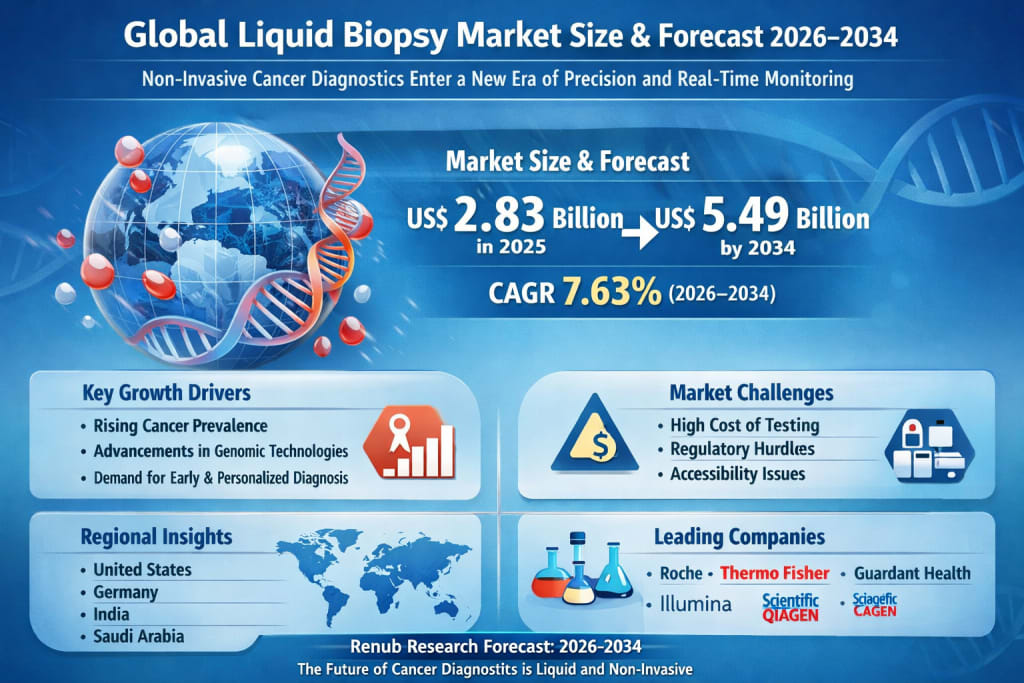
According to Renub Research, the Global Liquid Biopsy Market is projected to grow from US$ 2.83 billion in 2025 to US$ 5.49 billion by 2034, expanding at a CAGR of 7.63% from 2026 to 2034. This steady growth trajectory reflects rising global cancer prevalence, technological innovations in genomic sequencing, and the increasing adoption of precision medicine approaches.
As healthcare systems worldwide prioritize early detection and patient-centric care, liquid biopsy is emerging as a cornerstone of modern oncology.
Liquid Biopsy Market Outlook
Liquid biopsy is a minimally invasive diagnostic technique used to detect and analyze biomarkers such as circulating tumor DNA (ctDNA), circulating tumor cells (CTCs), exosomes, and other nucleic acids present in body fluids, particularly blood. Unlike traditional tissue biopsies, liquid biopsy does not require surgical procedures and can be performed repeatedly with minimal discomfort.
The technology is widely used in oncology for early cancer detection, monitoring disease progression, evaluating treatment response, and identifying tumor mutations. The ability to perform serial testing enables clinicians to track tumor evolution in real time — a capability that conventional biopsies cannot offer efficiently.
With increasing awareness of early cancer detection and improvements in next-generation sequencing (NGS), digital PCR, and molecular diagnostics, liquid biopsy is rapidly transitioning from research labs into routine clinical practice.
Growth Drivers in the Global Liquid Biopsy Market
Rising Global Cancer Prevalence and Demand for Early Diagnosis
Cancer remains one of the leading causes of mortality worldwide. The need for early, accurate, and less invasive diagnostic solutions is intensifying across healthcare systems.
In the United States alone, approximately 2,041,910 new cancer cases and 618,120 deaths are expected in 2025. Common cancers include breast, prostate, lung, colon, melanoma, pancreatic, leukemia, thyroid, and liver cancers.
Liquid biopsy enables detection of genetic mutations and cancer-associated biomarkers often before symptoms appear. Early detection significantly improves survival rates and treatment outcomes. Furthermore, its ability to support continuous disease monitoring makes it particularly valuable for tracking recurrence and treatment resistance.
The growing awareness among patients and clinicians about non-invasive testing options is accelerating market adoption globally.
Advancements in Genomic and Molecular Diagnostic Technologies
Technological innovation is another core growth catalyst. Rapid advancements in NGS platforms, digital PCR, and bioinformatics tools are improving the sensitivity and accuracy of liquid biopsy tests.
In April 2025, Labcorp expanded its precision oncology portfolio with two new offerings. The introduction of Plasma Detect aims to assess relapse risk in stage III colon cancer patients post-surgery. Additionally, PGDx elio plasma focus Dx became the first FDA-approved comprehensive liquid biopsy test for solid tumors, strengthening targeted therapy identification capabilities.
These technological milestones demonstrate how companies are refining test precision and expanding clinical utility, thereby strengthening the overall market landscape.
Growing Adoption of Personalized and Precision Medicine
Precision medicine is reshaping oncology treatment paradigms. Liquid biopsy plays a crucial role by identifying actionable mutations that help oncologists tailor therapies to individual genetic profiles.
In April 2025, Guardant Health partnered with Bayshore HealthCare in Canada to expand access to its precision oncology solutions nationwide. This collaboration underscores how liquid biopsy is becoming integral across the entire cancer care continuum — from early detection to treatment monitoring.
Pharmaceutical companies are also leveraging liquid biopsy in clinical trials to stratify patients more effectively and evaluate drug efficacy. As targeted therapies gain prominence, the demand for companion diagnostics like liquid biopsy continues to grow.
Key Challenges in the Global Liquid Biopsy Market
High Cost and Limited Accessibility
Despite its clinical promise, liquid biopsy remains expensive. Advanced sequencing platforms, specialized laboratory infrastructure, and expert interpretation add to overall costs.
In developing nations, limited reimbursement policies and inadequate healthcare funding further restrict widespread adoption. While local innovation and competition are gradually reducing prices, affordability remains a key hurdle.
Regulatory Complexity and Clinical Validation
Regulatory approval processes for diagnostic tests are rigorous and time-consuming. Authorities require extensive evidence of clinical validity, accuracy, and reproducibility.
Large-scale clinical trials are necessary to establish standardization across patient populations. These processes demand substantial investment and time, which can delay commercialization.
Segment Analysis
Liquid Biopsy Kits & Reagents Market
Kits and reagents form the backbone of liquid biopsy testing. These products are used for isolating tumor DNA, RNA, and circulating tumor cells from blood samples.
Growing adoption in oncology diagnostics and research laboratories is fueling demand for ready-to-use kits that ensure accuracy and reproducibility. As testing volumes rise, this segment is expected to remain a major revenue contributor.
Cancer Therapeutic Liquid Biopsy Market
This segment focuses on leveraging liquid biopsy to guide cancer therapy decisions. By identifying actionable genomic alterations, clinicians can select targeted treatments and monitor resistance mechanisms.
Real-time assessment of therapeutic response offers a major advantage over imaging-based monitoring. Increasing reliance on precision oncology strengthens this segment’s growth prospects.
Circulating Tumor Cell (CTC) Market
CTC-based liquid biopsy analyzes intact tumor cells present in the bloodstream. Though technically challenging due to low cell counts, advancements in capture technologies are enhancing feasibility.
CTCs provide insights into metastasis mechanisms and tumor biology, making them valuable for research and clinical applications alike.
Diagnostic Laboratories Market
Specialized diagnostic laboratories play a pivotal role in scaling liquid biopsy services. Investments in automation, high-throughput sequencing, and bioinformatics enable efficient testing at centralized facilities.
Collaborations between hospitals and labs enhance accessibility, while economies of scale reduce operational costs. As adoption expands, diagnostic labs will remain central to market growth.
Academic Institutes Market
Academic and research institutions drive innovation in biomarker discovery and assay development. Government grants and institutional funding support large-scale research initiatives that form the foundation for commercialization.
Scientific validation from academic research is critical for regulatory approvals and clinical integration.
Regional Insights
United States
The United States represents one of the most advanced liquid biopsy markets globally. Robust healthcare infrastructure, early adoption of innovative diagnostics, and strong pharmaceutical industry support accelerate growth.
In January 2023, Tempus AI, Inc. launched its FDA-approved NGS-based in vitro diagnostic test, xT CDx, expanding genomic profiling access across the country.
Favorable reimbursement policies and strong regulatory frameworks further strengthen market expansion in the U.S.
Germany
Germany’s advanced healthcare system and emphasis on precision oncology contribute to steady market growth. Active participation from research institutions and a structured reimbursement environment facilitate adoption.
Collaborative initiatives across European hospitals are enhancing sustainable diagnostic solutions, reinforcing Germany’s leadership in molecular diagnostics.
India
India is witnessing rapid growth due to rising cancer incidence and increasing awareness of non-invasive diagnostics.
In February 2025, Lucence partnered with Agilus Diagnostics to introduce LiquidHALLMARK, a next-generation sequencing test analyzing 80 ctDNA genes and 37 RNA fusions. This partnership aims to enhance accessibility to targeted cancer therapies across India.
Government initiatives and private sector investment are gradually addressing affordability challenges.
Saudi Arabia
Saudi Arabia’s healthcare modernization efforts and cancer control programs are supporting early-stage adoption of liquid biopsy technologies.
Strategic investments in advanced hospital infrastructure and partnerships with global technology providers are driving regional growth, positioning the country as an emerging diagnostic hub in the Middle East.
Competitive Landscape
The global liquid biopsy market features strong participation from leading biotechnology and diagnostic firms. Key companies include:
F. Hoffmann-La Roche Ltd.
Bio-Rad Laboratories
Thermo Fisher Scientific Inc.
Johnson & Johnson
Biocept Inc.
Illumina, Inc.
Laboratory Corporation of America Holdings
QIAGEN N.V.
Exact Sciences Corporation
These companies focus on product innovation, strategic collaborations, mergers and acquisitions, regulatory approvals, and expanding geographic presence to strengthen their market position.
Market Segmentation Overview
By Product:
Kits & Reagents
Platforms & Instruments
Services
By Application:
Cancer Therapeutic Applications
Reproductive Health
Other Therapeutic Areas
By Circulating Biomarkers:
Circulating Tumor Cells
Circulating Tumor DNA
Cell-Free DNA
By End-User:
Hospitals
Diagnostic Laboratories
Point-of-Care Testing
Academic Institutes
Others
By Region:
North America, Europe, Asia-Pacific, Latin America, and Middle East & Africa.
Final Thoughts
The Global Liquid Biopsy Market stands at the intersection of oncology, genomics, and precision medicine. With market value expected to nearly double from US$ 2.83 billion in 2025 to US$ 5.49 billion by 2034, the industry is poised for sustained expansion.
Technological advancements, rising cancer prevalence, and growing demand for personalized treatment strategies are driving momentum. While cost and regulatory complexities remain challenges, continuous innovation and strategic partnerships are gradually addressing these barriers.
About the Creator
Sakshi Sharma
Content Writer with 7+ years of experience crafting SEO-driven blogs, web copy & research reports. Skilled in creating engaging, audience-focused content across diverse industries.
Keep reading
More stories from Sakshi Sharma and writers in Trader and other communities.
Global Transdermal Skin Patches Market Size and Forecast 2026–2034
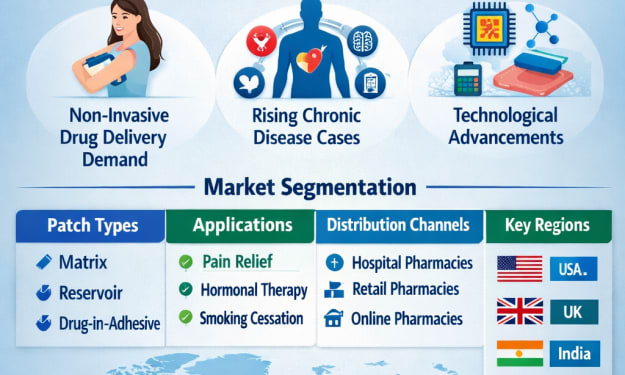
The Global Transdermal Skin Patches Market is entering a dynamic growth phase as healthcare systems worldwide increasingly prioritize patient-friendly drug delivery solutions. According to Renub Research, the market is projected to expand from US$ 8.75 billion in 2025 to US$ 13.64 billion in 2034, growing at a compound annual growth rate (CAGR) of 5.06% between 2026 and 2034.
By Sakshi Sharmaa day ago in Trader
XVG.SI Down 15% Pre-Market 28 Feb 2026: Aedge Group Risks to Watch
Aedge Group shares, trading under the ticker XVG.SI on the Singapore Exchange, came under sharp pressure in pre-market trading on February 28, 2026, with the stock indicated down roughly 15%. Such a steep pre-open move immediately shifts market focus from growth potential to risk assessment, as investors reassess exposure amid heightened uncertainty.
By Hammad Nawaz4 days ago in Trader
Crude Oil Price Today: Global Trends, Market Drivers, and Investment Insights
Understanding Crude Oil Price Crude oil is one of the world’s most traded commodities, and its price is a key indicator for global economic trends. It affects industries ranging from energy and manufacturing to transport and consumer goods. Even small fluctuations in crude oil price can ripple through markets, influencing corporate earnings, inflation, and investor sentiment.
By Hammad Nawazabout 14 hours ago in Trader



Comments
There are no comments for this story
Be the first to respond and start the conversation.