
Global Ginger Market Size and Forecast 2026–2034
Rising Demand for Natural Ingredients and Functional Foods to Drive Steady Expansion

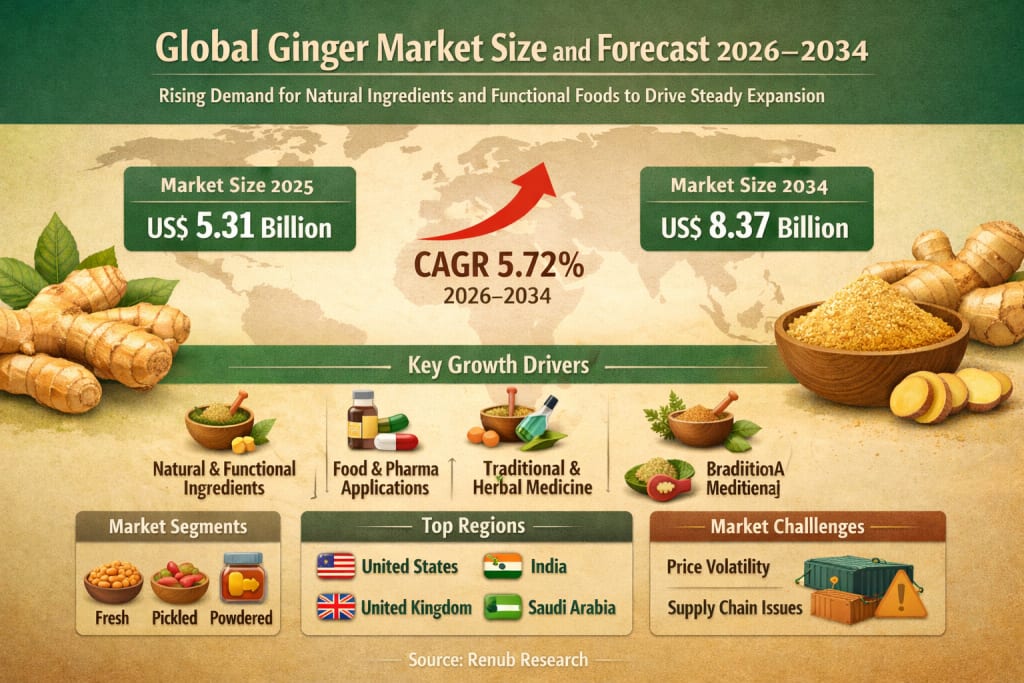
The Global Ginger Market is entering a phase of sustained growth, supported by evolving consumer preferences and expanding industrial applications. According to Renub Research, the market is projected to grow from US$ 5.31 billion in 2025 to US$ 8.37 billion by 2034, registering a compound annual growth rate (CAGR) of 5.72% during 2026–2034.
This upward trajectory is fueled by rising demand from the food and beverage industry, increasing use of ginger in pharmaceutical and nutraceutical products, and a global shift toward natural and clean-label ingredients. From traditional kitchens in Asia to wellness aisles in Western supermarkets, ginger has evolved into a versatile, globally traded commodity with both culinary and medicinal significance.
Global Ginger Market Outlook
Ginger, derived from the rhizome of Zingiber officinale, has long been valued as a spice, flavor enhancer, and medicinal ingredient. Its pungent aroma and sharp taste come from bioactive compounds such as gingerol and shogaol, which are known for antioxidant, anti-inflammatory, and immunomodulatory properties.
Commercially, ginger is available in multiple forms — fresh, dried, powdered, pickled, preserved, crystallized, and as oil or extract. It is used extensively in savory dishes, bakery products, confectionery, beverages, and herbal remedies. Beyond flavor, ginger is widely associated with relief from nausea, digestive discomfort, inflammation, and immune-related conditions.
Globally, ginger holds a strong presence in Asian, African, and Middle Eastern cuisines. However, Western markets are increasingly integrating ginger into smoothies, immunity shots, herbal teas, and functional beverages. The rising popularity of clean-label products and plant-based health solutions continues to elevate ginger’s profile as a preferred natural ingredient.
Growth Drivers in the Global Ginger Market
1. Increasing Demand for Natural and Functional Ingredients
The global consumer landscape is shifting toward natural, minimally processed, and health-enhancing ingredients. Ginger fits seamlessly into this trend. Its perceived therapeutic benefits — from aiding digestion to boosting immunity — align well with modern wellness priorities.
Countries such as India play a central role in the global supply chain. India ranks first globally as a producer, consumer, and exporter of ginger. According to the Food and Agriculture Organization (FAO), India accounts for nearly 45% of global spice production, highlighting its influence in the global spice ecosystem.
As consumers increasingly avoid artificial additives and synthetic preservatives, ginger’s natural profile enhances its demand across packaged foods, beverages, and dietary supplements.
2. Expanding Applications Across Industries
Ginger’s growth is also being driven by its expanding role in food, beverage, pharmaceutical, and nutraceutical industries.
In the food and beverage segment, ginger is used in sauces, snacks, bakery items, teas, kombucha, confectioneries, and ready-to-drink beverages. Its distinct flavor profile enhances both traditional recipes and innovative fusion products.
In January 2026, Health-Ade launched a limited-edition Ginger Lemon Berry kombucha, blending zesty lemon and spicy ginger to appeal to wellness-focused consumers. Such innovations highlight ginger’s growing relevance in the functional beverage segment.
Pharmaceutical and nutraceutical sectors are increasingly incorporating ginger in digestive aids, anti-nausea syrups, immunity boosters, and anti-inflammatory formulations. Continuous research into its bioactive compounds supports product development and broadens market scope.
3. Rising Popularity of Traditional and Herbal Medicine
The resurgence of traditional healing systems such as Ayurveda and Traditional Chinese Medicine has significantly influenced ginger consumption. Herbal teas and wellness blends featuring ginger are gaining traction across global markets.
In June 2023, Traditional Medicinals expanded its Organic Lemon Ginger tea into the Canadian market. The product combines organic ginger with herbs such as lemon, lemongrass, and hibiscus, reinforcing the demand for responsibly sourced herbal products.
As consumer trust in herbal and plant-based medicine strengthens, ginger’s role as a foundational ingredient in wellness routines continues to expand.
Challenges in the Global Ginger Market
Price Volatility and Supply Chain Constraints
Ginger production is highly dependent on climatic conditions, soil quality, and seasonal cycles. Weather disruptions, pest attacks, and crop diseases can significantly affect output. These fluctuations often lead to unstable pricing, impacting both farmers and processors.
Supply chain inefficiencies and export bottlenecks further complicate market dynamics. Ensuring stable production and improving logistics infrastructure remain critical challenges for sustaining long-term growth.
Quality Variability and Regulatory Compliance
Quality consistency is another key concern. Differences in cultivation practices, harvesting methods, and storage conditions influence ginger’s potency and shelf life. Additionally, stringent regulations related to pesticide residues, food safety, and labeling standards increase operational complexity and compliance costs.
Segment Insights
Fresh Ginger Market
Fresh ginger accounts for a substantial share of global consumption. It is widely used in households, restaurants, and traditional medicine. Its high concentration of bioactive compounds, especially gingerol, makes it popular among health-conscious consumers.
However, fresh ginger is perishable and requires proper storage and transportation. Despite logistical challenges, rising preference for fresh and minimally processed foods supports its steady demand.
Pickled Ginger Market
Pickled ginger, often served as a palate cleanser with sushi and seafood, has witnessed growing demand alongside the global popularity of Japanese cuisine. Its longer shelf life and convenience make it suitable for retail and foodservice channels.
As international cuisines gain acceptance worldwide, pickled ginger consumption is expected to maintain stable growth.
Preserved and Crystallized Ginger Market
Preserved ginger, processed with sugar or syrup, finds application in bakery products, traditional sweets, and festive foods. Crystallized ginger is particularly popular in confectionery and snack segments. While this segment maintains a steady share, its growth is relatively moderate compared to fresh and powdered formats.
Ginger Powder Market
Ginger powder offers convenience, extended shelf life, and ease of transportation. It is extensively used in bakery products, spice blends, nutraceutical formulations, and instant beverages. Rising demand for ready-to-cook and packaged foods supports this segment’s growth globally.
Regional Insights
United States Ginger Market
4
The United States ginger market is driven by strong consumer interest in health and wellness products. Ginger is widely used in herbal teas, kombucha, dietary supplements, and functional beverages.
In October 2023, Stansfeld Scott Inc. and Select Brands acquired Stone’s Ginger Wine from Accolade Wines, strengthening their footprint in the Caribbean and U.S. markets. Such strategic acquisitions underscore ginger’s relevance in both alcoholic and non-alcoholic beverage categories.
As the U.S. relies heavily on imports, global production trends significantly influence domestic pricing and supply.
United Kingdom Ginger Market
The United Kingdom ginger market benefits from growing demand for herbal teas and functional wellness shots. In August 2025, MOJU launched a 3 x 60ml Ginger shot pack, addressing consumer demand for convenient immunity-boosting solutions.
Ethnic cuisines and health-focused retail distribution further support ginger’s expansion across the UK.
India Ginger Market
India remains one of the largest producers and exporters of ginger globally. Domestic consumption is robust due to culinary traditions and widespread use in Ayurveda. Government support for spice cultivation and export promotion further strengthens India’s position in the global supply chain.
However, weather dependency and price fluctuations continue to influence market stability.
Saudi Arabia Ginger Market
The Saudi Arabia ginger market is largely import-driven. Rising awareness of immunity-boosting foods and increasing adoption of global cuisines contribute to demand growth. According to the Observatory of Economic Complexity, Saudi Arabia imported approximately US$ 41.8 million worth of ginger in 2023, ranking among the world’s leading importers.
Competitive Landscape
The global ginger market includes key players such as:
Archer Daniels Midland Company
Kerry Group
Olam International Limited
CHS Inc
Nestle SA
McCormick & Company Inc.
The Ginger People
These companies focus on expanding product portfolios, enhancing sourcing capabilities, and strengthening distribution networks to capture growing global demand.
Market Segmentation Overview
By Product:
Fresh, Dried, Preserved, Pickled, Crystallized, Powdered, Others
By Region:
North America (United States, Canada)
Europe (France, Germany, Italy, Spain, United Kingdom, Belgium, Netherlands, Turkey)
Asia Pacific (China, Japan, India, Australia, South Korea, Thailand, Malaysia, Indonesia, New Zealand)
Latin America (Brazil, Mexico, Argentina)
Middle East & Africa (South Africa, Saudi Arabia, United Arab Emirates, Rest of the World)
Final Thoughts
The Global Ginger Market is positioned for stable and sustainable growth through 2034. Rising health awareness, expanding applications in food and pharmaceutical sectors, and the global shift toward natural ingredients are key pillars supporting this expansion.
While challenges such as price volatility and quality standardization persist, technological advancements in cultivation, improved supply chain management, and growing demand for wellness-oriented products are expected to offset these constraints.
With Renub Research projecting the market to reach US$ 8.37 billion by 2034, ginger is no longer just a traditional spice — it is a strategic agricultural commodity embedded in the global wellness economy. As consumer preferences continue to favor functional and plant-based solutions, the humble ginger root stands poised to play an even greater role in shaping the future of global food and health industries.
About the Creator
Keep reading
More stories from shibansh kumar and writers in Trader and other communities.
Global Plywood Market Size and Forecast 2026–2034
The global plywood market is entering a transformative decade, driven by rapid urbanization, infrastructure expansion, and the growing preference for engineered wood products. According to Renub Research, the worldwide plywood market is projected to grow from approximately US$ 52.74 billion in 2025 to around US$ 81.33 billion by 2034, registering a CAGR of 4.93% during the forecast period 2026–2034.
By shibansh kumarabout 10 hours ago in Trader
US Rare Earth Elements Market Size, Share, Industry Trends & Growth Factors Forecast 2034
Understanding the Evolution of the US Rare Earth Elements Market Rare earth elements play a quiet but essential role in modern life. From smartphones and electric vehicles to wind turbines and advanced electronics, these materials support technologies that define today’s economy. In the United States, growing industrial demand and supply chain awareness are reshaping how rare earth resources are sourced, processed, and utilized.
By Kim Soo hyunabout 18 hours ago in Trader
VTOP.SW at CHF5.60 after 37.30% YTD drop on SIX 27 Feb 2026: Top losers insight
VTOP, trading as VTOP.SW on the SIX Swiss Exchange, closed at CHF5.60 on February 27, 2026, marking a year-to-date decline of 37.30%. This sharp drop places the stock among the top losers in the Swiss market and draws attention to both the drivers of weakness and potential factors for stabilization or recovery.
By Hammad Nawaz4 days ago in Trader



Comments
There are no comments for this story
Be the first to respond and start the conversation.