
Global Plywood Market Size and Forecast 2026–2034
Construction Boom, Sustainable Materials, and Furniture Demand Drive a US$ 81.33 Billion Opportunity

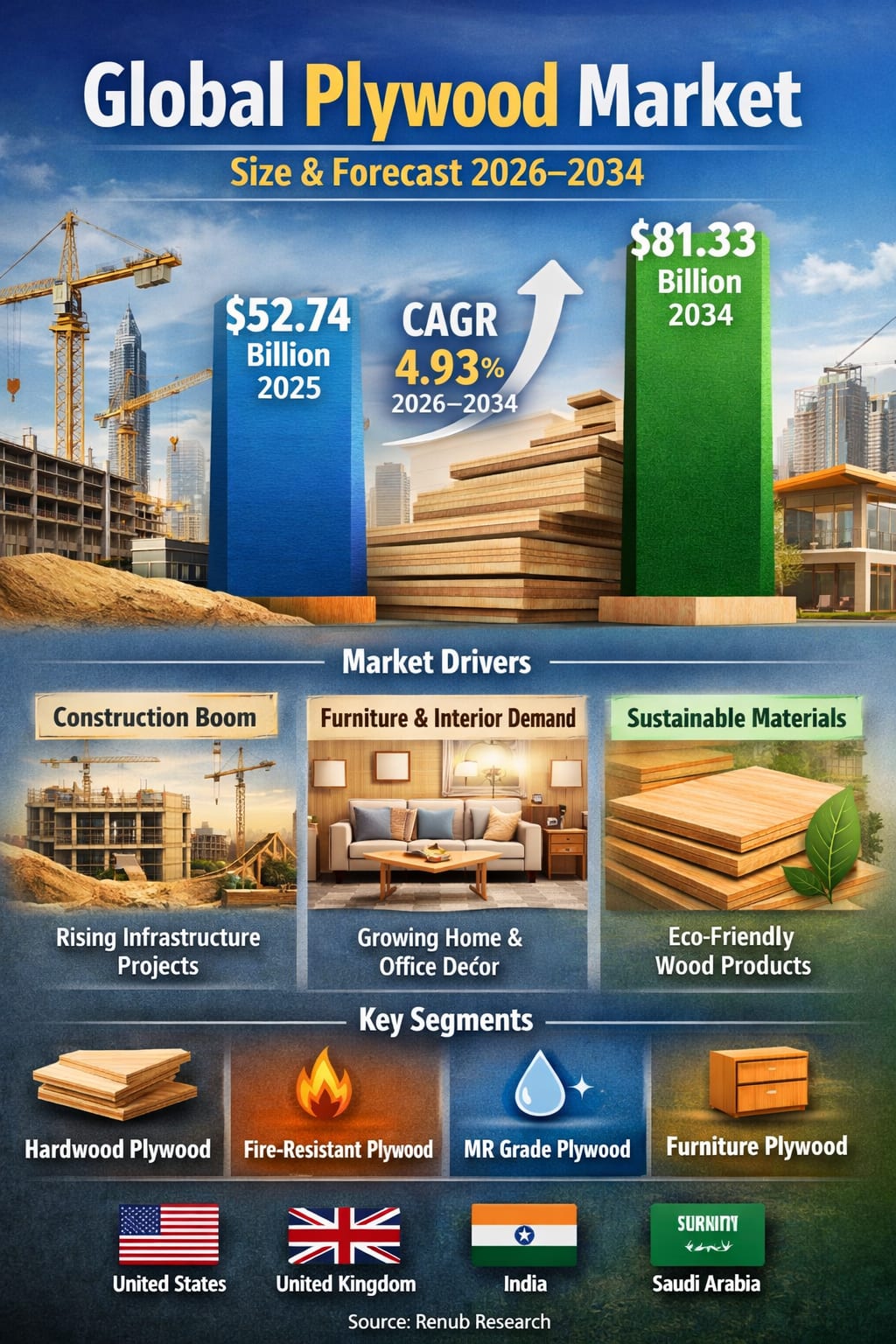
The global plywood market is entering a transformative decade, driven by rapid urbanization, infrastructure expansion, and the growing preference for engineered wood products. According to Renub Research, the worldwide plywood market is projected to grow from approximately US$ 52.74 billion in 2025 to around US$ 81.33 billion by 2034, registering a CAGR of 4.93% during the forecast period 2026–2034.
The sector is expected to command a significant share of the broader wood panel market, fueled primarily by heightened construction activities and increasing demand from furniture and interior design applications worldwide.
As governments invest in affordable housing, infrastructure modernization, and green building initiatives, plywood continues to position itself as a cost-effective, durable, and environmentally conscious alternative to solid wood products.
Global Plywood Market Outlook
Plywood is a processed wood product manufactured by bonding multiple thin layers of wood veneers—known as plies—together. These layers are arranged with their grain direction perpendicular to one another, enhancing structural strength and dimensional stability.
This cross-grain construction offers several advantages:
High load-bearing capacity
Resistance to cracking and splitting
Improved durability
Dimensional stability
Cost efficiency compared to solid timber
Various types of plywood are available in the market, including:
Softwood plywood
Hardwood plywood
Marine plywood
Outdoor plywood
Fire-resistant plywood
Moisture-resistant plywood
The growing popularity of plywood across residential, commercial, and industrial sectors stems from its versatility, uniform quality, and adaptability for customization. As global urban populations expand and real estate projects multiply, plywood demand continues to rise steadily.
Additionally, increasing environmental awareness is encouraging the adoption of engineered wood products. Since plywood utilizes thin wood veneers rather than solid logs, it optimizes timber usage and reduces waste, aligning with sustainability goals.
Key Growth Drivers in the Global Plywood Market
1. Rapid Growth in Construction and Infrastructure Development
One of the primary drivers of the global plywood market is the sustained increase in construction activities worldwide.
Plywood is widely used in:
Roofing and flooring
Wall sheathing
Concrete formwork
Structural paneling
Interior partitions
Developing economies are witnessing major investments in affordable housing schemes and infrastructure projects, boosting demand for cost-effective construction materials. Even in developed regions, renovation and remodeling activities remain strong, sustaining plywood consumption.
Large-scale industrial and energy projects also indirectly support plywood demand. For instance, infrastructure expansion and modular construction projects contribute to the increased use of engineered wood panels in formwork and structural applications.
With construction pipelines remaining robust globally, plywood demand is expected to maintain steady momentum through 2034.
2. Rising Demand from Furniture and Interior Design Industries
The furniture and interior décor sector represents another major growth engine for the plywood market.
Plywood is extensively used in manufacturing:
Cabinets
Wardrobes
Beds
Tables
Modular kitchens
Doors
Office furniture
The rising disposable income of urban consumers has significantly increased spending on home improvement and premium interior products. Ready-to-assemble and modular furniture trends are further accelerating plywood consumption, as the material offers machinability, strength, and smooth finishing.
In January 2025, innovative developments such as reinforced plywood solutions were introduced to enhance durability and thermal resistance, reflecting the industry’s focus on product differentiation and technological upgrades.
As global housing markets expand and interior aesthetics gain importance, plywood’s role in furniture manufacturing continues to strengthen.
3. Growing Preference for Engineered and Sustainable Wood Products
Environmental sustainability is becoming a decisive factor in material selection. Plywood’s engineered composition makes it more resource-efficient compared to traditional solid timber.
Key sustainability advantages include:
Reduced timber consumption
Improved yield from harvested wood
Lower material wastage
Compatibility with eco-friendly adhesives
Governments and regulatory bodies are increasingly promoting sustainable construction materials. Consumers are also more conscious of environmental impact, driving preference toward responsibly sourced wood products.
Premium plywood brands are now offering fire-resistant, waterproof, and eco-certified variants to meet evolving market standards. This shift toward value-added and sustainable plywood solutions is expected to significantly boost global sales over the forecast period.
Challenges in the Global Plywood Market
1. Volatility in Raw Material Prices
The plywood market faces substantial challenges from fluctuations in timber prices. Deforestation regulations, forest conservation policies, and supply chain disruptions can lead to raw material shortages.
Timber price volatility directly affects manufacturing costs, impacting profit margins and competitiveness. Producers must adopt efficient sourcing strategies and sustainable forestry partnerships to mitigate risks.
2. Competition from Alternative Materials and Regulatory Pressures
Plywood competes with alternative materials such as:
Medium-density fiberboard (MDF)
Particle board
Plastic composites
Metal panels
Additionally, strict regulations regarding formaldehyde emissions and adhesive use require continuous technological innovation. Manufacturers must invest in R&D to develop low-emission and compliant products, adding to operational costs.
Despite these challenges, strong demand fundamentals continue to support long-term market growth.
Segment Analysis
Global Hardwood Plywood Market
Hardwood plywood is known for superior strength and durability. Manufactured using hardwood veneers, it is widely used in construction, transportation, flooring, and high-end furniture applications.
Its resistance to impact and heavy loads makes it suitable for structural purposes. With global infrastructure investments rising, hardwood plywood is expected to witness consistent demand growth.
MR (Moisture Resistant) Grade Plywood Market
MR Grade plywood is primarily used for interior applications exposed to occasional moisture, such as:
Furniture
Wall paneling
Partitions
Cupboards
Its cost-effectiveness and widespread application in residential interiors make it one of the most consumed grades globally.
Fire-Resistant Grade Plywood Market
Fire-resistant plywood is treated with special chemicals to slow flame spread. It is increasingly adopted in:
Commercial buildings
High-rise residential projects
Public infrastructure
Transportation interiors
Rising fire safety regulations globally are boosting adoption rates for this segment.
Furniture Plywood Market
Furniture plywood remains a dominant application segment due to high demand from residential and commercial spaces. As design trends evolve and customization gains traction, plywood remains a preferred raw material for durable and aesthetically pleasing furniture.
Decoration Plywood Market
Decorative plywood is widely used in:
Wall cladding
Ceiling designs
Decorative panels
Office interiors
Growing consumer spending on décor and modern aesthetics is significantly contributing to this segment’s expansion.
Regional Insights
United States Plywood Market
The U.S. plywood market is well-established, supported by strong residential construction and remodeling activities. Plywood is extensively used for roofing, flooring, and structural sheathing.
Major industry participants such as Boise Cascade and Weyerhaeuser Company Ltd continue to invest in operational efficiency and modernization initiatives.
With sustained housing demand and disaster-resistant construction requirements, the U.S. market is expected to remain resilient.
United Kingdom Plywood Market
The UK market benefits from increasing construction, refurbishment, and sustainability-driven initiatives. Demand remains steady due to green building regulations and rising interior renovation trends.
Trade exhibitions and transportation sector innovations are further promoting advanced plywood applications.
India Plywood Market
India is witnessing rapid growth due to urbanization, rising disposable incomes, and expanding real estate activities. Leading domestic players such as Greenply Industries Ltd and Century Plyboards Ltd are investing in new manufacturing facilities to strengthen production capacity.
With large-scale housing projects and government-backed infrastructure initiatives, India is emerging as a high-growth plywood market.
Saudi Arabia Plywood Market
Saudi Arabia’s plywood demand is closely tied to construction megaprojects, tourism infrastructure, and industrial expansion under national development programs. Increased investment in housing and modular construction supports steady plywood consumption growth in the region.
Competitive Landscape
The global plywood market features both multinational corporations and regional manufacturers. Key players include:
Boise Cascade
Weyerhaeuser Company Ltd
UPM-Kymmene
Potlatchdeltic Corporation
Metsä Board
Century Plyboards Ltd
Greenply Industries Ltd
Companies are focusing on:
Capacity expansion
Sustainable sourcing
Product innovation
Low-emission adhesives
Strategic partnerships
Comprehensive company analysis typically includes overviews, key leadership profiles, recent developments, SWOT analysis, revenue assessment, and strategic positioning.
Market Segmentation
By Type:
Hardwood
Softwood
By Grade:
MR Grade (Moisture Resistant)
BWR Grade (Boiling Water Resistant)
Fire Resistant Grade
Structural Grade
Others
By Application:
Construction
Furniture
Packaging
Flooring
Transport
Decoration
Others
By Region:
North America, Europe, Asia Pacific, Latin America, Middle East & Africa
Final Thoughts
The global plywood market stands at the intersection of construction expansion, furniture demand, and sustainability transformation. With Renub Research projecting growth from US$ 52.74 billion in 2025 to US$ 81.33 billion by 2034, the industry’s trajectory reflects stable, long-term momentum.
Although raw material volatility and regulatory pressures pose challenges, innovation in fire-resistant, moisture-resistant, and eco-certified products continues to reshape competitive dynamics.
About the Creator
Keep reading
More stories from shibansh kumar and writers in Trader and other communities.
Urinary Tract Infection Treatment Market Size and Forecast 2025–2033
The global Urinary Tract Infection (UTI) Treatment Market continues to demonstrate resilient growth as infection prevalence rises across all age groups and healthcare systems intensify their focus on timely diagnosis and effective antimicrobial therapy. According to Renub Research, the Urinary Tract Infection (UTI) Treatment Industry is anticipated to reach US$ 9.11 billion in 2025, expanding further to US$ 11.93 billion by 2034, registering a CAGR of 3.04% between 2026 and 2034.
By shibansh kumara day ago in Trader
Australia Cigarette Market Remains Resilient Amid Regulation and Illicit Trade Pressures
In 2025, the Australia cigarette market was valued at around USD 23.31 billion and is projected to reach approximately USD 27.47 billion by 2034, expanding at a compound annual growth rate (CAGR) of 1.84% from 2026 to 2034. This measured growth comes against a backdrop of one of the world’s most stringent tobacco regulatory environments — marked by plain packaging, extensive advertising curbs, and rising excise taxes — yet consumer demand has shown resilience. As the industry evolves, shifts in consumer preferences, retail strategies, and broader socio-economic forces are reshaping the landscape.
By Rashi Sharma7 days ago in Trader
REEEEEEEEE!
I'm on a low road right now. There are a literal million things to do and not one of them worth my time. I would rather sit in place and burn but the orbit takes me on its inevitable route 'round the center; and I a center in my own right, around which others orbit, and so on and so forth, ad infinitum, ad nauseum.
By C. Rommial Butlera day ago in Poets




Comments
There are no comments for this story
Be the first to respond and start the conversation.