
United States Electric Vehicle Market Size and Forecast 2026–2034
America’s Road to Electrification: Innovation, Policy, and Consumer Shift Power a US$ 585.65 Billion Future

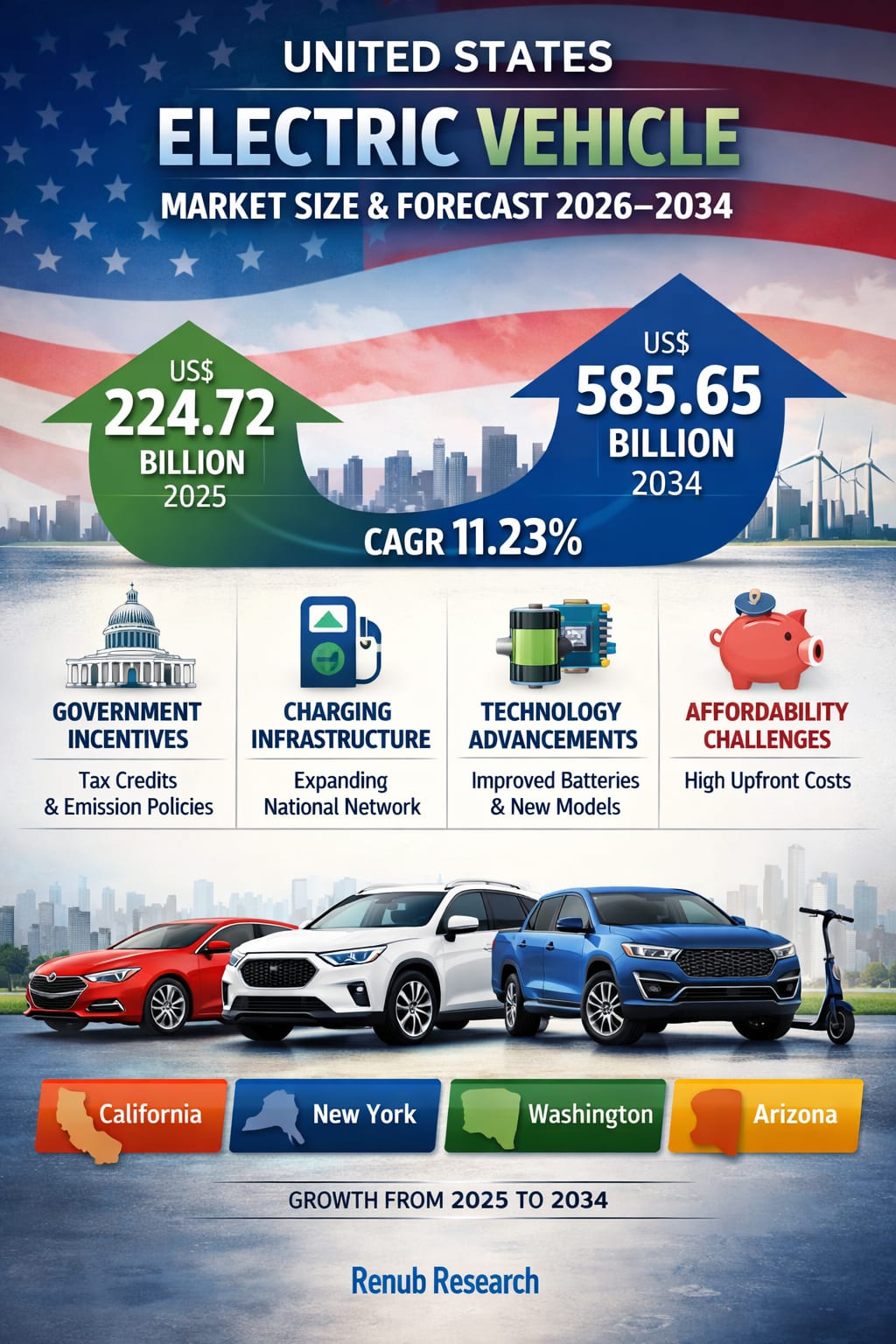
The electric vehicle (EV) revolution in the United States is no longer a distant vision—it is a fast-evolving reality reshaping transportation, energy systems, and consumer behavior. Driven by technological advancements, strong policy support, and rising environmental awareness, the United States Electric Vehicle Market is poised for remarkable expansion over the coming decade.
According to Renub Research, the U.S. electric vehicle market is projected to grow from US$ 224.72 Billion in 2025 to US$ 585.65 Billion by 2034, registering a robust Compound Annual Growth Rate (CAGR) of 11.23% from 2026 to 2034. This growth trajectory underscores a fundamental transformation in how Americans view mobility—shifting from fossil-fuel dependency toward sustainable, technology-driven transportation solutions.
United States Electric Vehicle Market Outlook
An electric vehicle (EV) operates using one or more electric motors powered by rechargeable batteries, unlike conventional vehicles that rely on internal combustion engines. The EV ecosystem includes:
Battery Electric Vehicles (BEVs) – Fully electric vehicles with zero tailpipe emissions.
Plug-in Hybrid Electric Vehicles (PHEVs) – Vehicles combining electric propulsion with a gasoline engine.
Hybrid Electric Vehicles (HEVs) – Vehicles that integrate electric assistance with fuel-based engines.
Electric vehicles produce little to no emissions, operate quietly, and offer lower maintenance and operating costs over time. As fuel prices fluctuate and climate concerns intensify, American consumers increasingly recognize EVs as both an environmentally responsible and financially sensible option.
Widespread adoption has been supported by tax credits, state-level rebates, and non-financial incentives such as HOV lane access. Simultaneously, improvements in charging infrastructure and growing model diversity across price segments are reducing historical barriers like range anxiety and limited affordability.
Growth Drivers of the United States EV Market
1. Strong Government Incentives and Regulatory Support
Government policy plays a decisive role in accelerating EV adoption. Federal tax credits, state rebates, and infrastructure grants reduce the effective purchase price of electric vehicles. Stricter fuel economy standards and emissions regulations are compelling automakers to expand their electric portfolios.
Several states have outlined long-term plans to phase out new gasoline vehicle sales, sending a powerful market signal. The U.S. Department of Transportation, through multiple operating administrations, continues to invest in charging corridors and rural EV programs. Initiatives such as the National Electric Vehicle Infrastructure (NEVI) Formula Program have strengthened DC fast-charging networks along major highways.
Such coordinated federal and state action is building the regulatory backbone necessary for sustained EV market growth.
2. Rapid Expansion of Charging Infrastructure
Infrastructure development is critical to scaling the EV ecosystem. Over the past decade, the number of public EV charging ports in the United States has increased more than sixfold—from around 30,000 in 2016 to nearly 196,000 by January 2025.
Charging stations are expanding across:
Highways and interstate corridors
Urban centers
Suburban residential areas
Workplaces and commercial complexes
Private companies and automakers are investing in high-speed charging networks, significantly reducing charging times. As infrastructure reliability improves, range anxiety—a major consumer concern—is steadily diminishing.
3. Technological Advancements and Expanding Model Availability
Battery innovation is transforming the economics of electric mobility. Improvements in energy density, battery life, and cost efficiency have enhanced vehicle range and affordability. Simultaneously, domestic battery production is strengthening supply chain resilience.
Automakers are launching EVs across multiple segments:
Compact sedans
Family SUVs
Electric pickup trucks
Commercial fleet vehicles
In August 2025, Ford Motor Company introduced a US$ 30,000 electric pickup truck manufactured domestically, highlighting the push toward affordable electrification in traditionally fuel-dominated segments.
Enhanced connectivity, advanced driver-assistance systems, and autonomous features further improve the appeal of EVs, positioning them as technology-forward alternatives to gasoline vehicles.
Challenges Facing the U.S. EV Market
High Upfront Costs
Despite falling battery prices, EVs often carry a higher sticker price compared to conventional vehicles. While total ownership costs may be lower due to fuel and maintenance savings, upfront affordability remains a hurdle—particularly in regions with limited state incentives.
Additionally, uncertainty around battery longevity and resale values affects consumer confidence in the used EV market.
Supply Chain and Grid Readiness
The EV industry depends heavily on critical minerals such as lithium, cobalt, and nickel—resources subject to geopolitical risks and price volatility. Expanding domestic mining, processing, and recycling infrastructure is a long-term challenge.
Moreover, rising EV adoption will increase electricity demand. Grid modernization, renewable energy integration, and smart charging solutions are essential to ensure sustainable electrification without overburdening power systems.
Segment Analysis
Battery Electric Vehicles (BEVs)
BEVs are leading the EV transformation. Fully electric and emission-free, they offer simplified mechanics and lower operational costs. As regulatory pressure to reduce carbon emissions intensifies, BEVs are expected to dominate market share through 2034.
Automakers including Tesla, General Motors Company, and Toyota Motor Corporation are heavily investing in BEV platforms across passenger and commercial categories.
151–300 Mile Range Vehicles
The 151–300 mile range category strikes a balance between performance, practicality, and affordability. These vehicles meet daily commuting needs and moderate road-trip demands without significantly increasing vehicle weight or cost.
Improvements in battery efficiency and the rapid expansion of fast-charging networks make this segment particularly attractive to middle-income households.
Two-Wheeler Electric Vehicles
Though smaller in market share, electric two-wheelers are gaining traction in urban environments. Rising congestion, demand for last-mile delivery solutions, and affordability advantages are boosting adoption.
Electric bikes and scooters offer efficient, sustainable mobility alternatives, especially in densely populated cities.
Mid-Priced Electric Vehicles
The mid-priced EV segment is critical for mass adoption. Targeting middle-class consumers, these vehicles combine competitive range, modern features, and accessible pricing.
Federal tax credits and scale-driven cost reductions are expanding this segment. As more mid-priced electric SUVs and sedans enter the market, consumer confidence in EV reliability continues to grow.
State-Level Market Insights
California
California remains the largest EV market in the country. Aggressive zero-emission mandates, robust charging infrastructure, and high environmental awareness position the state as a national leader in electrification.
The presence of innovators like Tesla has further strengthened the ecosystem. High fuel prices and supportive state policies make EV ownership economically attractive.
New York
New York’s dense urban centers, particularly New York City, favor short-range commuting and fleet electrification. State investments in public charging infrastructure and EV fleet transitions are accelerating growth. Urban apartment charging installations are addressing space constraints.
Washington
With abundant renewable energy resources, particularly hydropower, Washington State presents an environmentally favorable landscape for EV adoption. Tech-forward consumers and workplace charging networks support steady growth, especially in cities like Seattle.
Arizona
Rapid population growth and solar energy potential make Arizona an emerging EV market. Cities such as Phoenix and Tucson are expanding charging infrastructure to support rising adoption, although extreme heat conditions require continued battery performance improvements.
Competitive Landscape
Major companies shaping the U.S. EV market include:
Tesla
BMW Group
BYD Company Ltd.
Mercedes-Benz Group AG
Ford Motor Company
General Motors Company
Nissan Motor Co. Ltd.
Toyota Motor Corporation
These players are evaluated across five strategic viewpoints:
Company Overview
Key Leadership
Recent Developments
SWOT Analysis
Revenue Analysis
Their collective investments in battery technology, domestic production, and diversified EV portfolios are reshaping competitive dynamics in the U.S. automotive landscape.
Market Segmentation Overview
By Product:
Battery Electric Vehicles
Plug-in Hybrid Electric Vehicles
Hybrid Electric Vehicles
By Range:
Up to 150 Miles
151–300 Miles
Above 300 Miles
By Vehicle Type:
Two-Wheeler
Passenger Cars
Commercial Vehicles
By Vehicle Class:
Low Priced
Mid-Priced
Luxury
By Geography:
Key states include California, Texas, New York, Florida, Illinois, Pennsylvania, Ohio, Georgia, Washington, Arizona, and others across the United States.
Final Thoughts
The United States Electric Vehicle Market is entering a decisive decade. With projections indicating growth from US$ 224.72 Billion in 2025 to US$ 585.65 Billion by 2034, electrification is no longer a niche trend—it is becoming the mainstream direction of the American automotive industry.
Policy backing, infrastructure expansion, battery innovation, and consumer acceptance are converging to create a strong growth ecosystem. While affordability and supply chain challenges remain, strategic investments and regulatory alignment are steadily addressing these constraints.
By 2034, electric vehicles are expected to represent not just an alternative—but a dominant force—in sustainable transportation across the United States. The road ahead is electric, and America is accelerating confidently toward a cleaner, technologically advanced mobility future.
About the Creator
The Saddest Thing - The Billionaires Who Rule America Aren't Even Enjoying Themselves
This single post says more about our ruling class than a thousand policy papers. The saddest thing about today's system is that the men robbing the rest of us - sabotaging our economic prospects, our pensions, our access to affordable healthcare - are not even happy.
By Scott Christenson🌴25 days ago in The Swamp
Cassie and Johnny
I’m the kind of dame you notice. I’m no femme fatale, but you can’t ignore me, at least not until I warn you about what’s coming, then everybody ignores me. Hell, they usually blame me afterwards and give Johnny all the credit for saving the day, but my Johnny couldn’t save a seat at the movies without my help. Sure, he’s brawny, but brainy? Not so much. Like that time I asked him to spot me five bucks, and he said he didn’t see it anywhere on me, and believe you me, he looked but good.
By Harper Lewis5 days ago in Critique



Comments
There are no comments for this story
Be the first to respond and start the conversation.