
Smart TV Market Size and Forecast 2026–2034
Connected Living Redefined: How Smart TVs Are Powering the Future of Digital Entertainment

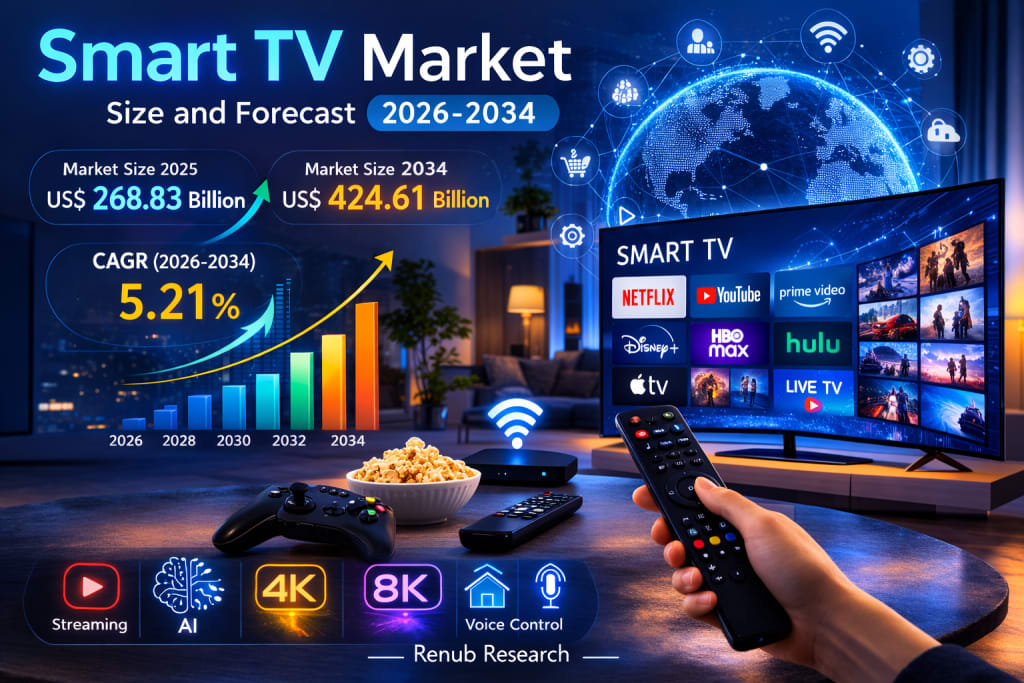
The global Smart TV Market is entering a new era of sustained growth and innovation. According to Renub Research, the Smart TV Market is expected to reach US$ 424.61 billion by 2034, up from US$ 268.83 billion in 2025, expanding at a CAGR of 5.21% from 2026 to 2034. Rising disposable incomes, expanding internet penetration, rapid urbanization, and evolving consumer demand for immersive home entertainment are fueling this expansion worldwide.
What was once a simple television screen has now become the centerpiece of the connected home — integrating streaming, gaming, voice control, artificial intelligence, and smart home management into a single digital ecosystem. As media consumption habits continue shifting toward on-demand and personalized experiences, smart TVs are no longer luxury upgrades; they are fast becoming household essentials.
Smart TV Industry Overview
Over the past decade, the smart TV industry has transformed dramatically. Traditional televisions have evolved into fully connected multimedia hubs capable of streaming content, running applications, supporting video conferencing, enabling cloud gaming, and even acting as command centers for smart home ecosystems.
Major global brands such as Samsung Electronics, LG Electronics, Sony Corporation, and TCL Technology dominate the competitive landscape. At the same time, operating system platforms such as Android TV/Google TV, webOS, Tizen, and Roku OS play an equally critical role in shaping the user experience. The battle today is not only about display quality but also about ecosystem integration, app compatibility, and software performance.
The decline in hardware prices, particularly in 4K televisions, has democratized access to smart TVs across emerging markets. Meanwhile, high-speed broadband adoption and affordable data plans have made streaming seamless even in price-sensitive regions.
Technological advancements remain central to the industry’s evolution. Innovations in display technologies — including OLED, QLED, Mini-LED, and 8K resolution — are enhancing contrast, brightness, energy efficiency, and overall aesthetics. Artificial intelligence now powers content recommendations, adaptive picture optimization, and voice recognition. Software updates and intuitive user interfaces are becoming just as important as panel resolution.
The industry is gradually shifting from being product-centric to service-oriented. Revenue streams increasingly extend beyond hardware sales into advertising, streaming partnerships, cloud gaming, and subscription integrations. Smart TVs are no longer standalone devices; they are digital platforms.
Growth Drivers of the Smart TV Market
1. Streaming and On-Demand Content Explosion
The explosive growth of streaming platforms has reshaped global entertainment consumption. Consumers are moving away from traditional cable and satellite services toward digital streaming services offering flexibility, affordability, and vast content libraries.
Smart TVs provide built-in access to popular OTT platforms, eliminating the need for additional streaming devices. This convenience is a key driver of adoption. The rise of original content, live sports streaming, regional programming, and interactive entertainment further strengthens the appeal.
Advertising-supported streaming models have expanded access to content in emerging markets. As viewing time for digital content continues to increase globally, smart TVs serve as the primary gateway to modern entertainment ecosystems.
2. Advancements in Display and AI Technologies
Continuous innovation in display technology is encouraging consumers to upgrade their televisions. OLED and QLED panels deliver superior color accuracy and deeper contrasts, while Mini-LED enhances brightness and precision dimming. 4K has become mainstream, and 8K is gradually entering premium segments.
Artificial intelligence plays a growing role in personalization. AI-driven recommendations tailor content to individual viewing habits. Voice assistants enable hands-free control, and smart TVs increasingly integrate with broader home ecosystems.
Faster processors, advanced operating systems, and regular firmware updates extend device longevity. As smart TVs evolve into multifunctional digital platforms, consumers are motivated to invest in technologically advanced models.
3. Rising Internet Penetration and Smart Home Integration
Expanding broadband infrastructure is a major catalyst for market growth. Affordable internet access has unlocked streaming and digital services in developing regions. Smart TVs act as control hubs within connected homes, interacting with smart speakers, lighting systems, cameras, and thermostats.
Urbanization and rising disposable incomes are further accelerating demand. Younger, tech-savvy consumers prioritize connectivity, app ecosystems, and cross-device compatibility when purchasing televisions.
As digital transformation deepens across economies, smart TVs are becoming foundational elements of modern living spaces.
Challenges Facing the Smart TV Market
1. Market Saturation and Price Pressure
In developed regions such as North America and parts of Europe, smart TV penetration is already high. Replacement cycles now drive demand rather than first-time purchases. This maturity intensifies competition and compresses margins.
Manufacturers face pressure to continuously introduce advanced features while maintaining competitive pricing. Low-cost entrants, particularly from Asia, have intensified price competition. Hardware commoditization makes differentiation challenging.
To maintain profitability, companies are investing heavily in software ecosystems, content partnerships, and advertising monetization.
2. Data Privacy and Cybersecurity Concerns
Smart TVs collect significant user data to enable personalization and targeted advertising. Viewing habits, voice commands, and app usage patterns are often analyzed.
This raises regulatory and consumer concerns about privacy and data protection. Compliance with data protection regulations increases operational complexity. Additionally, as connected devices within home networks, smart TVs may become entry points for cyber threats if security protocols are insufficient.
Maintaining consumer trust while leveraging data for monetization remains a delicate balance for industry players.
United States Smart TV Market
The United States represents one of the most mature and technologically advanced smart TV markets globally. Strong broadband infrastructure and widespread streaming adoption support consistent demand.
In 2025, U.S. smart TV shipments are projected at approximately 50.7 million units. Consumers are increasingly upgrading to larger screens and premium technologies such as OLED and QLED.
Leading brands such as Samsung Electronics, LG Electronics, Sony Corporation, TCL Technology, and VIZIO Inc. dominate the competitive environment. Roku OS and Google TV platforms have gained substantial market penetration.
Streaming viewership now surpasses traditional broadcast consumption in many U.S. households, positioning smart TVs at the center of advertising and digital content monetization strategies.
Germany Smart TV Market
Germany’s smart TV market is well established, with high adoption rates and strong consumer emphasis on quality and reliability. Replacement demand drives growth as households upgrade to advanced display technologies and energy-efficient models.
German consumers value seamless connectivity, user-friendly interfaces, and compliance with environmental standards. Sustainability and energy efficiency regulations significantly influence purchasing decisions.
Although mature, the market continues to expand steadily due to innovation in display performance and integration with smart home ecosystems.
India Smart TV Market
India represents one of the fastest-growing smart TV markets globally. Unlike mature regions, first-time buyers contribute significantly to demand, particularly in tier-2 and tier-3 cities.
Affordable models, competitive pricing, and expanding internet penetration are accelerating adoption. Regional streaming content and multilingual programming enhance appeal among diverse audiences.
Local manufacturing initiatives and expanding retail networks further strengthen market penetration. Despite intense competition and price sensitivity, long-term growth potential remains strong.
Saudi Arabia Smart TV Market
Saudi Arabia’s smart TV market reflects high consumer purchasing power and rapid technology adoption. Large screen sizes, premium designs, and advanced resolution technologies are highly preferred.
High internet penetration supports streaming growth, while multilingual content caters to diverse demographics. Smart TVs are increasingly integrated into connected home ecosystems.
Innovation, brand reputation, and premium features strongly influence consumer decisions in the region.
Recent Industry Developments
The competitive landscape continues evolving through strategic investments and partnerships:
January 2026: LG Display committed USD 3.2 billion to expand its Paju OLED facility, targeting cost efficiencies and expanded capacity.
December 2025: TCL acquired Sharp’s Sakai Gen 10 LCD factory for USD 1.8 billion, strengthening large-panel production capabilities.
November 2025: Samsung introduced its Neo QLED 8K QN900D featuring neural upscaling technology and advanced dimming zones.
October 2025: Hisense and Foxconn formed a USD 450 million joint venture to establish a major TV manufacturing facility in Mexico targeting North American markets.
These developments highlight the industry’s continued focus on capacity expansion, cost optimization, and technological differentiation.
Market Segmentation Overview
By Resolution Type:
HD TV, Full HD TV, 4K UHD TV, 8K TV, Others
By Screen Size:
Below 32 inches, 32–45 inches, 46–55 inches, 56–65 inches, Above 65 inches
By Type:
Flat, Curved
By Technology:
OLED, QLED, LED, Plasma, Others
By Operating System:
Android, Tizen OS, webOS, Roku, Firefox, CastOS, Fire TV, Others
By Application:
Residential, Commercial
By Region:
North America (United States, Canada), Europe (France, Germany, Italy, Spain, United Kingdom, Belgium, Netherlands, Turkey), Asia Pacific (China, Japan, India, South Korea, Thailand, Malaysia, Indonesia, Australia, New Zealand), Latin America (Brazil, Mexico, Argentina), Middle East & Africa (Saudi Arabia, UAE, South Africa, Rest of World)
Competitive Landscape
Prominent players in the global Smart TV market include:
Panasonic Corporation
Sony Corporation
Samsung Electronics
Sharp Corporation
VIZIO Inc.
Koninklijke Philips N.V.
Hitachi Ltd.
Toshiba Visual Solutions Corporation
Apple Inc.
Companies are evaluated based on company overview, key personnel, recent developments, SWOT analysis, and revenue performance. Competitive advantage increasingly depends on software ecosystems, AI integration, content partnerships, and advertising capabilities.
Final Thoughts
The Smart TV Market is undergoing a fundamental transformation from hardware-driven growth to ecosystem-driven value creation. With projected revenues reaching US$ 424.61 billion by 2034, the industry stands at the crossroads of entertainment, connectivity, and intelligent living.
As streaming platforms expand, AI personalization deepens, and smart home ecosystems mature, televisions are evolving into command centers of the digital household. While price pressures and privacy concerns present challenges, technological innovation and service monetization models provide long-term resilience.
In the coming decade, the question will not be whether households own smart TVs — but how deeply these devices integrate into everyday digital life. The smart TV is no longer just a screen; it is the gateway to the future of connected entertainment.
About the Creator
Sakshi Sharma
Content Writer with 7+ years of experience crafting SEO-driven blogs, web copy & research reports. Skilled in creating engaging, audience-focused content across diverse industries.
Keep reading
More stories from Sakshi Sharma and writers in The Swamp and other communities.
Automotive Robotics Market Size and Forecast 2026–2034
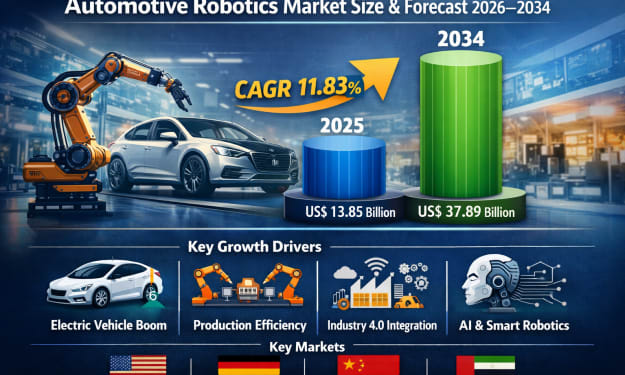
The global automotive industry is undergoing one of the most transformative decades in its history. Electrification, digitalization, customization, and advanced safety standards are reshaping how vehicles are designed and produced. At the heart of this industrial evolution lies robotics.
By Sakshi Sharmaabout 2 hours ago in The Swamp
The Saddest Thing - The Billionaires Who Rule America Aren't Even Enjoying Themselves
This single post says more about our ruling class than a thousand policy papers. The saddest thing about today's system is that the men robbing the rest of us - sabotaging our economic prospects, our pensions, our access to affordable healthcare - are not even happy.
By Scott Christenson🌴25 days ago in The Swamp


Comments
There are no comments for this story
Be the first to respond and start the conversation.