
Inside Iran’s 2026 Nuclear Talks
The One Detail No One on TV Is Talking About

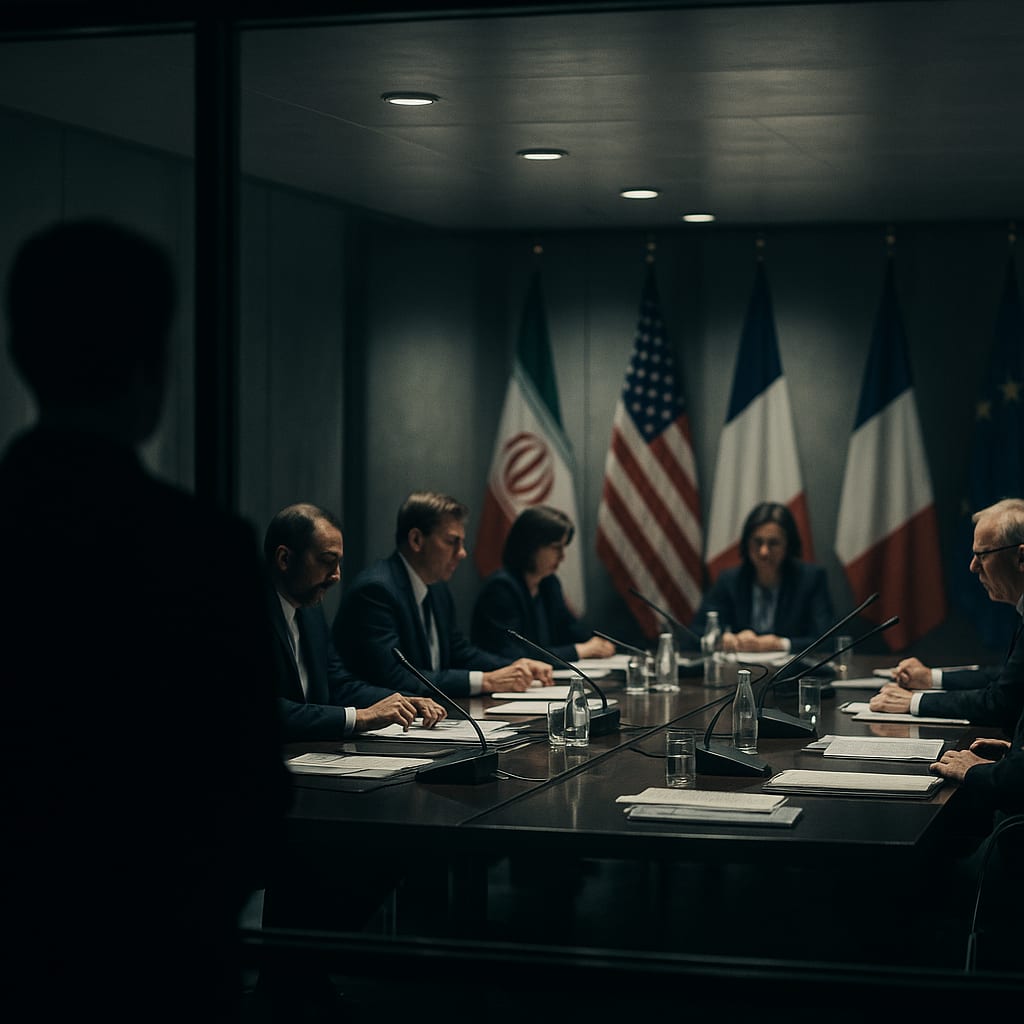
Behind the closed doors of Vienna and Doha, something bigger than centrifuges is being negotiated: whose fear matters, and whose doesn’t
The first thing you notice in a negotiation room is the silence.
Not the absence of words—there are always plenty of those—but the weight of what doesn’t get said.
In 2024, at a security forum in Europe, I sat three rows back from an Iranian diplomat and a former U.S. negotiator who had once stared each other down in nuclear talks. They weren’t at a table this time, just on a stage with bottled water and microphones. But the air around them felt the same: cautious, crowded with ghosts of deals signed, broken, reworded, buried.
The Iranian official said something that stuck to me like burrs:
“We have learned that security is a language. You only get heard when your voice can cause damage.”
Two years later, as the world inches toward the 2026 round of Iran nuclear talks, that sentence keeps replaying in my head.
Because what’s actually at stake in these talks isn’t just uranium levels or centrifuge counts.
It’s whose fear is treated as rational—and whose is dismissed as dangerous.
And that, more than any technical detail in a 200-page agreement, is what makes these negotiations terrifyingly fragile and quietly hopeful at the same time.
The world keeps misreading Iran’s nuclear program—and that mistake is deadly
Most headlines reduce the Iran nuclear talks to a simple, familiar story:
Iran bad. Bomb close. West nervous. Talks needed.
It’s easy. It fits into a push notification.
But whenever I talk to people who grew up inside Iran’s borders or watched the Iran–Iraq War as kids from a TV across the world, that frame feels like a lie of omission.
For many Iranians, the story doesn’t start with centrifuges.
It starts with sirens.
It starts with the 1980s, when Saddam Hussein’s Iraq invaded Iran, used chemical weapons, and the world mostly looked away. No “red lines.” No UN emergency sessions that actually stopped the gas.
Iran lost hundreds of thousands of people in that war. An entire generation grew up with funerals as a weekly routine.
If you’re wondering why Iranian leaders still use the word “humiliation” when talking about the West, that’s your answer.
To Western security planners, Iran’s nuclear activity looks like provocation.
To many inside the system in Tehran, it looks like insurance.
Not because they necessarily want a bomb tomorrow, but because they learned that countries without a serious deterrent get bullied, sanctioned, or invaded—and no one is held accountable.
You don’t have to agree with that logic to understand it.
But if you refuse to understand it, you will absolutely misread what is happening in the 2026 talks.
Sanctions, broken promises, and why trust is the rarest element in the room
The 2015 nuclear deal, the JCPOA, was supposed to be a reset.
Iran agreed to ship out 97% of its enriched uranium, smash centrifuges, accept intrusive inspections. In return, it was promised sanctions relief, trade, access to frozen assets.
For a brief moment, Tehran’s skyline changed. Western business delegations showed up. Iranian airlines put in orders for European jets. Students talked about graduate programs abroad instead of just escape plans.
Then 2018 happened.
The U.S. pulled out of the deal unilaterally. Sanctions snapped back. Companies fled. The currency plunged. People who had bet on openness watched the floor vanish beneath them in real time.
You cannot overstate the emotional damage that did.
Not just to Iran’s rulers, but to ordinary people who had allowed themselves one risky thing: hope.
When you watch your savings evaporate because of a policy announced in a language you don’t speak, thousands of miles away, it does something to your sense of reality.
In the years after the U.S. withdrawal:
Iran slowly stepped away from its JCPOA limits.
Enrichment levels climbed closer to weapons-grade.
Transparency dropped.
Hardliners, who had warned that “America cannot be trusted,” cashed in the ugliest I-told-you-so in modern Iranian politics.
So when diplomats talk now about the 2026 nuclear talks, they’re not just arguing about uranium levels and centrifuge models.
They’re arguing about something far more personal:
Is any promise from the other side worth anything?
That’s not a technical question. It’s a trauma question.
And trauma, once baked into policy, is almost impossible to negotiate away with bullet points and staged handshakes.
The 2026 nuclear talks aren’t just about Iran—they’re about everyone’s worst-case scenario
Here’s what keeps people in think tanks awake at 3 a.m., though they rarely say it out loud on TV:
If the 2026 talks fail badly enough, the world doesn’t just risk “a nuclear Iran.”
It risks a chain reaction of panic.
Because nuclear programs spread. Fear spreads faster.
If Iran is seen as crossing the threshold to a usable nuclear weapon—or even hovering just a few screwdriver turns away—other countries in its neighborhood will not quietly sit and meditate about it.
Saudi Arabia has already floated the idea that it will not stay nuclear-free if Iran goes nuclear. Turkey and Egypt are watching the same chessboard. Israel, which is widely believed to have its own undeclared nuclear arsenal, has repeatedly signaled that it will not tolerate a nuclear-armed Iran.
In other words:
The future of nuclear non-proliferation is sitting in that 2026 conference room too, even if it doesn’t have a nameplate.
At the same time, the United States, Europe, Russia, and China all have their own anxieties in the mix:
Washington fears a Middle East where U.S. troops and allies are under permanent nuclear shadow.
European capitals fear refugee waves and energy chaos if regional war erupts.
Russia sees Iran as a partner in evading sanctions and reshaping global order.
China wants stability for trade routes and energy imports, not an arms race that sends oil prices into the stratosphere.
So when you imagine the 2026 nuclear talks, don’t picture a single table with two flags.
Picture a crowded room with invisible chairs reserved for every worst-case scenario.
Everyone in that room is negotiating not just with Iran, but with their own nightmares.
The part almost no one talks about: the people who will never sit at the table
Security debates are full of “Iran” and “the West,” as if both are single, coherent people with one set of feelings.
They’re not.
While officials argue over enrichment caps and sanctions relief, there’s another, quieter story unfolding offstage: the lives being shaped by decisions they’ll never get to vote on.
In Iran, young people scroll through news about nuclear negotiations between censorship filters and VPNs. They know that the outcome might affect whether their university has funds, whether their medicine is imported, whether their cousin’s business can survive another round of sanctions.
They also know that they have virtually no say in any of it.
I remember a conversation with an Iranian friend whose brother was studying engineering. When talk of a revived deal resurfaced, he said something that cut clean through the abstract policy chatter:
“If they sign, maybe my brother will stay. If they don’t, he’ll join the million others trying to leave.”
Nuclear talks, from the outside, look like elite geopolitics.
From the inside, they feel like a referendum on whether staying is viable or foolish.
On the other side, there are people in Israel who run nightly through missile scenarios in their heads, wondering if “Iran deal” will become a synonym for “we miscalculated and now it’s too late.”
There are Gulf residents who hear drones overhead and wonder what happens if the next exchange isn’t conventional.
There are Americans and Europeans who don’t have the bandwidth for foreign policy, but will see gas prices spike or headlines of “conflict in the Middle East” and feel a familiar dread settle in.
None of these people will sit at the 2026 negotiating table.
But they are all, in the most literal sense, what is at stake.
Their futures are the collateral that gets silently put on the table every time a diplomat walks into the room and closes the door.
Why both sides are trapped in their own story—and how that kills progress
There’s a painful symmetry in how Iran and its adversaries misunderstand each other.
Iran’s leadership tends to read every sanction, every military exercise, every harsh statement as proof that the West’s true aim is regime change—that no concession will ever be enough.
From that vantage point, nuclear capability becomes a shield: a way to make the cost of attack unbearably high.
Meanwhile, many in Washington, Tel Aviv, and European capitals read every Iranian concession as tactical, temporary, reversible. They’re haunted by the possibility that Tehran might sign an agreement, pocket the benefits, and cheat in the shadows while the world relaxes.
Both sides see the other as fundamentally dishonest.
Both see themselves as reacting, not provoking.
This mutual victimhood creates a deadly pattern:
One side takes a step seen as aggressive.
The other responds “defensively” with its own escalation.
Each looks at the other’s move and says, See? We were right not to trust them.
Repeat until someone miscalculates in a way that can’t be walked back.
The 2026 nuclear talks are happening inside that loop.
They’re not just a technical discussion. They’re a rare chance to interrupt that pattern, even slightly, before it crystallizes into something unfixable.
The problem is, interrupting the pattern requires something political systems hate: admitting that your fear might not be the only legitimate one in the room.
The uncomfortable truth: “success” in 2026 will not feel satisfying to anyone
If these talks produce anything meaningful, it will almost certainly be attacked from all directions.
If Iran agrees to roll back enrichment levels again and accept strict inspections, hardliners will call it surrender. They’ll point to 2018 and say, “We gave up leverage once and got screwed. Why are we doing this again?”
If the U.S. and Europe offer real sanctions relief and some form of economic guarantees, critics will accuse them of rewarding “bad behavior,” funding proxies, endangering allies.
There is no version of a serious agreement that produces a clean victory lap for anyone.
Any workable deal will be ugly, partial, frustrating.
It might extend Iran’s “breakout time” to a nuclear weapon—not eliminate it.
It might give Iran economic breathing room without changing its regional behavior in the way neighbors want.
It might protect the non-proliferation regime while still leaving everyone on edge.
And yet, the alternative to that unsatisfying, fragile, incremental progress isn’t some morally pure stance. It’s freefall.
Freefall looks like:
Iran quietly crossing a threshold that can’t be reversed without war.
Regional powers speeding up their own nuclear options.
A Middle East where every crisis has a radioactive shadow, and every misread signal feels like the start of something you can’t contain.
Sometimes the grown-up choice is the one that makes everyone equally angry.
The 2026 talks, if they succeed, will almost certainly feel like that.
What’s really at stake: whose fear we choose to take seriously
If you strip away the acronyms and the position papers, the Iran nuclear talks are built on a single, haunting question:
Whose fear gets to shape the future?
Is it the fear in Tel Aviv that a nuclear-armed Iran could one day turn a doctrine into an irreversible act?
Is it the fear in Tehran that without some kind of powerful deterrent, Iran will always be one election away in Washington from economic strangulation or worse?
Is it the fear in Riyadh, Ankara, Cairo that they will wake up one morning at a permanent strategic disadvantage?
Is it the fear in European cities that a regional war could spill outward in ways no border can hold?
Or the quieter fear in ordinary homes—from Shiraz to Haifa to Houston—that someone else’s miscalculation will rewrite their lives without ever knowing their names?
Inside those 2026 rooms, the technical language of “confidence-building measures” and “breakout timelines” is really just a way of saying:
Can any of us afford to keep acting like we’re the only ones whose fear is rational?
Because the harsh truth is this: if the negotiators treat fear as a weapon instead of a reality to be shared, the talks will fail. Maybe not on paper. Maybe there will be a joint statement, some handshakes, a set of bullet points that look decent on a government website.
But underneath, the logic of the arms race will keep ticking away like a hidden clock.
The takeaway we don’t like to admit: we’re already inside the blast radius of these choices
Most of us will never see the inside of the 2026 negotiation rooms.
We’ll encounter them as headlines, debate clips, maybe a worried conversation over coffee when a friend says, “Did you see what’s happening with Iran? Feels like something bad is coming.”
It’s tempting to treat all of this as distant, as if “global security” is something that happens on maps, not in actual lives.
But every time a deal collapses, a threat is made, a sanction is tightened, someone’s world narrows.
A student changes their major from physics to whatever gets them a visa out.
A family cancels a trip home because they’re afraid of getting stuck.
A parent starts hoarding medicine because they remember what shortages felt like last time.
A teenager in a coastal town thousands of miles away hears “conflict with Iran” and quietly worries about a draft, or about oil prices gutting their family’s already fragile budget.
We’re all closer to these negotiations than it feels.
Inside Iran’s 2026 nuclear talks, what’s really at stake isn’t just whether one country does or doesn’t cross a nuclear line.
It’s whether we keep pretending that security is something governments own, or whether we finally admit it’s made of millions of small, fragile lives—none of which are as distant from each other as our leaders like to believe.
If there’s one thing worth carrying out of all this, it might be this uncomfortable, necessary thought:
When those doors close in 2026, the people inside the room will be speaking for us—whether we asked them to or not.
The question is not whether they’ll protect our side.
It’s whether they’ll remember that there was never just one side to begin with.
About the Creator
abualyaanart
I write thoughtful, experience-driven stories about technology, digital life, and how modern tools quietly shape the way we think, work, and live.
I believe good technology should support life
Abualyaanart
Keep reading
More stories from abualyaanart and writers in The Swamp and other communities.
A Gathering of Evil Bosses
“I’m the queen of chin jutting while I smooth my hair, attacking, insulting, and deflecting to protect my appointer.” “Oh, please, Blondi, my hair is curled, highlighted, and longer than yours. I feature television commercials telling immigrants that we will give them a free plane ride home, and if they voluntarily turn themselves in, they will be allowed to legally apply for re-entry. It runs everywhere, and I look good in it! You can’t compete because of your blond hair. Mine is nicer, and my lips are prettier than yours.”
By Andrea Corwin 13 days ago in The Swamp
A Knight of the Seven Kingdoms Series Review (Season 1)
As one of the biggest properties in fantasy, A Song of Ice and Fire remains immensely popular with audiences. After reaching far into the past with House of the Dragon, a second spin-off was on the cards. A Knight of the Seven Kingdoms serves up a bite-sized slice of action and drama, but it still claims a spot among the best small-screen titles.
By Robert Cain4 days ago in Geeks



Comments
There are no comments for this story
Be the first to respond and start the conversation.