
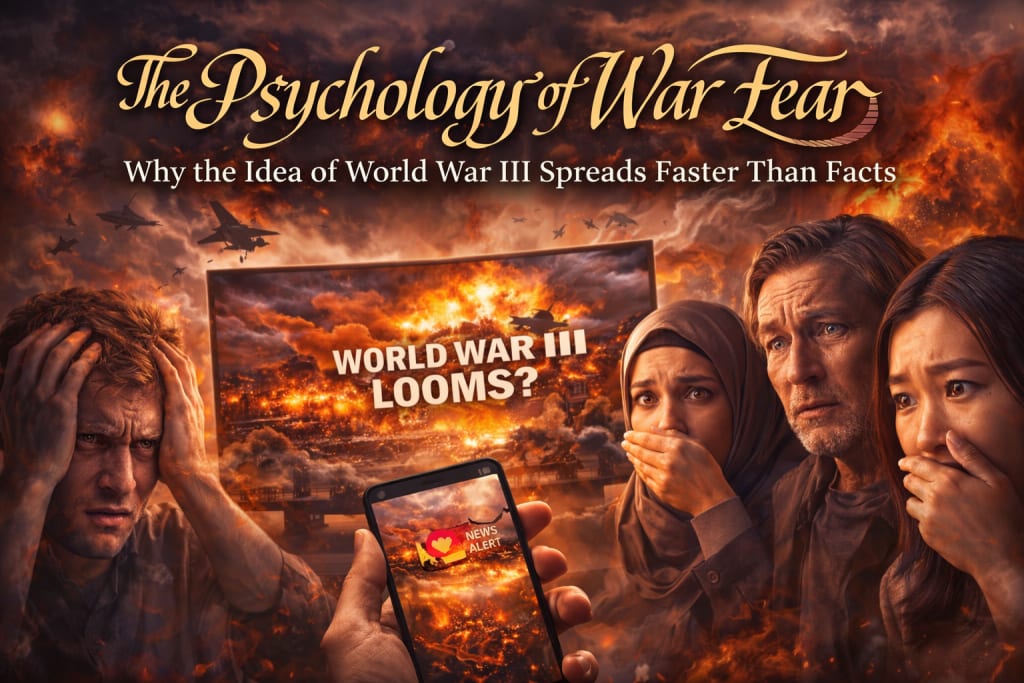
The Psychology of War Fear: Why the Idea of World War III Spreads Faster Than Facts
How uncertainty, media cycles, and human instinct amplify global anxiety

How uncertainty, media cycles, and human instinct amplify global anxiety
Before any missile is launched, before any official declaration is made, something else happens first — fear spreads.
Not across borders.
Across minds.
The phrase “World War III” is not just a geopolitical label. It is a psychological trigger. It carries emotional gravity far heavier than the syllables themselves. When people hear it, they do not process it as neutral information. They experience it as an existential threat.
And that reaction is not irrational. It is evolutionary.
The human brain evolved to detect danger quickly. Thousands of years ago, hesitation could mean death. If you heard a rustle in the bushes, assuming it was a predator increased your odds of survival. The brain became biased toward caution. Better to overreact than underreact.
That survival bias never disappeared. It simply changed targets.
Today, the “rustle in the bushes” is a breaking news alert. A trending hashtag. A political speech. A viral video predicting escalation. The biological machinery is ancient, but the stimuli are modern.
The phrase “World War III” activates what psychologists call threat perception circuitry — primarily involving the amygdala, a small almond-shaped structure in the brain responsible for emotional processing, especially fear. When the amygdala detects danger, it signals the body to prepare: heart rate rises, attention sharpens, stress hormones increase.
Here is the important part: the amygdala does not wait for full evidence. It reacts to possibility.
Uncertainty amplifies this process.
When political leaders exchange aggressive rhetoric, when military exercises dominate headlines, or when analysts speculate publicly about worst-case scenarios, the mind begins filling in gaps. Humans are uncomfortable with incomplete narratives. We prefer closure. When information is ambiguous, imagination steps in.
Psychologists call this catastrophic thinking — the tendency to assume the worst outcome when faced with uncertainty. It is not stupidity. It is a cognitive shortcut. In ancestral environments, assuming danger during uncertainty was safer than assuming calm.
But in the age of 24-hour news cycles, this instinct becomes overloaded.
Modern media ecosystems are structured around attention. And fear captures attention more efficiently than calm analysis. Strong emotion increases engagement. Engagement increases visibility. Visibility increases revenue. This is not necessarily a conspiracy. It is incentive alignment.
Alarming language spreads faster than measured language.
“On the brink.” “Escalation imminent.” “Global conflict looming.”
These phrases are emotionally sticky. They generate urgency. Nuanced discussions about deterrence theory or diplomatic backchannels do not spread with the same velocity.
Social media accelerates the dynamic. Algorithms amplify content that provokes reaction. Anger, fear, outrage — these emotions travel rapidly because people feel compelled to share them. When someone posts a dramatic interpretation of global events, others respond, debate, and repost. Within hours, a speculative statement can feel like consensus.
This creates what psychologists refer to as social proof. If many people appear concerned, individuals interpret that concern as evidence of real danger. Anxiety becomes contagious. Emotional states spread across networks much like viruses.
But there is another layer.
Historical memory.
Even those who never lived through global war inherit its psychological residue. Documentaries, school lessons, films, novels, and family stories create a cultural memory of devastation. Images of mushroom clouds, ruined cities, and mass mobilization are embedded into collective imagination.
The term “World War” does not register as abstract strategy. It evokes existential catastrophe.
Nuclear weapons intensify the imagery. Since the mid-20th century, humanity has lived with the knowledge that large-scale conflict between major powers could have planetary consequences. This awareness forms a psychological backdrop to international tension. The mere suggestion of superpower confrontation reactivates that background fear.
And yet, paradoxically, that same nuclear reality has also shaped modern geopolitics toward restraint.
This is where perspective becomes essential.
While fear spreads rapidly, geopolitical systems are not governed purely by emotion. Modern international relations operate within frameworks of deterrence, economic interdependence, intelligence analysis, and strategic calculation. Major powers are deeply aware of the consequences of full-scale war in a nuclear age.
Deterrence theory, for example, is based on the idea that mutual vulnerability discourages direct conflict. If two nuclear-armed states understand that war would result in catastrophic loss for both, the incentive shifts toward avoidance. This does not eliminate risk, but it changes strategic logic.
Economic globalization adds another layer of constraint. Supply chains, trade agreements, financial markets — these systems are interwoven. Large-scale war would disrupt not just military targets but entire economic structures. Leaders factor these consequences into decisions.
However, the public does not typically see the slow, cautious negotiations happening behind closed doors. What they see are headlines. Speeches. Visible military movements.
The visible signals often appear dramatic.
The invisible signals — diplomatic calls, intelligence assessments, strategic backchannel communications — are quieter.
The human brain reacts more strongly to visible drama than to unseen restraint.
There is also the phenomenon of availability bias. This cognitive bias occurs when people estimate the likelihood of an event based on how easily examples come to mind. If news coverage is saturated with war-related imagery and commentary, the brain interprets the risk as higher than statistical probabilities may justify.
Repetition creates perceived inevitability.
Another psychological factor is loss of control. Large geopolitical events feel beyond individual influence. When people sense they cannot control a threat, anxiety increases. This is why global conflict speculation can feel more overwhelming than local challenges. The scale is immense, and personal agency seems minimal.
Yet history offers a more complex narrative than constant escalation.
Throughout the Cold War, the world experienced multiple crises — the Cuban Missile Crisis being the most famous example — that brought superpowers to the edge of confrontation. Each time, leaders ultimately chose de-escalation. Not because fear was absent, but because cost-benefit calculations prevailed.
Human systems are capable of restraint.
Fear, however, operates faster than analysis.
Emotion activates immediately. Rational evaluation requires time.
This creates the central tension: instinct versus reasoning.
Understanding this dynamic does not mean dismissing risk. Geopolitical tensions are real. Military buildups matter. Political rhetoric influences behavior. Pretending everything is harmless would be naïve.
But reacting to every dramatic headline as imminent global war is equally flawed.
The real psychological battle is internal. It is the struggle between ancient survival wiring and modern informational overload.
Perspective becomes a stabilizing force.
When encountering alarming news, slowing down allows the prefrontal cortex — the part of the brain responsible for rational thinking — to engage. Instead of reacting instantly, analysis can occur. What are the sources? What is confirmed? What incentives shape the framing?
Critical thinking reduces panic without ignoring reality.
It is also helpful to recognize that fear spreads socially. When anxiety appears universal online, remember that digital platforms magnify extreme voices. Calm analysis rarely trends. Sensational predictions do.
Silence often indicates stability.
Most of the time, global systems function without collapse. Diplomats negotiate quietly. Intelligence agencies assess threats. Military planners model scenarios with caution. These processes lack cinematic drama, but they dominate real-world decision-making.
The phrase “World War III” spreads quickly because it compresses complexity into a single catastrophic image. It simplifies tangled geopolitical realities into an emotionally charged narrative.
Facts move slower because they are detailed. Nuanced. Conditional.
But slowness is not weakness.
In a world where information moves at light speed, emotional regulation becomes a strategic skill. Recognizing cognitive biases does not eliminate them, but it weakens their automatic power.
Fear is not the enemy. It is data. It signals that something feels threatening. The task is not to suppress fear but to contextualize it.
Before any missile is launched, fear spreads.
But so can perspective.
And perspective — grounded in understanding human psychology as much as geopolitics — may be one of the most powerful defenses against unnecessary panic in an uncertain world.
About the Creator
Amanullah
✨ “I share mysteries 🔍, stories 📖, and the wonders of the modern world 🌍 — all in a way that keeps you hooked!”
How Do DBT IOP Programs Near Me Help With Emotional Regulation?
Managing intense emotions can feel overwhelming, especially for individuals struggling with mood disorders, trauma, or co-occurring substance use issues. When emotional reactions become difficult to control, relationships, work performance, and overall well-being can suffer. Dialectical Behavior Therapy (DBT) offered within an Intensive Outpatient Program (IOP) provides structured tools to improve emotional regulation and stability.
By Jordan Blake3 days ago in Psyche



Comments
There are no comments for this story
Be the first to respond and start the conversation.