
🩸 The Crimson Cure
In a forgotten town where ketchup is gospel and medicine bleeds, one girl must fight horror with truth.

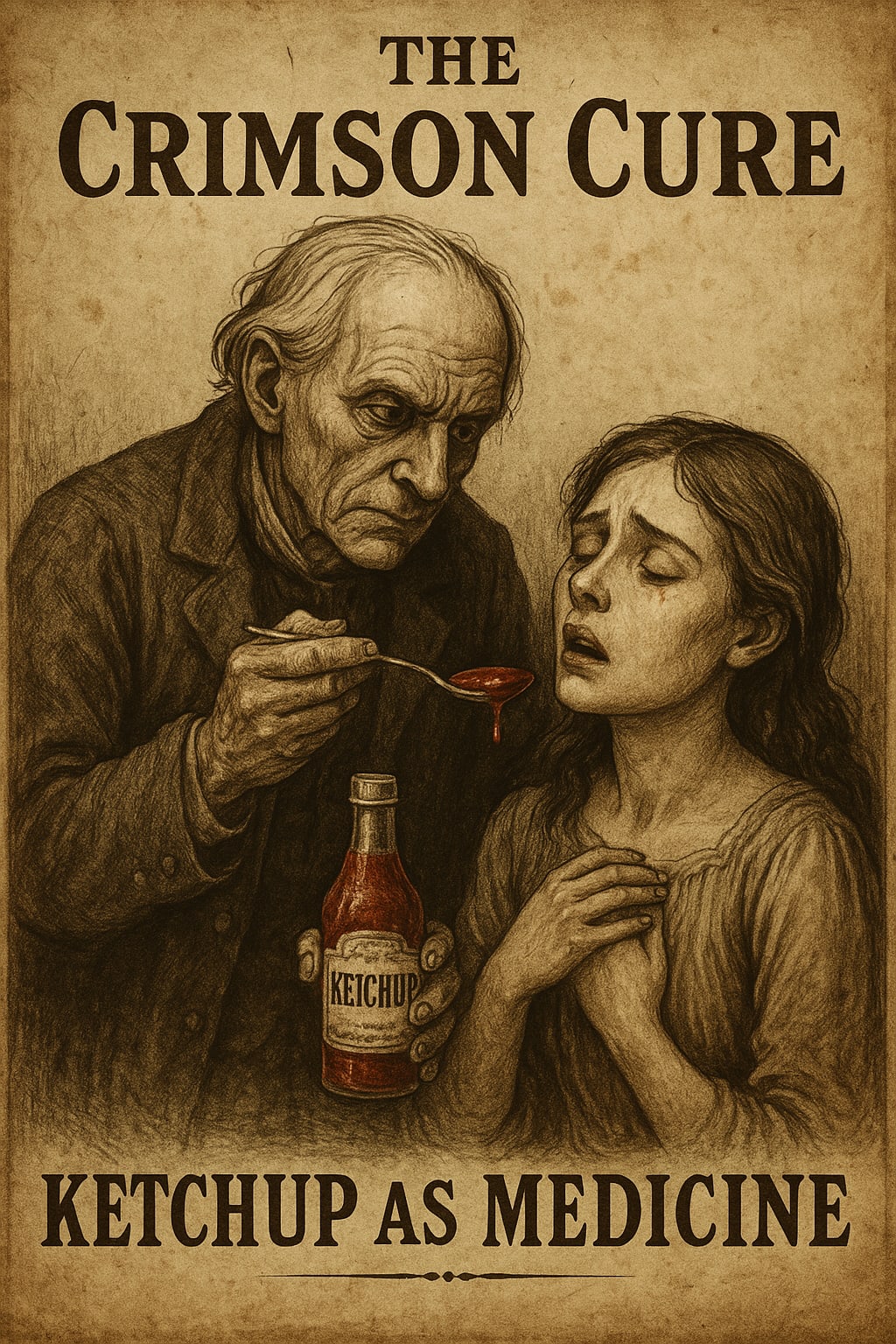
The town of Gorehollow had long been forgotten by maps, satellites, and even God Himself. Tucked beneath the shadow of the Western Ridge, surrounded by the forests that hissed secrets at night, it breathed the suffocating silence of a place left behind. There were no roads in, no roads out—only a rusted train track that hadn't rattled in thirty years and a sign that read:
“Health Is Freedom. Obey the Order.”
To the world, Gorehollow was dead.
But inside it lived Dr. Solomon Trask, a man of peculiar vision and sadistic genius. Once a respected physician and member of the Royal Academy of Surgical Sciences, he had been disgraced for experimenting with biochemical elixirs derived from—of all things—condiments. It had been satire to the world, a joke in the journals. “The Tomato Messiah,” they called him. “Dr. Red.”
But Solomon Trask believed in only two things: pain as a pathway to purity, and ketchup as a cure.
In Gorehollow, there were no clinics. No pharmacies. No whispers of modern pills or stethoscopes. The townspeople, gaunt and glassy-eyed, carried bottles of Trask’s Crimson Cure, labeled in cursive gold, as sacred as the Quran in a shrine.
You had a fever? Take a teaspoon.
A broken leg? Pour it over the bone.
A stroke? Gulp it down and scream, for salvation was painful.
Trask believed that tomatoes, when fermented with leeches and “blood-thinned vinegar,” produced a serum that could “repent the sin inside the body.” He claimed it healed the flesh by punishing it.
And he was adored. Worshipped, even.
But not by all.
Elsa Morven, seventeen, kept her eyes low and her head lower. She had lost her mother to Trask’s red medicine. A minor cough, a single spoonful, and then seizures, howls, vomiting until her skin turned grey. Trask had blamed her “lack of faith.” The town nodded. Elsa had screamed.
Her father, Caleb Morven, once a poet, now limped through life as a storekeeper who spoke in broken phrases and wept without reason.
And Elsa—affectionate, clever, fierce—was waiting.
For justice.
The horror began when a boy arrived.
Peter Vance, a city-bred teen with chestnut curls and a laugh that made Elsa forget she lived in a grave. He came with his aunt—Trask’s new assistant—who claimed he was “sickly and fragile,” sent to recover in the healing climate of Gorehollow.
On the first day, Trask offered him a goblet of the Crimson Cure. Peter sipped. His nose bled. Trask called it “divine bleeding.”
On the third day, he kissed Elsa behind the clocktower and told her, “Your town is mad.” She touched his lips and whispered, “No, it’s dying.”
On the sixth day, Peter collapsed during morning inspection. Trask ordered a full-body marinade. They tied him to a table, stripped him bare, and poured boiling ketchup mixed with crushed herbs over his chest as villagers hummed hymns. Elsa tried to interrupt.
They beat her.
Fear became a being in Gorehollow.
People bled from their mouths and were told it was cleansing. Children wept at night from red-induced hallucinations. Hypertension, strokes, madness—all washed down with teaspoons of Crimson Cure. No one questioned anymore. Fear had twisted into faith.
Elsa and Peter planned escape.
One night, beneath a blood-orange moon, they met at the old train tracks. Peter carried a crowbar. Elsa held a satchel of his aunt’s notes—proof of experiments, of overdoses, of murdered skeptics.
Just as the stars blinked in silent encouragement, Trask appeared.
He walked barefoot, cloaked in a robe of stitched medical gauze, smiling.
“You misunderstand,” he said to Elsa. “It’s not medicine. It’s penance. Humanity is rotten, and rot must be pickled.”
“Then you’re the devil in a chef’s hat,” Elsa snapped.
Trask opened a jar of Cure and threw it at her feet. The glass shattered. Red splattered the dirt like a sacrificed heart.
“I offered redemption,” he said softly, “but you crave justice. Very well.”
What followed was a scene written in madness.
Peter lunged. Trask’s eyes gleamed as he pulled a scalpel. They clashed beneath the pale constellations—young flesh against ancient cruelty.
Peter fell.
Elsa screamed and swung the crowbar with the fury of centuries. It cracked against Trask’s jaw. Then his temple. Then again. And again.
By the time she stopped, he was pulp. Like crushed tomatoes.
They buried Peter near the Hollow Oak. Elsa cried like only the unjustly punished cry—long, loud, full of love and rage. She vowed no one else would bleed for false cures.
She returned to town at dawn, bloodied, broken, carrying the notes.
She stormed the chapel where Trask once preached, unrolled the documents, and read every line aloud. She showed the drawings: children with open veins, women miscarrying after injections, old men screaming as ketchup was funneled down their throats.
There was no applause. Only silence.
Then a sob.
Then another.
Then a scream.
Then a riot.
The townspeople burned the temple. Poured gallons of Crimson Cure into the river until the water turned wine-dark. They smashed the golden-labeled bottles and buried their faces in their hands.
And then they looked at Elsa.
And knelt.
Years passed.
Gorehollow was reclaimed by the maps. Doctors came. Real doctors. The rail line returned.
Elsa became a nurse. She refused injections unless necessary. She believed in love, in conversation, in slow healing. People trusted her. She never spoke of Trask unless asked—and even then, only said:
“He was a man who mistook pain for purity.”
Yet on stormy nights, when the wind howled down from the Ridge, the townspeople claimed they could hear the clang of jars, the whisper of vinegar, and the phrase: “Drink, and be clean.”
And some swore, in the deepest corner of the abandoned chapel, a small red bottle still stood.
Untouched.
Glowing.
Waiting.
Moral:
"The cure that demands your blood may not be a cure at all. Trust not the medicine of tyrants, nor the gospel of pain."
About the Creator
Muhammad Abdullah
Crafting stories that ignite minds, stir souls, and challenge the ordinary. From timeless morals to chilling horror—every word has a purpose. Follow for tales that stay with you long after the last line.
Keep reading
More stories from Muhammad Abdullah and writers in Horror and other communities.
The Girl in Ward 19
There are hospitals that heal, and there are hospitals that remember. St. Elora’s Asylum, built in the 1800s on the edge of a forgotten town in Murree’s chilling highlands, belonged to the latter. Now decrepit, its walls still breathed the whispers of those who had screamed, wept, and begged behind them.
By Muhammad Abdullah9 months ago in Horror
Mon Ange (My Angel)
I was one of Louis XVI’s (sez) many black dot assassins. One wouldn’t suspect a woman, so it was easier to go through the city unnoticed, even without being on the arm of a man. I wore my hair differently (in a tight bun) and wore black street clothes. When I wore my hair in the popular noodle island curls with my signature white long teardrop earrings and my off-the-shoulder red ball gown, I became La Duchesse de DuBarry. While everyone else wore wigs, I slept in braids every night to achieve the curls they thought I naturally had. Oh, the blush was real. In those days a Vitamin D deficiency was favorable.
By Alexandra Fabout 15 hours ago in Horror




Comments
There are no comments for this story
Be the first to respond and start the conversation.