
When 67 Words Changed the Middle East: The Declaration That Sparked the Arab–Israeli Conflict
How the 1917 Balfour Declaration Laid the Political Foundation for a Century of Struggle

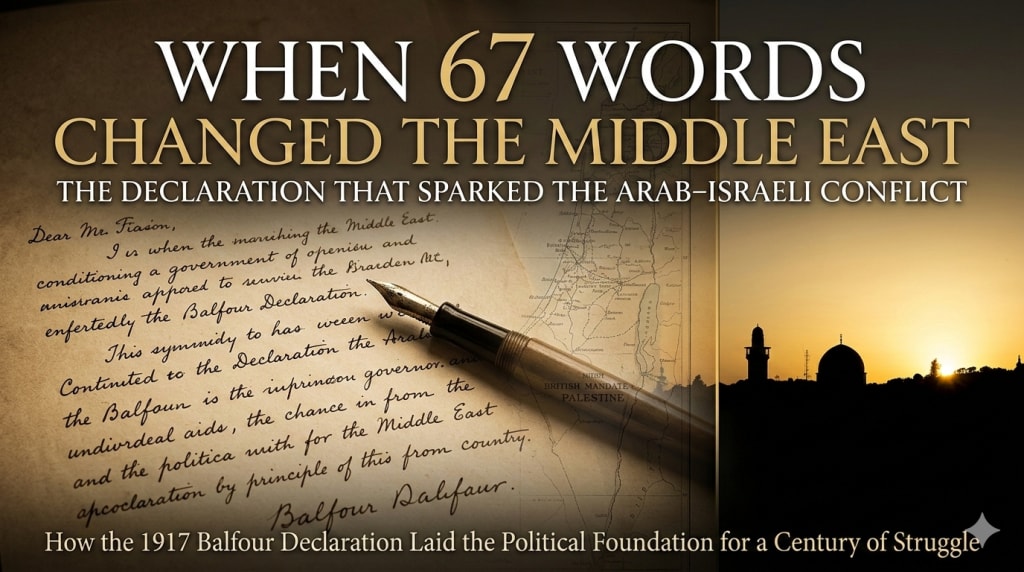
In the long and turbulent history of the Middle East, few political documents have had as profound and lasting an impact as the Balfour Declaration. Written in just 67 words in 1917, this brief letter from British Foreign Secretary Arthur Balfour to Lord Rothschild would go on to shape the destiny of Palestine and lay the foundation for what became the Arab–Israeli conflict. A century later, the consequences of those carefully crafted words continue to influence geopolitics, identity, and regional stability.
The Historical Context
To understand the significance of the Balfour Declaration, one must look back to World War I. At the time, the Middle East was largely under the control of the Ottoman Empire, which had aligned itself with Germany and Austria-Hungary. As British forces fought against the Ottomans, London began planning for the post-war division of Ottoman territories.
At the same time, the Zionist movement—led by figures such as Chaim Weizmann—was lobbying for international support to establish a Jewish homeland in Palestine. Palestine was then home to an overwhelming Arab majority population, consisting mainly of Muslim and Christian Arabs, alongside a smaller Jewish communit
The 67 words
On November 2, 1917, Arthur Balfour issued a letter stating that His Majesty’s Government viewed “with favour the establishment in Palestine of a national home for the Jewish people,” adding that “nothing shall be done which may prejudice the civil and religious rights of existing non-Jewish communities in Palestine.”
Although short, the declaration was deliberately ambiguous. It supported the idea of a Jewish national home but did not clearly define what that meant—whether it implied a state or merely a cultural center. Nor did it explicitly recognize the political rights of the Arab majority living there. The phrase “non-Jewish communities” notably referred to nearly 90 percent of the population at the time, without acknowledging them as a people with national aspirations.
Conflicting Promises
The Balfour Declaration did not exist in isolation. During the war, Britain had also made promises to Arab leaders. Through the McMahon-Hussein Correspondence, British officials appeared to support Arab independence in return for an uprising against Ottoman rule. Meanwhile, the secret Sykes-Picot Agreement between Britain and France planned the division of Ottoman territories into spheres of influence.
These overlapping and contradictory commitments created deep mistrust. Arabs felt betrayed when it became clear that Britain had pledged support to both Arab independence and a Jewish homeland in the same region.
The British Mandate and Rising Tensions
After the war, the League of Nations granted Britain the Mandate for Palestine in 1922. The Balfour Declaration was incorporated into the Mandate’s terms, giving it international legitimacy.
Jewish immigration to Palestine increased significantly in the following decades, particularly as Jews fled persecution in Europe. Land purchases and demographic shifts intensified tensions between Jewish and Arab communities. By the 1930s and 1940s, violence had erupted into open conflict, including Arab revolts and Jewish paramilitary actions.
For Palestinian Arabs, the declaration symbolized colonial imposition and dispossession. For Jews, especially those escaping antisemitism and later the horrors of the Holocaust, it represented hope and international recognition.
The Road to 1948
The growing crisis eventually led Britain to refer the issue to the United Nations. In 1947, the UN proposed partitioning Palestine into separate Jewish and Arab states. Jewish leaders accepted the plan, while Arab leaders rejected it, arguing it unfairly divided land and disregarded the wishes of the Arab majority.
On May 14, 1948, the State of Israel was declared. The following day, neighboring Arab states invaded, beginning the first Arab–Israeli war. Hundreds of thousands of Palestinians were displaced in what they call the Nakba, or “catastrophe.” The conflict that followed would span generations, involving wars, uprisings, peace negotiations, and ongoing disputes over territory, refugees, and sovereignty.
A Legacy Still Unfolding
More than a century after those 67 words were written, the Balfour Declaration remains deeply controversial. Israelis often see it as a milestone in the international recognition of Jewish national aspirations. Palestinians view it as a colonial decision made without their consent, one that ignored their political rights and led to decades of displacement and conflict.
The Arab–Israeli conflict has evolved over time, influenced by regional politics, global powers, and internal divisions. Yet the roots of the struggle trace back to the diplomatic maneuvering of World War I and the decisions made in European capitals about lands far away.
In retrospect, the Balfour Declaration illustrates how brief diplomatic statements can carry enormous historical weight. Its 67 words did not merely express policy—they reshaped a region. Today, debates over history, legitimacy, and justice continue to echo the tensions embedded within that short letter.
History often turns on grand battles and sweeping revolutions. But sometimes, it turns on a single page—signed, sealed, and sent—whose consequences endure for generations.
About the Creator
Irshad Abbasi
Ali ibn Abi Talib (RA) said 📚
“Knowledge is better than wealth, because knowledge protects you, while you have to protect wealth.
Keep reading
More stories from Irshad Abbasi and writers in History and other communities.
Will a War Between Iran, the United States, and Israel Trigger World War III?
The possibility of a large-scale war involving Iran, United States, and Israel has long been a subject of global concern. Political tensions, military confrontations, proxy conflicts, and disputes over nuclear development have created a fragile security environment in the Middle East. Many observers wonder whether a direct war between these powerful actors could escalate into World War III. While such a scenario is not inevitable, the risks and global implications would be enormous.
By Irshad Abbasi about 4 hours ago in History


Comments
There are no comments for this story
Be the first to respond and start the conversation.