
What Seven Soldier Skeletons Reveal About Their Lives.
“A bioarchaeological investigation into the health, origins, and combat history of fallen warriors.”

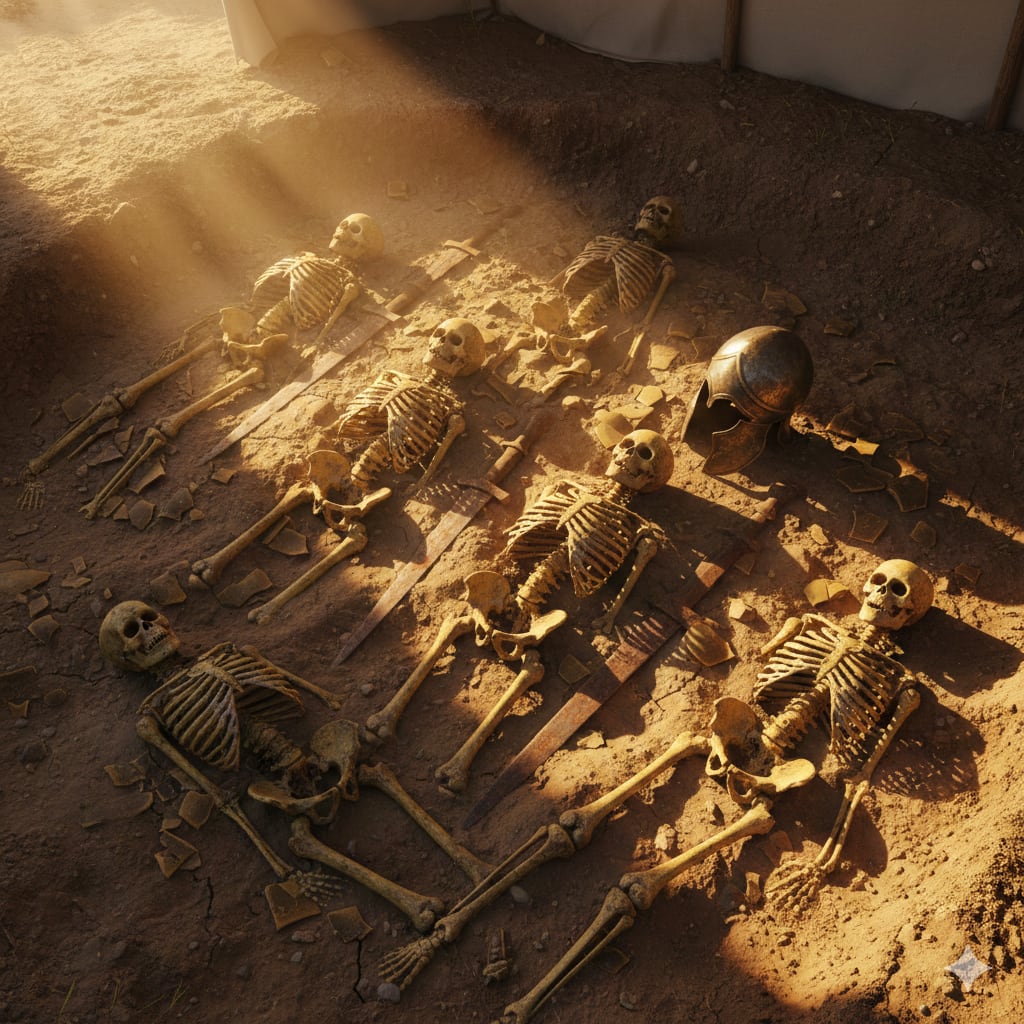
History is often written by the victors, recorded in ink on parchment that celebrates grand strategies and royal decrees. However, the most honest account of war is frequently found beneath the earth, written in the very bones of those who fought it. When archaeologists uncover a mass grave—such as a recent discovery containing the remains of seven soldiers—they aren't just looking at the end of a life; they are opening a biological diary that spans decades.
Through the lens of modern forensic science, bioarchaeology, and DNA analysis, these seven skeletons offer a profound window into the physical reality of the past. Here is what their remains tell us about their lives, their hardships, and their final moments.
1. The Geography of Childhood: Where They Came From
One of the most remarkable breakthroughs in modern archaeology is Isotope Analysis. By examining the strontium and oxygen isotopes trapped in the enamel of a soldier’s teeth, scientists can determine where that soldier spent their childhood. Tooth enamel forms in the early years of life and acts as a chemical "GPS."
In a group of seven, the results are rarely uniform. These tests often reveal whether the men were local defenders or foreign mercenaries. For instance, finding different mineral signatures in the teeth of these seven men might suggest a diverse coalition or a "press-ganged" army where men were pulled from distant villages to fill the ranks. It tells a story of migration, mobilization, and the reach of ancient empires.
2. The Toll of Training: A Biography of Hardship
A soldier’s life is etched into their joints. Osteologists (bone experts) look for "markers of occupational stress." If several of the seven skeletons show asymmetrical bone growth in the right shoulder and a specific thickening of the left forearm, it is a classic sign of long-term archery training—the "archer’s arm."
Alternatively, worn-out vertebrae and stress fractures in the feet speak of long, grueling marches under the weight of heavy packs. If the bones show signs of "Schmorl’s nodes" (spinal lesions), we know these men performed heavy lifting from a young age. These skeletons tell us whether these were professional, elite warriors who trained for a lifetime, or peasants who were suddenly handed a spear and sent to the front lines.
3. Health and Rations: The Quality of Life
The bones also act as a record of health and nutrition. "Harris Lines" (lines of increased bone density) and "Cribra Orbitalia" (pitting in the eye sockets) are indicators of childhood malnutrition or severe bouts of disease.
By analyzing these seven men, we can see the social stratification of their time. Did they have access to protein-rich diets, or do their teeth show the high wear and decay associated with a diet of gritty, low-quality grains? If their teeth are in surprisingly good condition, it suggests a military that cared for its soldiers' health, or perhaps that these men came from a higher social class.
4. The Brutality of the Battlefield
The most harrowing part of the analysis is the "perimortem trauma"—injuries that occurred at or near the time of death. Unlike healed scars from previous battles (which prove a soldier was a veteran), unhealed bone fractures tell the story of the massacre.
Forensics can often reconstruct the "ballet of death" that took place. A clean, sharp-force trauma to the skull might indicate a professional sword strike, while blunt-force crushing suggests maces or the trampling of horses. In mass graves of seven, if the wounds are all to the back of the head, it suggests an execution. If the wounds are defensive (fractures on the forearms), it depicts a desperate, hand-to-hand struggle for survival.
5. Brotherhood in the Final Act
Finally, the "taphonomy"—the way the bodies were arranged—tells us about the culture of the army. Were the seven laid side-by-side with their equipment, indicating they were buried with honor by their comrades? Or were they thrown in haphazardly, tangled together, suggesting a hurried burial by a victorious enemy?
Often, small artifacts found with the bones—a lead seal, a copper button, or a hidden lucky charm—provide the only "personal" touch. These items remind us that these weren't just "skeletons"; they were individuals with families, superstitions, and a sense of duty.
Conclusion: Beyond the Numbers
The discovery of seven soldiers in a mass grave is more than a morbid curiosity; it is a scientific resurrection. By combining DNA profiling with forensic osteology, we move past the "seven" as a statistic and begin to see them as men. We learn about their childhoods in distant lands, the weight of the armor that bent their spines, the diseases they survived, and the violence that eventually claimed them.
These silent witnesses bridge the gap between historical text and human experience, proving that while the "great" men of history may have planned the wars, it is the bones of the common soldier that truly hold the memory of the conflict.
About the Creator
Irshad Abbasi
Ali ibn Abi Talib (RA) said 📚
“Knowledge is better than wealth, because knowledge protects you, while you have to protect wealth.
Keep reading
More stories from Irshad Abbasi and writers in History and other communities.
From Alexander to America: Afghanistan—Graveyard of Empires or Highway of Conquest?
For centuries, the rugged peaks of the Hindu Kush have stood as silent witnesses to the greatest ambitions of mankind. From the bronze shields of Alexander the Great’s phalanxes to the high-tech drones of the United States military, Afghanistan has been the stage for a recurring historical drama. It is often labeled the "Graveyard of Empires," a place where superpowers go to bleed. Yet, a deeper look at history suggests a more complex reality: for many, it was also a "Highway of Conquest," a vital corridor that linked the civilizations of the East and West.
By Irshad Abbasi a day ago in History
Pearl
1980 something. we all hung out at Pearl and you and i were nothing special, or so i thought. i mean we all danced, drenched in our own sweat, our own saline solution of fear, too many beers, shots, laughter, tears, fucks in the bathroom and i don't know when we began to be afraid. do you?
By ROCK aka Andrea Polla (Simmons)6 days ago in Fiction


Comments
There are no comments for this story
Be the first to respond and start the conversation.