
Selim I: The Ottoman Prince Who Ordered the Execution of His Own Family
How Sultan Selim I secured the Ottoman throne through ruthless power, eliminating brothers, nephews, and even his own sons to prevent civil war.

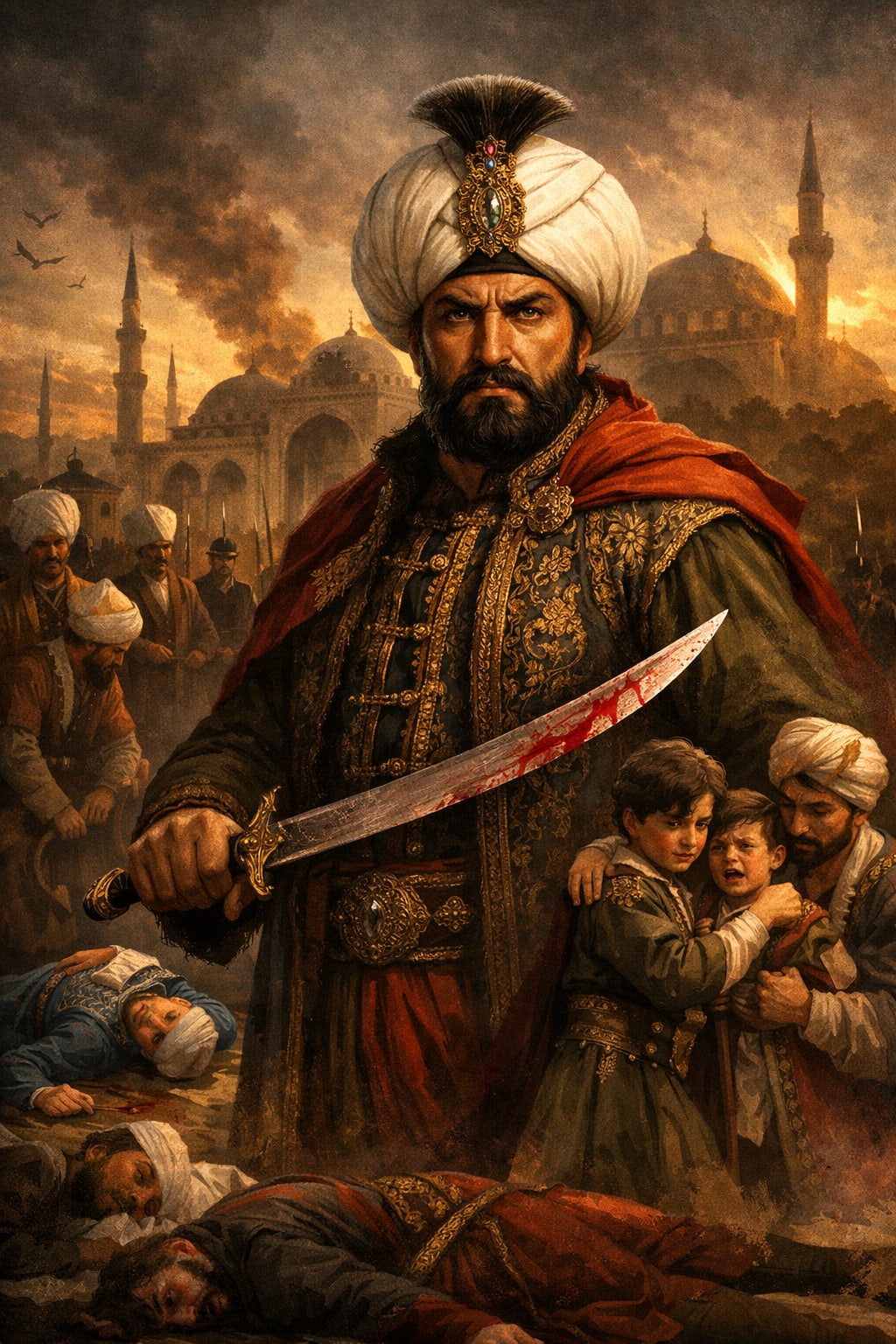
In the long and dramatic history of the Ottoman Empire, few rulers are remembered as fiercely and controversially as Selim I, also known as Selim the Grim. Rising to power in 1512, Selim I transformed the Ottoman Empire into a dominant force in the Islamic world. Yet his reign began with a chilling series of executions that shocked even his contemporaries. To secure the throne, Selim reportedly ordered the deaths of his own brothers, nephews, and even some of his sons—an act that reflected the brutal political realities of the Ottoman dynasty.
The Ottoman Empire had long followed a harsh principle of succession. Unlike many European monarchies that relied strictly on primogeniture (the eldest son inheriting the throne), the Ottomans allowed all princes of the royal family to compete for power. This often led to violent struggles among brothers after the death or removal of a sultan. To prevent long civil wars that could weaken the empire, the Ottomans developed a controversial practice known as fratricide.
The legal foundation for this policy was established during the reign of Mehmed II, the conqueror of Constantinople. In his imperial law code, he permitted a new sultan to execute his brothers “for the sake of the order of the world.” Though brutal, the policy was intended to prevent devastating civil wars that had previously torn apart the empire.
Selim I’s rise to power was itself the result of a bitter struggle. He was the son of Bayezid II, whose later years as sultan were marked by tensions between his sons. Bayezid favored another prince, Ahmed, as his successor. Selim, however, had strong support from the powerful Janissary army and many military leaders who preferred his aggressive and expansionist vision.
In 1512, Selim rebelled against his father. With the backing of the Janissaries, he forced Bayezid II to abdicate the throne. Shortly afterward, the former sultan died while traveling away from the capital, and Selim officially became the ruler of the vast Ottoman domains.
Once on the throne, Selim moved quickly and ruthlessly to eliminate any potential rivals. According to many historical accounts, he ordered the execution of several brothers and nephews who could claim the throne. These killings were carried out by palace officials, often through strangulation with a silk cord, a method traditionally used to avoid spilling royal blood.
Some chronicles also claim that Selim ordered the deaths of numerous male relatives to ensure that no rebellion could arise against him. While the exact numbers are debated among historians, it is widely accepted that he eliminated multiple members of the royal family in the early days of his rule. These actions solidified his authority but also cemented his reputation for severity and harshness.
Despite the bloody beginning of his reign, Selim I proved to be one of the most powerful and transformative rulers in Ottoman history. He quickly turned his attention to external enemies. In 1514, he defeated the Safavid Empire under Shah Ismail I at the famous Battle of Chaldiran, securing eastern Anatolia and weakening Safavid influence.
Selim’s greatest achievement came a few years later when he launched a massive campaign against the Mamluk Sultanate. In 1516–1517, Ottoman forces defeated the Mamluks and captured key cities including Damascus, Cairo, and Jerusalem. This victory brought the holy cities of Mecca and Medina under Ottoman control.
The conquest also led to the transfer of the symbolic leadership of the Muslim world to the Ottoman sultans. Selim adopted the title of Caliph, greatly enhancing the religious authority of the Ottoman dynasty.
By the time of his death in 1520, Selim had expanded the Ottoman Empire dramatically, nearly doubling its territory and transforming it into the most powerful Muslim empire of the era. His successor, Suleiman the Magnificent, would build upon this foundation and lead the empire into its golden age.
Selim I remains a complex figure in history. On one hand, he was a brilliant military leader and a strategic ruler who strengthened the Ottoman state. On the other, the brutal elimination of his own family members at the start of his reign illustrates the harsh realities of dynastic politics in the early modern world.
His story serves as a stark reminder that the pursuit of absolute power in royal courts often came at a terrible human cost.
About the Creator
Irshad Abbasi
Ali ibn Abi Talib (RA) said 📚
“Knowledge is better than wealth, because knowledge protects you, while you have to protect wealth.
Keep reading
More stories from Irshad Abbasi and writers in History and other communities.
When the Caliph’s Head Hung from the Gates of Baghdad
In the early ninth century, the Abbasid Caliphate stood as one of the most powerful empires in the world. Stretching from North Africa to Central Asia, it was a center of wealth, culture, and intellectual achievement. At the height of this golden age ruled the legendary caliph Harun al-Rashid, whose reign is often remembered as a period of prosperity and brilliance. Yet after his death in 809 CE, the empire he left behind descended into a devastating civil war between his own sons—a conflict that would scar the Abbasid state for generations.
By Irshad Abbasi a day ago in History


Comments
There are no comments for this story
Be the first to respond and start the conversation.