
Al-Jahiz: The Muslim Thinker Who Proposed Evolutionary Ideas a Thousand Years Before Darwin
How a 9th-century Islamic scholar laid the intellectual foundations of evolutionary thought long before modern science.

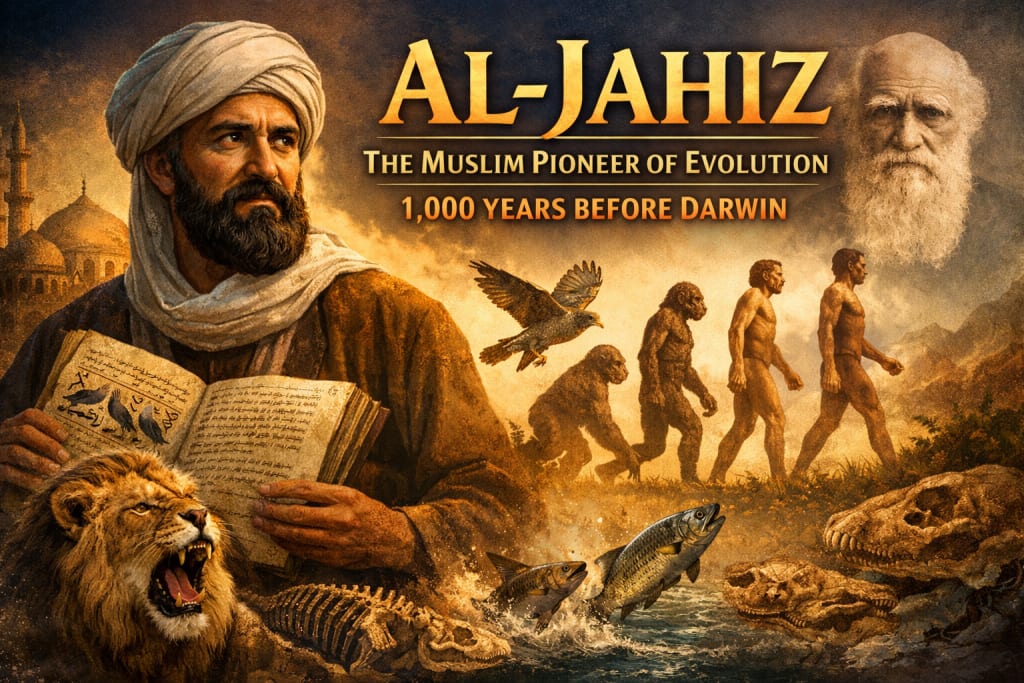
When the theory of evolution is discussed, the name that immediately comes to mind is Charles Darwin, the 19th-century scientist who transformed biology with his groundbreaking work On the Origin of Species. However, what many people do not know is that more than 1,000 years before Darwin, a Muslim scholar from the Islamic Golden Age had already proposed ideas that strongly resemble evolutionary thinking. His name was Al-Jahiz.
Al-Jahiz was not a biologist in the modern sense, but his observations about life, adaptation, environment, and survival make him one of the earliest thinkers in history to articulate concepts that resemble natural selection and evolution. His work shows that scientific thinking did not begin in Europe alone, but was deeply rooted in Islamic civilization centuries earlier.
⸻
Who Was Al-Jahiz?
Al-Jahiz (born around 776 CE in Basra, present-day Iraq) was a polymath—an intellectual who wrote on a wide range of subjects including theology, literature, philosophy, zoology, and social behavior. He lived during the Abbasid Caliphate, a time known as the Islamic Golden Age, when scholarship, science, and philosophy flourished across the Muslim world.
He is best known for his massive encyclopedic work “Kitab al-Hayawan” (The Book of Animals), a multi-volume text that discusses hundreds of species, their behaviors, environments, and interactions with each other. This book is not just a zoological record—it is a philosophical and scientific reflection on life itself.
⸻
Evolutionary Thinking in Kitab al-Hayawan
In The Book of Animals, Al-Jahiz presents ideas that are remarkably similar to what we today call evolutionary theory. Although he did not use modern scientific language, the concepts are clearly present:
1. Struggle for Survival
Al-Jahiz wrote that animals compete with each other for food, safety, and survival. Stronger animals prey on weaker ones, and every species is engaged in a constant struggle to live. This idea closely resembles Darwin’s later concept of the “struggle for existence.”
2. Environmental Influence
He believed that the environment directly affects the characteristics of animals. Climate, food sources, and geographical conditions shape physical traits and behavior. This is similar to the modern idea that environmental pressures drive adaptation.
3. Adaptation and Change
Al-Jahiz suggested that species are not fixed and unchanging. Instead, they change over time in response to their environment. Animals that adapt better survive, while others disappear. This mirrors the core principle of natural selection.
4. Food Chains and Ecosystems
He described interconnected systems where animals depend on one another, forming what we now call food chains and ecosystems—a concept far ahead of its time.
⸻
How Al-Jahiz’s Ideas Compare to Darwin
While Darwin developed a full scientific theory supported by genetics, fossil records, and empirical data, Al-Jahiz approached evolution philosophically and observationally. The key difference is methodology, not concept.
Similarities:
• Both recognized competition for survival
• Both emphasized environmental influence
• Both believed in change in species over time
• Both saw nature as a dynamic system, not static
Differences:
• Al-Jahiz did not develop a formal biological model
• He did not use genetics or heredity (unknown at the time)
• His approach was philosophical, not experimental
Still, the intellectual similarity is undeniable.
⸻
Why Al-Jahiz Matters in History
Al-Jahiz’s work challenges the Eurocentric narrative that scientific thought began only in the West. His writings prove that Muslim scholars were deeply engaged in scientific reasoning centuries before modern Europe.
He represents a tradition where Islam, science, and philosophy worked together rather than against each other. Knowledge was seen as a form of worship, and understanding nature was considered a way to understand the Creator.
⸻
A Forgotten Pioneer of Evolutionary Thought
Although Darwin rightfully holds his place as the founder of modern evolutionary biology, Al-Jahiz deserves recognition as one of the earliest thinkers to articulate evolutionary concepts in human history. He did not invent evolution as a scientific theory, but he clearly laid intellectual foundations that resemble it.
In reality, Darwin did not create the idea of evolution from nothing—he systematized and scientifically proved ideas that humans had been thinking about for centuries.
⸻
Conclusion
Al-Jahiz stands as a powerful reminder that scientific thought is a shared human heritage. More than a thousand years before Darwin, this Muslim thinker observed nature carefully, reflected deeply, and proposed ideas about adaptation, survival, and change that continue to shape modern science.
His legacy proves that the roots of evolution are not limited to one civilization or one era. They are part of a long intellectual journey—one in which Al-Jahiz holds a rightful and honorable place as a pioneer of evolutionary thinking long before the modern age.
About the Creator
Irshad Abbasi
Ali ibn Abi Talib (RA) said 📚
“Knowledge is better than wealth, because knowledge protects you, while you have to protect wealth.
Keep reading
More stories from Irshad Abbasi and writers in History and other communities.
18,000-Year-Old ‘Dog’ Discovered in Siberia, Scientists Left in Awe
A remarkable archaeological discovery in Siberia has stunned the scientific community: the remains of an 18,000-year-old animal believed to be an early form of a domesticated dog. Preserved in the region’s frozen soil, this ancient find is being described as one of the most important discoveries in understanding the origins of the human–dog relationship.
By Irshad Abbasi 3 days ago in History
Timothy Hines and The Red Head: Director Hines’ Unrelenting Drive Behind the True WWII Story of Dutch Resistance Fighter Hannie Schaft Coming to the Big Screen
If Hollywood’s rhythm is measured in cycles, careers often arc from gritty indie beginnings to the glare of mainstream luminosity. For director Timothy Hines, that arc is not only unfolding - it’s about to hit warp speed with The Red Head, a major motion picture in development that promises to redefine his work and introduce the world to one of World War II’s most extraordinary unsung heroes.
By charliesamuel3 days ago in History




Comments
There are no comments for this story
Be the first to respond and start the conversation.