
Is the Open Web Losing to Closed Platform Ecosystems?
As user behavior consolidates inside app stores, social feeds, proprietary marketplaces, and algorithm-governed digital environments, the foundational principles of the open web — decentralization, interoperability, and direct access — are facing mounting pressure from tightly controlled ecosystems that optimize for retention, monetization, and data capture rather than openness.

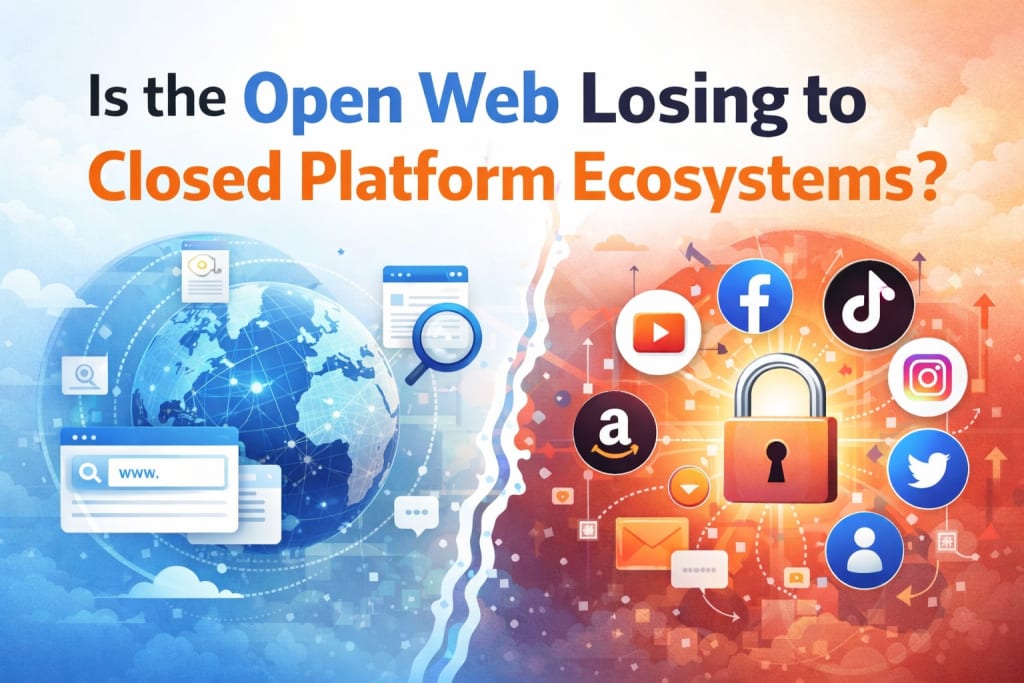
In the early days of the internet, discovery felt expansive.
You typed a URL. You followed hyperlinks. You built a website and, in theory, anyone could find it. No central authority determined visibility beyond search engine ranking. The architecture was messy, decentralized, and surprisingly resilient.
Today, much of digital life unfolds inside closed environments.
Users scroll through curated feeds rather than navigating across independent websites. Applications are downloaded through app stores that dictate approval standards and revenue shares. Content lives inside subscription ecosystems rather than on open domains.
The shift has been gradual, almost imperceptible.
The question now is whether the open web is slowly losing ground — not through collapse, but through quiet migration.
The Migration of Attention
User behavior offers the first clue.
DataReportal’s 2025 global digital report shows that the average internet user spends nearly 6 hours and 40 minutes online daily. Of that time, more than 50% occurs within mobile applications rather than web browsers.
App Annie reports that global app usage exceeded 4.5 trillion hours in the past year. Meanwhile, direct website traffic growth has plateaued in several mature markets.
The browser is no longer the primary gateway to digital interaction.
App ecosystems — governed by Apple and Google — mediate distribution for billions of devices. Revenue models operate within defined rules, with commission rates typically ranging from 15% to 30%.
Access now passes through gatekeepers.
The Economic Incentives of Closure
Closed platforms offer economic advantages to operators.
Subscription ecosystems bundle services under unified billing systems. Streaming platforms host exclusive content unavailable elsewhere. Marketplaces manage payment processing, dispute resolution, and search visibility within controlled parameters.
According to Deloitte’s 2025 Digital Media Trends report, 68% of consumers prefer accessing content through bundled platforms rather than navigating independent websites.
From a business perspective, closed environments increase retention. Bain & Company research suggests that increasing customer retention by 5% can increase profitability between 25% and 95% in subscription-based models.
Control reduces churn.
For platform operators, openness offers less predictability than enclosure.
Algorithmic Visibility vs. Open Discovery
Search engines once functioned as primary discovery engines for web content. Today, algorithmic feeds increasingly replace search-driven navigation.
A Pew Research Center study found that 62% of adults receive news primarily through social media platforms rather than direct visits to publisher websites.
Algorithms prioritize engagement metrics over chronological order. Visibility depends on internal ranking systems rather than hyperlink structures.
This dynamic shifts power from independent publishers to platform owners.
The open web still exists, but its discoverability depends heavily on external platforms.
Developer Dependence and Ecosystem Gravity
Software creators face similar dynamics.
Building for the open web allows greater independence but limits access to built-in payment systems, push notifications, and app store distribution channels.
According to a 2026 Stack Overflow survey, 59% of developers report prioritizing platform-based distribution over standalone web deployment due to monetization convenience.
Even companies engaged in mobile app development San Diego must navigate platform guidelines, store optimization strategies, and revenue-sharing policies when launching products.
The economics of reach often outweigh the philosophical appeal of openness.
Platform gravity exerts force on developers and users alike.
The Data Loop Advantage
Closed ecosystems benefit from consolidated data flows.
User interactions, purchase history, viewing habits, and behavioral signals remain inside controlled environments. This data fuels recommendation engines and targeted advertising.
eMarketer estimates that over 70% of global digital advertising revenue is concentrated among a small number of platform companies.
Data concentration reinforces competitive advantages.
Independent websites may struggle to match personalization capabilities without comparable behavioral datasets.
The open web disperses data. Closed ecosystems centralize it.
Regulatory Friction and Interoperability Efforts
Governments have begun addressing concerns around platform dominance.
The European Union’s Digital Markets Act requires certain large platforms to allow greater interoperability and alternative app distribution methods. Similar regulatory conversations are unfolding in the United States and Asia.
OECD tracking data shows a 40% increase in digital market investigations targeting major platform companies over the past four years.
Yet regulatory efforts face structural challenges. User habits are entrenched. Platform ecosystems offer convenience that many consumers value.
Policy may slow consolidation, but reversing user behavior patterns proves more difficult.
The Resilience of the Open Web
Despite consolidation, the open web retains advantages.
Web standards remain publicly governed. Anyone can publish content without seeking platform approval. Open-source software continues to power much of the internet’s infrastructure.
The World Wide Web Consortium (W3C) maintains open technical standards that ensure interoperability across browsers and devices.
Moreover, web-based technologies such as progressive web apps (PWAs) attempt to combine the accessibility of the open web with app-like functionality.
The open web adapts, even as closed platforms expand.
The Subscription Economy and Content Fragmentation
Streaming services illustrate enclosure clearly.
Content once accessible through broadcast television or shared platforms now resides behind subscription walls. According to Statista, the average U.S. household subscribes to more than four streaming services.
Fragmentation increases costs for consumers while strengthening platform loyalty.
The web once centralized access through hyperlinks. Closed ecosystems fragment access across multiple subscriptions.
Convenience becomes conditional.
Trust, Security, and User Perception
Closed platforms often frame their environments as safer.
Centralized moderation, app review processes, and integrated payment systems reduce certain risks associated with open distribution.
A 2026 Cisco Consumer Privacy Survey found that 79% of users feel more secure purchasing within known platforms than through unfamiliar independent websites.
Security perception reinforces enclosure.
The open web’s freedom comes with variability in quality and protection standards.
Economic Survival for Independent Publishers
Independent websites increasingly depend on platform referrals for traffic.
When algorithm updates reduce reach, revenue declines. Media outlets have experienced traffic drops of over 20% following changes in social media feed ranking systems.
This dependence alters editorial strategy.
Publishers may tailor content to platform algorithms rather than audience needs.
The open web’s sustainability becomes intertwined with platform policies.
Is the Open Web Losing?
The answer depends on definition.
In raw numbers, web traffic remains vast. Billions of websites operate globally. Open standards continue to evolve.
Yet attention, revenue, and control increasingly concentrate within closed ecosystems.
The open web persists structurally, but influence migrates toward platforms that control distribution, data, and monetization.
The shift is not absolute. It is directional.
A Future of Hybrid Coexistence?
The next phase may involve coexistence rather than replacement.
Open protocols could integrate with closed systems. Regulatory frameworks may require interoperability. Developers may build hybrid experiences combining web accessibility with app performance.
Artificial intelligence interfaces may further reshape discovery patterns, potentially redistributing traffic or consolidating it further.
The contest is ongoing.
Architecture as Destiny
The internet’s original architecture emphasized decentralization. Closed ecosystems prioritize coordination and control.
Neither model disappears entirely. Instead, they compete for attention, data, and revenue.
The open web may not be vanishing, but it is adapting under pressure.
The question is less about survival and more about balance.
As users continue migrating into curated digital environments, the foundational ideals of openness face economic and behavioral headwinds.
Whether the open web regains centrality or remains peripheral depends on how technology companies, regulators, developers, and users define the next chapter of digital interaction.
The architecture of the internet is still being written.
About the Creator
Crude Oil Prices and the Cost of Everyday Survival
Every morning, before most of us check the weather, global markets are already reacting to crude oil prices. The numbers rise and fall quietly on trading screens, yet they shape how we live. They influence how much it costs to drive to work, ship groceries across states, or heat a small apartment during winter.
By Muqadas khanabout 20 hours ago in FYI
I wanted to title this something different, but worried that my chosen title might cause problems entering the United States in the future so this is the new title. It's the greatest title. No one has ever written a title better than this. (All titles unrelated to content).
Let me be honest. I am finding this difficult. Now, I like a challenge, a stretch, a bit of an obstacle course. “Write about the decline of the British Empire in the form of a narrative poem in which your protagonist is an artichoke” I read, and flex my fingers. “Write a haiku to evoke the sensation of sibilance using only the first half of the alphabet.” “Well”, I think to myself, “this should be fun.” But “write about a system that isn’t working”? A system that isn’t working? Now? In 2026? ONE system? My favourite system that isn’t working? The sexiest system that isn’t working? The one giving me the most angst day to day? The one giving me the most existential dread? I am, as I say, finding this difficult. I will own that I have contemplated writing a thousand words on why the steady “all on” setting on my fairy lights is the EIGHTH of seven options which must be sequentially activated to get there, because that is a system that some fool came up with and it definitely doesn’t work, and now who is paying the price, eh? But how can I write about my fairy lights when…. When…. When….
By Hannah Moore5 days ago in Humans




Comments
There are no comments for this story
Be the first to respond and start the conversation.