
Essay Topic: What Do You Want to Be in the Future?
A classroom question that exposes the weight of family, fear, and the future

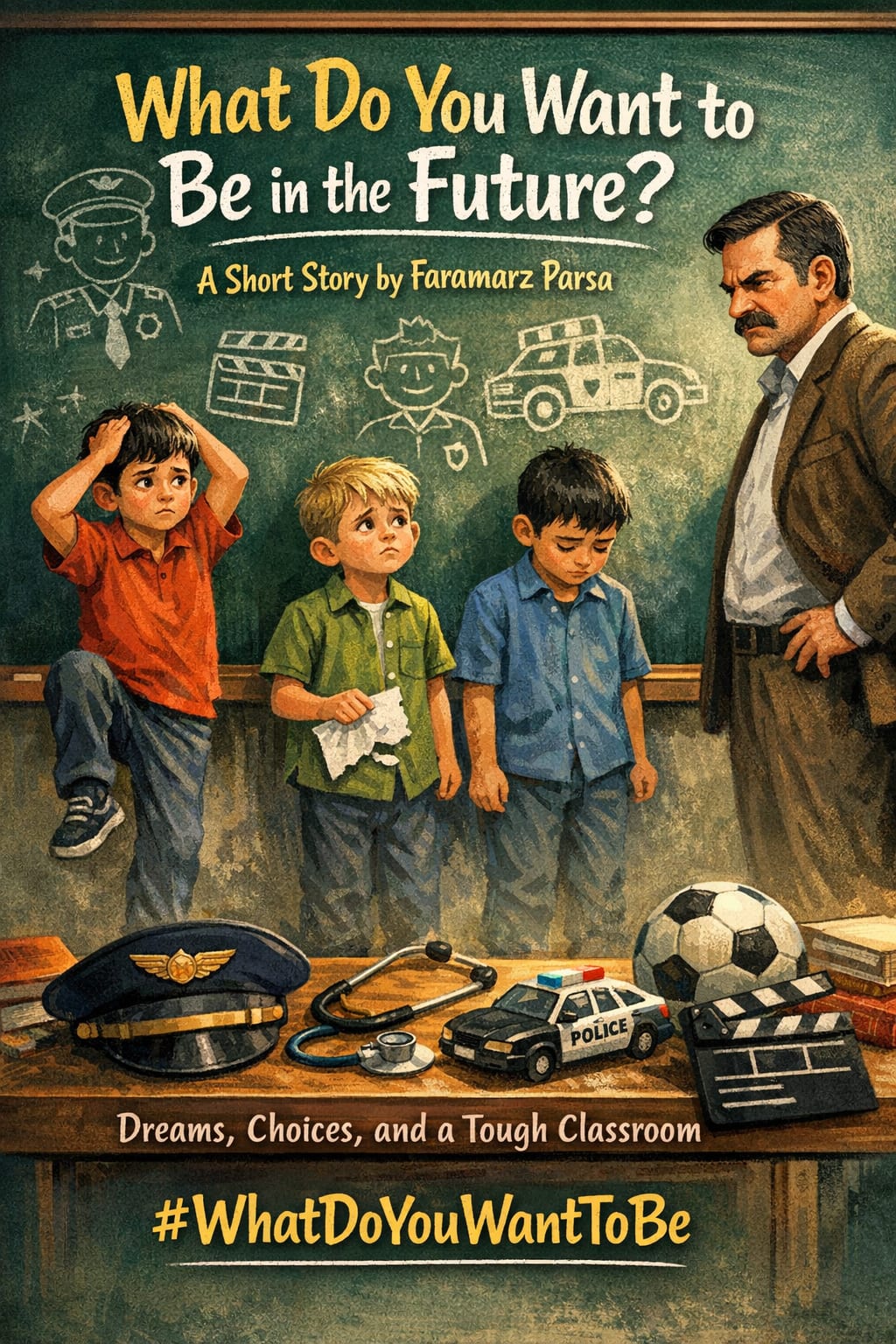
Sometimes a simple question reveals the most complicated truths of life.
“What do you want to be in the future?” seems like an ordinary classroom topic, yet it uncovers the tension between childhood dreams, family pressure, financial limits, and imposed decisions.
This story is a bitter yet honest reflection of a generation that must answer to reality before it is even allowed to dream. A simple classroom — but a mirror of a complex society
Essay Topic: What Do You Want to Be in the Future?
By Faramarz Parsa
The teacher wrote last week’s essay topic on the blackboard: “What do you want to be in the future?” Then he turned to the students and asked, “Is there anyone who didn’t write the essay?”
One student stood up. “Sir, I didn’t.”
The teacher asked, “Why? You had a whole week.”
The student replied, “Sir, when I asked my father to help me with the topic, he said the future can’t be predicted. He said he wanted to become an engineer, but now he’s a truck driver. So I didn’t write mine either.”
The teacher shook his head and said, “Son, I wanted to become a teacher so I could turn students like you into decent human beings. I tried and became a teacher, but I see it’s very difficult to make you decent! Tell me, don’t you have any decision for your own future? Does your father have to decide for you? Don’t you want to think about what you would like to do?”
The student answered, “Sir, no one has ever asked us that question before.”
The teacher said, “Go stand in the corner. Lift one leg and raise your hands above your head!”
Another student said, “Sir, I wrote mine. May I read it?”
“No. Sit down. Those who didn’t write their essays, come outside.”
Two more students stepped forward.
The teacher asked, “Why didn’t you write yours?”
The first one said, “Sir, I wrote it, but my mother said, ‘You’re not allowed to become a police officer!’ Then she tore up my notebook.”
The teacher said, “Tell your mother to come to school tomorrow.”
“Sir, my mother isn’t allowed to leave the house.”
“Then tell your father to come.”
“He leaves early for work.”
“Fine. I’ll come to your house myself! Go sit down.”
He turned to the next student. “What about you?”
“Sir, I want to become a doctor, but my father said it’s impossible because he can’t afford university.”
“Well, you could have chosen another job and written about that.”
“But sir, I want to become a doctor.”
The teacher shouted, “These are just excuses for not writing the essay! You go stand in the corner too—one leg up, hands raised!”
He pointed to another student. “Come, read your essay.”
The student began, “Essay topic: What do you want to be in the future? I want to become an actor and always be a movie star. As my father says, a man should be chivalrous because people always love the heroes in movies. When I become an actor, I’ll help everyone in films and act in foreign movies too. But my brother says I must know foreign languages. I told him, ‘Why? The foreign movies we watch speak our language!’ He said they’re dubbed. I said, ‘Well, the movies I act in will be dubbed too!’ But he didn’t accept it. I must become an actor and travel around the world.”
The teacher said, “Anyone who tries can succeed. Sit down. Next student!”
The next student stood up. “In the name of God. Essay topic: What do you want to be in the future? I want to become a football player and play in big European teams. My older brother says European clubs pay well. In our country, athletes aren’t valued and don’t earn much. I want to play as a striker, score all the goals myself, and become the top scorer.”
The teacher smiled and said, “That’s good, but in football everyone must cooperate. Individualism isn’t good. You must learn that unity and teamwork bring victory. Sit down. The essay period is over. Next week we’ll read the same topic again.”
The following week, the teacher entered the classroom and wrote on the board: “Essay Topic.”
The students read aloud: “What do you want to be in the future?”
The teacher called on a student.
The student began reading: “Greetings to my teacher and classmates. I will briefly read this week’s essay, which continues from last week. To succeed in life, effort is very important. One must study well, not be playful, and listen to the teacher’s advice, which affects our future. In the future, I want to become a pilot—”
The teacher interrupted him. “You didn’t write this yourself. Who wrote it for you?”
“Sir, my father.”
The teacher turned to the class and said, “You must know what you want yourselves. No one else should decide for you. If you don’t love your job, you’ll either be forced to continue it all your life or abandon it halfway—and then half your life will be wasted.”
The student said, “Sir, I actually want to become a merchant like my uncle.”
“Then why didn’t you write what you wanted?”
“My father doesn’t like it because he’s not speaking to my uncle. Since my uncle became wealthy and respected, my father says I must become a pilot. He doesn’t want me to be like my uncle.”
The teacher said, “Your father’s disagreement with your uncle shouldn’t affect your future. The job you like isn’t bad, and there’s nothing wrong with it. But in some matters, you should listen to your parents because they want what’s best for you.”
He called the next student.
The student said, “Sir, I discussed the topic with my older sister. She said two weeks is too short to decide your future career. But since this is just an essay, and when you grow up neither your teacher nor your classmates will see you again, just write something—it doesn’t matter! I said I want to become a heavy truck driver like my uncle. She said no, it’s dangerous. I said I want to become a fisherman
“Stop reading! Stop!” the teacher interrupted. “Is this how you write an essay? I told you to write what you want to become, not argue with your sister! I don’t understand—you can’t even write about a simple topic?”
He glanced at his watch and said, “We don’t have much time left. Until next week—with a new essay topic.”
About the Creator
Ebrahim Parsa
⸻
Faramarz (Ebrahim) Parsa writes stories for children and adults — tales born from silence, memory, and the light of imagination inspired by Persian roots.
Keep reading
More stories from Ebrahim Parsa and writers in Fiction and other communities.
Perhaps Death Is the Collapse of Our Illusion of Being the Center
In a philosophy class, a student asked, “Is death the end of life?” The professor paused. “Before you answer,” he said, “remember this: the universe was moving before you arrived—and it will continue long after you leave.”
By Ebrahim Parsa3 days ago in Fiction




Comments
There are no comments for this story
Be the first to respond and start the conversation.