
Perhaps Death Is the Collapse of Our Illusion of Being the Center
We don’t fear death. We fear a world that keeps going without us.

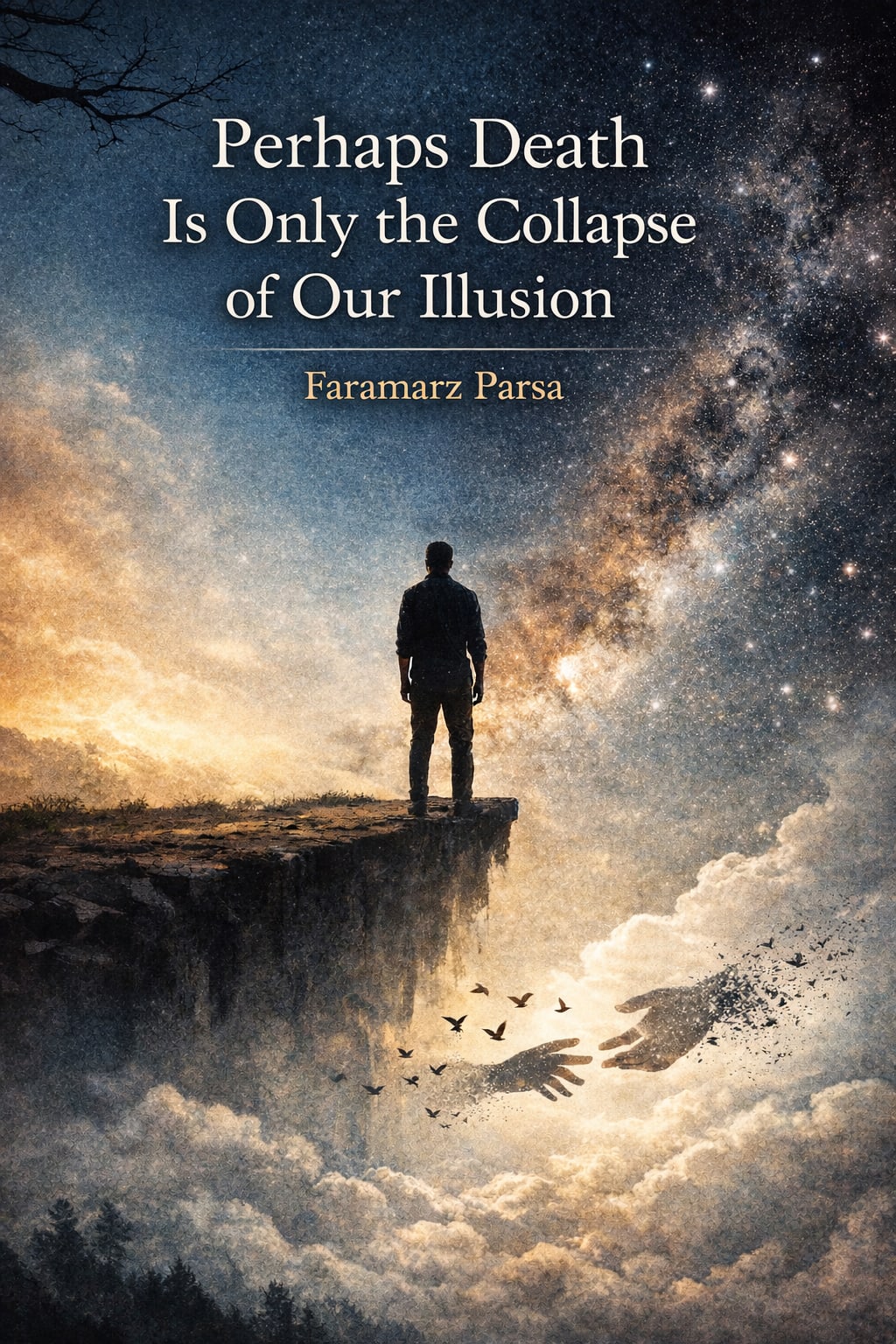
In a philosophy class, a student asked,
“Is death the end of life?”
The professor paused.
“Before you answer,” he said, “remember this: the universe was moving before you arrived—and it will continue long after you leave.”
Silence filled the room.
“We do not fear nothingness,” he continued.
“We fear existence continuing without us.
We fear being irrelevant.”
A student whispered,
“So death isn’t the end… it’s the illusion of an end?”
The professor nodded.
“Death is the fall of the walls of ‘I’—
so we may return to the vastness of the Whole.”
The bell rang.
The students left.
And the world—without hesitation—kept playing its music.
Perhaps Death Is the Collapse of Our Illusion of Being the Center
By Faramarz Parsa
In a philosophy class, a student asked without introduction:
“Professor, is death the end of life?”
The professor, who had been reviewing papers, looked up. He paused—measuring the weight of the question—then stood.
“That’s an interesting question. It’s not part of today’s lesson… but perhaps it matters more than the lesson itself. If you agree, let’s talk about death, nothingness, and existence.”
The class eagerly agreed.
The professor stepped forward and leaned against the desk.
“How many of you believe we return after death?”
Four hands rose.
“How many believe death is the end of existence?”
Twelve hands.
“And who believes death does not exist at all?”
Silence. No hands.
The professor smiled.
“Interesting… in a philosophy class, no one dares to deny death entirely.”
A young woman raised her hand.
“Life always continues. It never stops. We simply enter an opera concert midway and leave before it ends.”
The professor nodded.
“Exactly. The opera was playing before we arrived, it continues while we are present, and it will go on after we leave. Our presence or absence does not alter the music.”
Another student said,
“So death is not an ending… it is the illusion of an ending.”
The professor replied,
“We do not truly fear ‘nothingness.’ We fear existence continuing without us. Our fear is rooted in ego—not in physical reality.”
Silence filled the room.
A student asked,
“Then what is the purpose of our being? We come, we learn, we discover… and before we witness the final outcome, we die.”
The professor spoke softly.
“No one truly knows why we come and why we leave. I don’t know either.”
A young man asked,
“If life continues, are we part of that continuation?”
The professor glanced toward the window.
“Nature is a harsh but honest teacher. Autumn and spring show us that forms change, yet the whole remains. A tree does not mourn its falling leaves, because the roots remember the forest.”
Another student asked,
“Why has humanity always looked at death with fear?”
The professor answered,
“Because we cannot bear being insignificant. The greatest courage is to accept that the universe did not roll out a red carpet for our arrival—and it will not turn off its lights when we leave. When we accept this, fear transforms into peace.”
He paused, then added:
“Death is the collapse of the walls of ‘I’—so that we may return to the vastness of the Whole.”
A student asked one final question:
“Was death called ‘the end’ so that we would stop questioning?”
The professor smiled faintly.
“Perhaps. But the truth is this: we do not fear annihilation; we fear that the world will continue without us.”
The bell rang.
“Good discussion,” the professor said. “We’ll continue another time.”
The students left the classroom quietly.
And the world—without the slightest pause—continued playing its music.
About the Creator
Ebrahim Parsa
⸻
Faramarz (Ebrahim) Parsa writes stories for children and adults — tales born from silence, memory, and the light of imagination inspired by Persian roots.
Keep reading
More stories from Ebrahim Parsa and writers in Fiction and other communities.
Flower Bloom 369
FLOWER Bloom 2/25/26 Wednesday By Mariann Carroll Karen had been with Tony for 7 years. Tony started acting strangely after her surgery. He would mow the lawn in the rain and be on his cellphone. He started pushing Karen away. Tony came clean about seeing someone. Karen moved out two months later. Karen moved in with a friend. She felt betrayed.
By Mariann Carroll5 days ago in Fiction


Comments (2)
🚀 🚀💙💗🌹 WOW🌹💛💗🚀 🚀 🚀 🚀💙❤🌹 LOVE 🌹💛💗🚀 🚀
Nah, there are two directions of “I” collapse and inversion,as eternity is not the limitation but is also the limit of mortality, so the metamorphosis into a reversible state is not the progress of individual development but the depression of the collective. The truth is not Only the “way” of “I” but the paradox of the “am”. Get it? When you do it will blow your paradigm! Good luck🌊 answers are never in you knows, but the know is always predicament of the questioning!