
The Forgotten Wars That Changed the World
Conflicts History Books Rarely Mention but That Shaped Nations
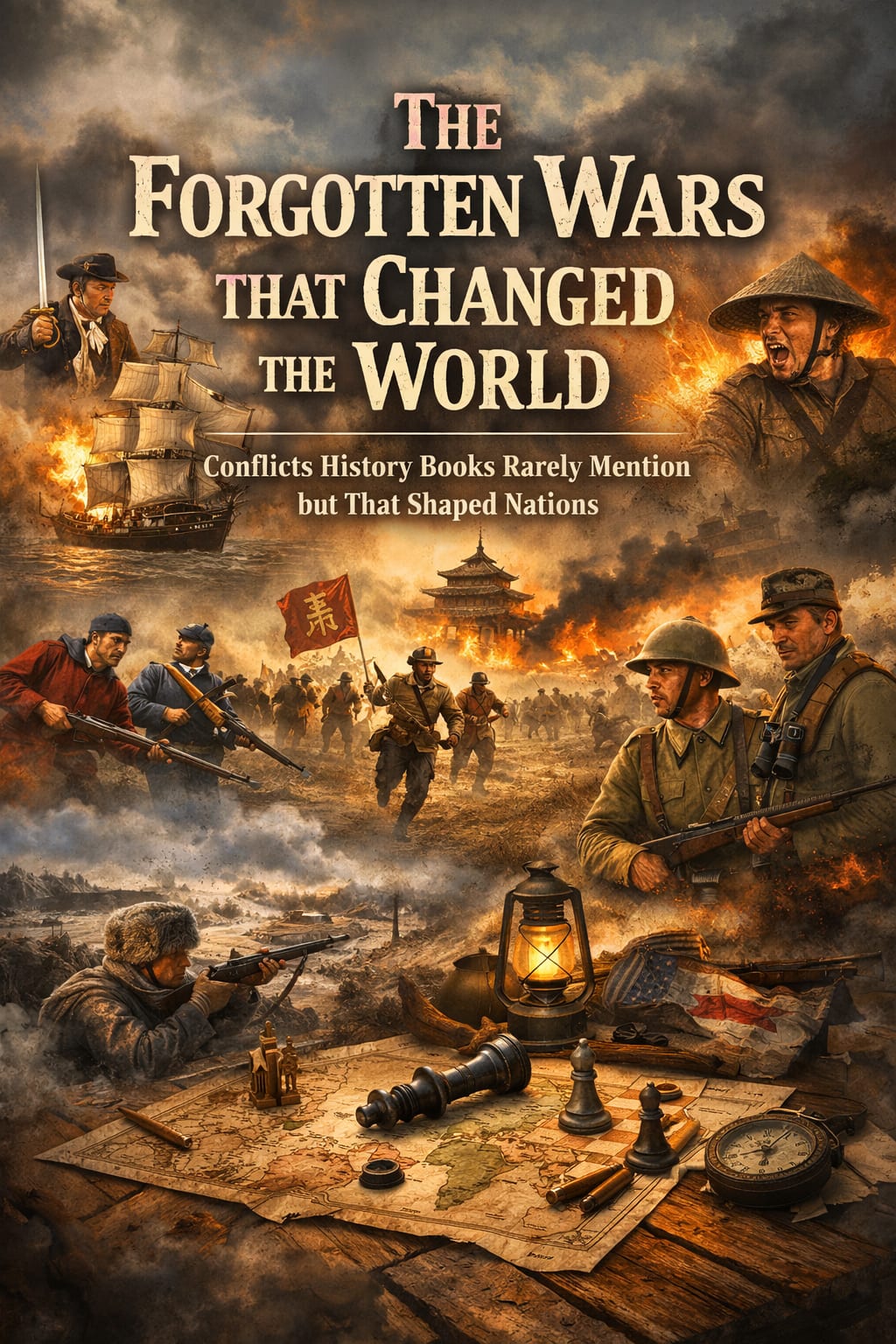
History is often told through the stories of famous wars. Names like the First World War, the Second World War, and the Napoleonic Wars dominate textbooks, documentaries, and public memory. Yet the truth is that many lesser-known conflicts quietly reshaped the world just as dramatically. These wars may not always appear in school lessons, but their consequences still influence modern borders, political systems, and global power structures.
The forgotten wars of history reveal an important truth: even conflicts that seem small or distant can leave lasting marks on humanity.
The War of Jenkins’ Ear (1739–1748)
One of the strangest conflicts in history began with a story about a severed ear. In 1731, a British merchant captain named Robert Jenkins claimed that Spanish coast guards had cut off his ear during a confrontation in the Caribbean. Years later, he reportedly presented the ear to the British Parliament as proof of Spanish aggression.
This dramatic event fueled anger in Britain and became one of the reasons for a war between Britain and Spain. Although the War of Jenkins’ Ear might sound almost comical, its consequences were serious. The conflict was part of a larger struggle for power and trade dominance in the Americas.
The war eventually merged with the broader War of the Austrian Succession, drawing multiple European powers into global conflict. Battles occurred not only in Europe but also in the Caribbean and North America. The war contributed to the growing rivalry between European colonial empires and helped shape the future of global trade routes.
While the story of the severed ear may seem unusual, the conflict highlights how personal incidents and political tensions can ignite wars that affect entire continents.
The Paraguayan War (1864–1870)
The Paraguayan War, also known as the War of the Triple Alliance, was one of the deadliest conflicts in the history of South America. It involved Paraguay fighting against a coalition of Brazil, Argentina, and Uruguay.
At the center of the war was Paraguay’s leader, Francisco Solano López. Determined to expand Paraguay’s influence, López engaged in aggressive military actions that ultimately triggered a regional war.
The conflict quickly turned devastating. Paraguay faced overwhelming opposition from the combined forces of its neighbors. Years of brutal fighting destroyed the country’s infrastructure, economy, and population.
By the time the war ended in 1870, Paraguay had suffered catastrophic losses. Historians estimate that a huge portion of its male population had died during the war. Entire communities were wiped out, and the country’s development was set back for generations.
Despite its enormous impact on South America, the Paraguayan War remains relatively unknown outside the region. Yet its consequences still shape the political and social landscape of the continent today.
The Taiping Rebellion (1850–1864)
Although often categorized as a rebellion rather than a war, the Taiping Rebellion was one of the deadliest conflicts in human history. It took place in China during the Qing dynasty and resulted in the deaths of millions.
The rebellion was led by Hong Xiuquan, a man who believed he was the younger brother of Jesus Christ. Inspired by his religious visions, Hong gathered followers and launched a movement aimed at overthrowing the Qing government.
The rebels established their own state called the Heavenly Kingdom of Taiping. For several years they controlled large territories, including the city of Nanjing, which they made their capital.
The Qing government eventually crushed the rebellion with the help of regional armies and foreign advisors. However, the damage was immense. Entire cities were destroyed, farmland was abandoned, and millions of people lost their lives.
The Taiping Rebellion weakened the Qing dynasty significantly and contributed to the political instability that later led to the fall of imperial China in the early twentieth century.
The Chaco War (1932–1935)
In the early 1930s, Bolivia and Paraguay fought a brutal conflict over a dry and largely uninhabited region called the Gran Chaco. At first glance, the area seemed almost worthless. However, rumors of oil deposits and the strategic importance of the territory sparked intense rivalry.
The war took place in harsh conditions. Soldiers battled extreme heat, limited water supplies, and dense forests. Many died not from combat but from disease, dehydration, and exhaustion.
Despite having fewer resources, Paraguay ultimately gained control of much of the disputed territory. The war reshaped borders in South America and left deep scars in both countries.
The Chaco War demonstrates how natural resources, even those that are only rumored to exist, can lead nations into devastating conflicts.
The Finnish Winter War (1939–1940)
When the Soviet Union invaded Finland in 1939, many observers believed the conflict would end quickly. The Soviet military was massive compared to Finland’s relatively small army. However, the war took an unexpected turn.
Finnish soldiers used innovative tactics and their deep knowledge of the snowy terrain to resist the Soviet invasion. Small groups of Finnish fighters carried out guerrilla attacks, ambushing Soviet troops and disrupting supply lines.
Despite their determination and skill, Finland eventually had to accept peace terms that required them to give up territory to the Soviet Union. Yet the war gained worldwide attention because of Finland’s remarkable resistance.
The Winter War had important consequences. It exposed weaknesses in the Soviet military and influenced strategic decisions during the early stages of the Second World War. It also helped shape Finland’s long-term policy of neutrality between East and West during the Cold War.
The War of the Pacific (1879–1884)
Another conflict that remains relatively unknown outside its region is the War of the Pacific, fought between Chile, Bolivia, and Peru.
The war began over disputes involving territory rich in valuable natural resources, particularly nitrate deposits that were essential for fertilizers and explosives at the time.
Chile eventually defeated the combined forces of Bolivia and Peru. As a result, Bolivia lost its access to the Pacific Ocean and became a landlocked country.
This territorial loss had long-lasting economic and political consequences for Bolivia. Even today, the issue remains sensitive, and Bolivia continues to express interest in regaining access to the sea.
The War of the Pacific is a powerful reminder that control of natural resources can dramatically reshape the destinies of nations.
Why Forgotten Wars Matter
The study of forgotten wars helps us understand the deeper forces that shape history. These conflicts often reveal patterns that repeat across time: competition for resources, political ambition, cultural tensions, and misunderstandings between nations.
While major wars attract global attention, smaller conflicts can quietly transform societies. Borders change, governments fall, economies collapse, and entire populations are affected.
Another reason these wars are important is that they highlight stories that might otherwise be overlooked. The soldiers, civilians, and leaders involved in these conflicts experienced struggles just as significant as those in more famous wars.
Understanding these events helps create a fuller and more accurate picture of world history.
Lessons From History’s Overlooked Conflicts
Forgotten wars also provide valuable lessons for the modern world. They remind us that conflicts do not always begin with grand ideological battles. Sometimes they start with trade disputes, territorial disagreements, or political rivalries that escalate beyond control.
These wars also demonstrate the resilience of people and nations. Finland’s resistance during the Winter War and Paraguay’s struggle during the Chaco War show how determination can shape the outcome of conflicts, even when resources are limited.
At the same time, the devastation of wars like the Paraguayan War and the Taiping Rebellion warns us about the immense human cost of prolonged conflict.
History teaches that wars rarely leave any nation unchanged.
Remembering the Stories History Almost Forgot
The world’s history is far richer and more complex than the few major conflicts most people learn about in school. Hidden within the pages of the past are wars that transformed continents, toppled governments, and reshaped societies.
By exploring these forgotten wars, we gain a deeper understanding of how our modern world was formed. Every conflict, no matter how small it may seem, carries lessons about power, ambition, survival, and human resilience.
The stories of these wars remind us that history is not only written by the most famous events. Sometimes the conflicts that receive the least attention leave the greatest impact.
And in remembering them, we ensure that their lessons are not lost to time.
About the Creator
Keep reading
More stories from Aiman Shahid and writers in Confessions and other communities.
The Life We Imagined vs The Life We Live
When we are young, life feels like an open road stretching endlessly ahead of us. Our dreams are vivid and limitless. We imagine the kind of person we will become, the career we will build, the places we will visit, and the people who will walk beside us. In those early years, the future seems clear and beautifully predictable. We believe that if we work hard and follow the right path, life will unfold exactly the way we imagined.
By Aiman Shahida day ago in Confessions
Shabbat is the seal of the Creation! Six steps of becoming, one step of being! Part 1 A
I was reading :''Historian suggests Willian Shakespeare was actually a black women! Story on .............’. Can you believe that ? come on …Really ? What else are those so called ‘historians' able to say ?
By CA'DE LUCE4 days ago in Confessions
The Politics of Playing Dress-Up
Well, to start off I'd like to say a happy world book day to all who celebrate. I know I haven't really posted anything on my socials about it but I'm not a jubilant kind of person. I lay low most of the time. Let's start off with a popular anecdote from the vaults...
By Annie Kapur7 days ago in Geeks



Comments
There are no comments for this story
Be the first to respond and start the conversation.