
Maritime Patrol Aircraft Market Size & Forecast 2026–2034
Global Naval Modernization and Rising Maritime Threats Propel MPA Demand Toward USD 25.59 Billion by 2034

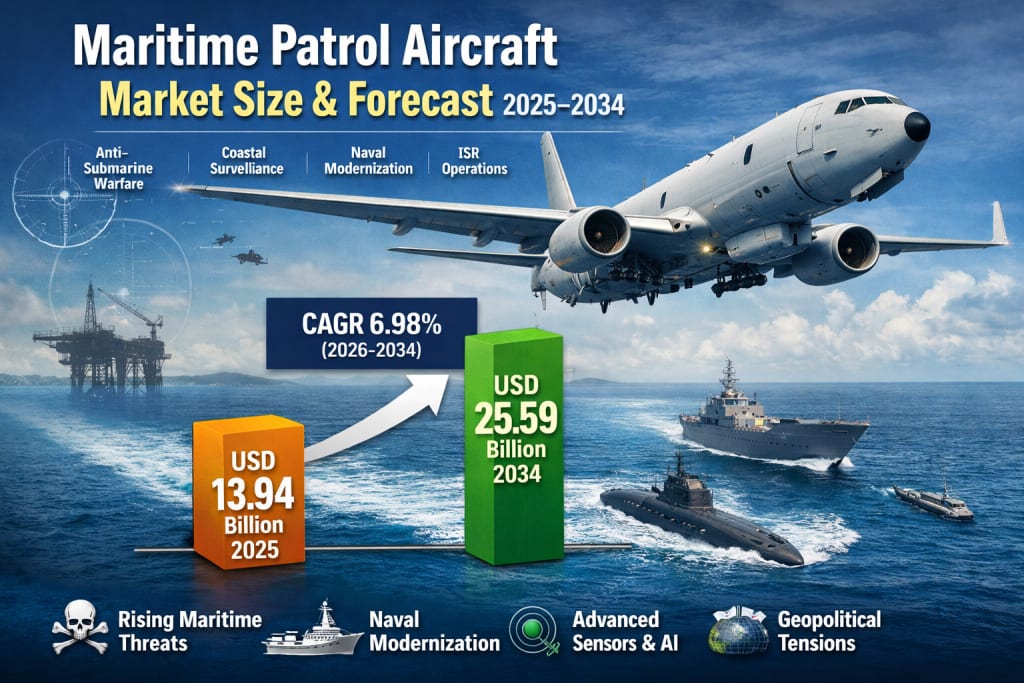
The Maritime Patrol Aircraft (MPA) Market is poised for steady and strategic expansion over the coming decade. According to Renub Research, the market is projected to grow from USD 13.94 billion in 2025 to USD 25.59 billion by 2034, registering a CAGR of 6.98% between 2026 and 2034.
This growth trajectory reflects the intensifying focus on maritime security, expanding naval modernization programs, increasing geopolitical tensions, and the growing need for enhanced intelligence, surveillance, and reconnaissance (ISR) capabilities across global waters.
As sea routes carry nearly 90% of global trade and strategic maritime chokepoints grow increasingly contested, maritime patrol aircraft have emerged as indispensable assets in national defense architectures.
Maritime Patrol Aircraft Market Outlook
Maritime Patrol Aircraft (MPAs) are specialized military aircraft designed for long-range maritime surveillance and operational missions. Their primary roles include:
Anti-Submarine Warfare (ASW)
Anti-Surface Warfare (ASuW)
Intelligence, Surveillance, and Reconnaissance (ISR)
Search and Rescue (SAR)
Monitoring piracy, smuggling, and illegal fishing
Protection of Exclusive Economic Zones (EEZs)
Modern MPAs are equipped with advanced radar systems, electro-optical and infrared sensors, sonobuoys, Magnetic Anomaly Detectors (MAD), secure communication systems, and sophisticated data fusion capabilities. Many contemporary platforms are derived from commercial aircraft, offering long endurance, fuel efficiency, and high reliability while supporting complex mission systems.
With maritime disputes escalating in regions such as the Indo-Pacific, the South China Sea, and the North Atlantic, countries are increasingly prioritizing maritime domain awareness as a cornerstone of national security.
Key Growth Drivers of the Maritime Patrol Aircraft Market
1. Rising Maritime Security Threats
Global maritime environments are becoming increasingly complex. Threats such as piracy, illegal fishing, smuggling, submarine intrusions, and grey-zone operations are pushing nations to strengthen surveillance capabilities.
MPAs provide:
Extended range coverage
Persistent monitoring
Rapid threat identification
Real-time data relay to naval fleets
In February 2025, Airbus Defence & Space, in collaboration with Thales, secured a 24-month contract from the French Defence Procurement Agency to conduct a risk assessment study for a next-generation maritime patrol aircraft. The proposed A321 MPA concept has been described as a “Flying Frigate,” emphasizing autonomy and support for oceanic nuclear deterrence.
Such developments reflect how nations are preparing for long-term maritime strategic competition.
2. Technological Advancements in Sensors and Systems
Technological evolution is redefining the capabilities of MPAs. Modern platforms integrate:
AESA radars
Multi-spectral EO/IR systems
Advanced acoustic processors
Secure satellite communication
AI-enabled threat detection
Network-centric warfare systems
In August 2025, India’s Defense Research & Development Organisation initiated the HALE UAV Development Project to match capabilities similar to MQ-9B systems, addressing capability gaps across the Navy, Air Force, and Army.
Artificial intelligence and real-time data fusion are dramatically enhancing maritime situational awareness, enabling faster decision-making and reduced human workload.
3. Expansion of Naval Modernization Programs
Naval modernization is a primary catalyst for MPA procurement globally. Countries are replacing aging fleets with multi-role aircraft capable of ASW, ISR, disaster response, and joint operations.
Russia has outlined a long-term naval development strategy extending to 2050, committing approximately $100.88 billion toward new naval vessel construction. Such investments indirectly stimulate demand for advanced maritime air capabilities to complement surface fleets.
Interoperability with allied forces—particularly within NATO and Indo-Pacific partnerships—further drives procurement of standardized MPA platforms.
Market Challenges
High Acquisition and Lifecycle Costs
MPAs represent highly sophisticated defense assets integrating mission systems, sensors, and weapons platforms. Acquisition costs, maintenance, training, spare parts, and mid-life upgrades significantly increase lifecycle expenses.
For smaller defense budgets, trade-offs often arise between investing in submarines, drones, or manned patrol aircraft. Cost considerations may delay procurement cycles in emerging markets.
Competition from Unmanned Systems
Unmanned Aerial Systems (UAS) are increasingly performing maritime surveillance tasks at lower operational costs and reduced risk to personnel.
Long-endurance drones offer persistent ISR coverage and satellite-enabled communications. While manned MPAs retain advantages in multi-role combat and complex ASW missions, many intelligence functions are gradually shifting toward unmanned platforms.
Future growth will likely depend on effective manned-unmanned teaming strategies.
Market Segmentation Insights
Armoured Maritime Patrol Aircraft
Armoured MPAs are gaining traction in hostile maritime environments. Enhanced ballistic protection, countermeasures, and reinforced structures enable operations in conflict-prone regions.
With naval operations increasingly conducted near contested zones, survivability features are becoming essential. Emerging economies are particularly investing in robust platforms for maritime interdiction and ASW missions.
Turbofan Maritime Patrol Aircraft
Turbofan-powered MPAs offer:
Higher transit speeds
Longer operational ranges
Heavy payload capacity
Rapid response capability
These aircraft are preferred for multinational missions and large-scale maritime patrol. Though more expensive than turboprops, turbofan MPAs dominate high-end surveillance and complex mission requirements.
Surveillance Maritime Patrol Aircraft
Surveillance-focused MPAs prioritize persistent maritime awareness. Equipped with surface search radars and data-link systems, they support:
EEZ monitoring
Anti-piracy operations
Counter-smuggling enforcement
Illegal fishing detection
Growing global maritime trade and increased vessel traffic ensure sustained demand for surveillance-dedicated platforms.
Reconnaissance Maritime Patrol Aircraft
Reconnaissance MPAs specialize in:
Signals Intelligence (SIGINT)
Electronic Intelligence (ELINT)
Strategic imaging
Pre-conflict threat assessment
As geopolitical competition intensifies, intelligence superiority is becoming central to defense strategy—driving demand for advanced reconnaissance aircraft.
Regional Market Insights
United States
The United States maintains the world’s most advanced maritime patrol aircraft ecosystem. Global force projection, extensive maritime interests, and advanced naval doctrine sustain strong demand.
In 2025, The Boeing Company delivered 127 military aircraft across multiple platforms, reinforcing its strong production capacity.
Continuous upgrades in sensor fusion, weapons integration, and data networking keep U.S. MPAs at the forefront of global capability.
United Kingdom
The UK has revitalized its maritime patrol capabilities in line with NATO commitments. In November 2025, three RAF P-8A Poseidon aircraft from 120 Squadron were deployed to Iceland, marking the RAF’s largest such deployment.
The UK’s emphasis on North Atlantic sea route protection and submarine monitoring reflects renewed strategic focus.
India
India’s maritime patrol aircraft sector is expanding rapidly due to Indo-Pacific security dynamics and its extensive coastline.
In January 2026, Tata Advanced Systems Limited, Airbus, and CABS (a DRDO laboratory) partnered to co-develop a specialized variant of the C-295 transport aircraft.
Indigenous capability development combined with foreign collaboration is shaping India’s long-term MPA growth strategy.
Saudi Arabia
Saudi Arabia’s MPA demand is driven by the need to safeguard coastlines along the Red Sea and Arabian Gulf.
In January 2025, the U.S. approved a $78.5 million sale of MK 54 lightweight torpedoes to Saudi Arabia, strengthening maritime defense readiness.
Modern MPAs with advanced sensor suites are becoming integral to protecting energy infrastructure and shipping routes.
Competitive Landscape
The maritime patrol aircraft market features prominent aerospace and defense leaders, including:
Airbus SE
BAE Systems plc
Dassault Aviation SA
Embraer S.A.
Kawasaki Heavy Industries Ltd
Lockheed Martin Corporation
Textron Inc.
Saab AB
These companies compete on platform innovation, sensor integration, lifecycle support, export partnerships, and defense collaboration agreements.
Market Segmentation Overview
By Type
Armoured
Unarmoured
By Engine Type
Turbofan
Turboprop
By Application
Surveillance
Reconnaissance
Situational Awareness
Others
By Region
North America (United States, Canada)
Europe (France, Germany, Italy, Spain, UK, Belgium, Netherlands, Turkey)
Asia Pacific (China, Japan, India, Australia, South Korea, Thailand, Malaysia, Indonesia, New Zealand)
Latin America (Brazil, Mexico, Argentina)
Middle East & Africa (South Africa, Saudi Arabia, UAE)
Final Thoughts
The Maritime Patrol Aircraft Market stands at the intersection of defense modernization, geopolitical competition, and maritime economic security.
With Renub Research forecasting growth from USD 13.94 billion in 2025 to USD 25.59 billion by 2034, the sector reflects steady, strategic investment rather than cyclical volatility.
While high acquisition costs and competition from unmanned systems pose challenges, the indispensable role of MPAs in ASW, ISR, and maritime deterrence ensures sustained global demand.
About the Creator
Europe Sulphur Recovery Technologies Market Analysis & Forecast 2026–2034
Introduction Europe’s industrial landscape is undergoing a quiet but crucial transformation. As governments tighten environmental regulations and industries move toward cleaner, more sustainable operations, technologies that once worked behind the scenes are now stepping into the spotlight. One such area is sulphur recovery technologies—a critical set of processes used to remove and recycle sulphur from oil, gas, and industrial streams.
By Sakshi Sharma8 days ago in Trader
Australia Agricultural Biologicals Market 2026: Sustainable Farming Shift, Soil Health Innovation and Bio-Input Adoption
Australia Agricultural Biologicals Market Overview Australia’s agricultural biologicals market is experiencing strong expansion as farmers increasingly transition toward sustainable crop production methods that prioritise soil health, environmental safety and long-term productivity. Agricultural biologicals — including biopesticides, biofertilizers and biostimulants — are emerging as eco-friendly alternatives to conventional agrochemicals, supporting integrated crop management and regenerative farming practices. With Australia’s leadership in organic agriculture and rising export demand for residue-free produce, biological inputs are becoming a critical component of modern agricultural strategies.
By Amyra Singh6 days ago in Trader
Trickle Them Down, But Not Out
The thing about smart people is that they should know better, but alas, intelligence is not the same as wisdom. Not only do the mistakes of experts too short on vision—when they are not corrected—have the potential to do great and far-reaching damage, but they also undermine public confidence in the very notion of expertise. This is particularly so when expertise is wielded in defence of the rich and powerful as a cudgel against those laid low. As an academic, this lack of faith in “so-called experts” is painful to see as it plays out in the spread of dis-/misinformation, conspiracy theories, and anti-intellectualism writ large. But it is also an understandable impulse given the catastrophic failure of an economic ideology pushed by certain economic experts. Supply-side economics has shaped a broken system for the last half-century and has arguably done more to undermine the fabric of the American Dream than any policy framework of the past century.
By Cory Wright-Maley7 days ago in Humans


Comments
There are no comments for this story
Be the first to respond and start the conversation.