
India Online Food Delivery Market Size and Forecast 2026–2034
Rapid Digital Adoption, Quick-Commerce Innovation, and Tier-2 Expansion Powering a US$ 269.77 Billion Opportunity

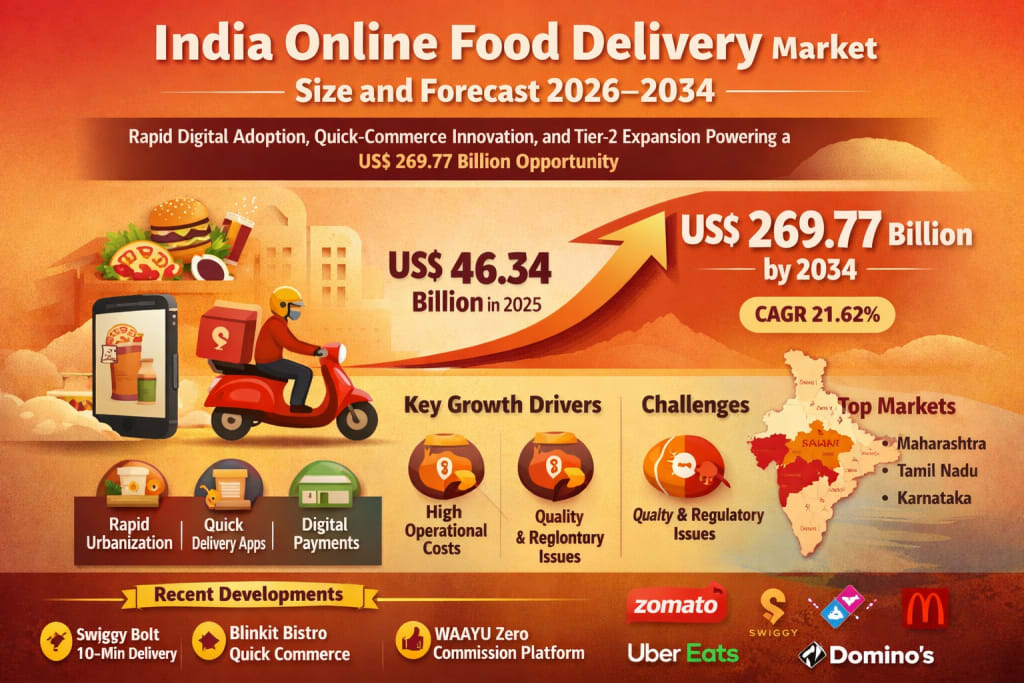
India’s online food delivery ecosystem is undergoing a remarkable transformation. According to Renub Research, the India Online Food Delivery Market is expected to reach US$ 269.77 billion by 2034 from US$ 46.34 billion in 2025, expanding at a CAGR of 21.62% from 2026 to 2034.
This impressive growth trajectory reflects not just rising demand for convenience but also deep structural shifts in India’s digital economy. Increasing smartphone penetration, widespread adoption of UPI and digital wallets, busy urban lifestyles, competitive pricing strategies, platform-driven discounts, diverse cuisine offerings, and rapid expansion into Tier-2 and Tier-3 cities are collectively reshaping how India eats.
Online food delivery is no longer a luxury service for metro cities—it has evolved into a mainstream consumption channel integrated into everyday life.
India Online Food Delivery Industry Overview
The online food delivery market in India enables consumers to order meals from restaurants, cloud kitchens, and cafés through mobile applications or websites. Leading platforms such as Swiggy and Zomato provide extensive cuisine choices, real-time order tracking, seamless digital payments, personalized recommendations, and loyalty benefits.
Urban professionals, students, nuclear families, and dual-income households increasingly rely on delivery platforms for convenience, affordability, and variety. Cloud kitchens—delivery-only kitchens optimized for app-based orders—have emerged as a core component of this ecosystem, enabling scalability and cost efficiency for restaurant operators.
Technological advancements such as AI-driven recommendations, machine learning-based route optimization, predictive demand forecasting, and contactless delivery systems have strengthened operational efficiency. Faster delivery models, including 10–15-minute food delivery services, are redefining customer expectations.
The sector has transitioned from an optional service to an essential digital utility in India’s urban and semi-urban consumption landscape.
Growth Drivers for the India Online Food Delivery Market
1. Rapid Urbanization & Demand for Convenience
India’s rapid urban expansion has intensified demand for time-saving solutions. Long working hours, heavy traffic congestion, growing corporate employment, and nuclear family structures have reduced the time available for home cooking.
Consumers now prefer ordering food via apps rather than dining out or cooking. The availability of multiple cuisines—from traditional Indian thalis to global fast-food chains—adds to the appeal. User-friendly interfaces, live tracking, cashless payments, subscription benefits, and attractive discounts further encourage repeat usage.
Cloud kitchens play a crucial role by reducing rental costs and enabling delivery-focused menu optimization. Their data-driven model allows quick adaptation to consumer trends, improving service efficiency.
Importantly, Tier-2 and Tier-3 cities are emerging as significant contributors. As digital literacy and internet access improve, these cities are witnessing strong adoption rates. Online food delivery is becoming a necessity rather than a discretionary spend.
2. Innovation in Delivery Speed & Service Safety
Speed has become a major competitive differentiator. In January 2025, Swiggy launched its 15-minute food delivery app “Snacc” in select Bengaluru areas, focusing on quick meals, beverages, and breakfast items. The move strengthened competition in India’s growing quick-delivery segment.
Similarly, Zomato introduced its Accelerated Safety Response program in December 2024, integrating crash detection technology within delivery partner apps to automatically dispatch emergency support if required. These initiatives enhance trust, reliability, and user confidence.
Quick-commerce integration is also reshaping the market. Zomato’s quick-commerce arm, Blinkit, launched Bistro, a 10-minute food delivery app competing directly in the rapid-delivery segment. Such models bridge the gap between restaurant dining and grocery-style instant fulfillment.
Faster delivery, enhanced safety protocols, and improved logistics management collectively drive higher order frequency and customer retention.
3. Growth of Digital Payments & Tech-Enabled Ecosystems
India’s fintech revolution has significantly supported food delivery growth. UPI, mobile wallets, and contactless payment methods have reduced checkout friction and enhanced transaction security.
AI-powered recommendation engines analyze user behavior, order history, cuisine preferences, and time-of-day trends to personalize menus. Machine learning improves delivery route optimization, reducing delays and increasing order accuracy.
Subscription programs such as Swiggy One and Zomato Gold boost customer loyalty by offering free delivery, discounts, and exclusive deals. Gamified reward systems further increase engagement.
As consumers grow comfortable with digital transactions, online food delivery becomes a natural extension of everyday lifestyle habits.
Challenges in the India Online Food Delivery Market
1. High Operational Costs & Thin Margins
Despite strong revenue growth, profitability remains challenging. Platforms face high operational expenses related to logistics, delivery partner incentives, fuel costs, marketing campaigns, and discounting strategies.
Maintaining 10–15-minute delivery standards requires high fleet availability, advanced routing systems, and dense restaurant networks. Competitive pricing pressures further reduce margins.
Continuous investment in technology, safety protocols, and cloud kitchen expansion adds to financial strain. Balancing customer affordability with sustainable profitability remains a central challenge.
2. Restaurant Dependence, Quality Control & Regulatory Issues
Platforms rely heavily on restaurant partners, making consistent quality control complex. Issues such as delayed preparation, poor packaging, or hygiene lapses can impact platform reputation even if the fault lies with individual outlets.
Regulatory compliance regarding food safety standards, labor regulations for gig workers, and data privacy laws introduces operational complexity. Urban traffic congestion affects delivery times, while infrastructure gaps in smaller cities can disrupt consistency.
Ensuring uniform service standards across thousands of partner restaurants remains a persistent operational hurdle.
State-Wise Market Insights
Maharashtra Online Food Delivery Market
Maharashtra stands among India’s largest markets for online food delivery, led by Mumbai, Pune, and Nagpur. Mumbai’s fast-paced corporate culture and Pune’s strong IT workforce contribute significantly to daily order volumes.
High disposable incomes, digital adoption, and diverse culinary preferences support robust growth. Cloud kitchens are thriving, supported by strong logistics infrastructure. Tier-2 cities within the state are also witnessing increased adoption as internet penetration improves.
Tamil Nadu Online Food Delivery Market
Tamil Nadu’s market is expanding steadily, with Chennai, Coimbatore, and Madurai acting as major demand centers. Consumers actively order both traditional South Indian cuisine and global restaurant offerings.
High smartphone usage, widespread UPI adoption, and urban employment growth support strong demand. A large student population and IT workforce further sustain order volumes. Expansion into Tier-2 cities continues to strengthen the state’s contribution.
Karnataka Online Food Delivery Market
Karnataka, especially Bengaluru, is among India’s most advanced food delivery markets. The city’s technology-driven population and vibrant startup ecosystem foster rapid adoption of innovations such as AI recommendations and 10-minute delivery services.
Beyond Bengaluru, cities like Mysuru, Mangaluru, and Hubballi are seeing rising usage due to expanding delivery networks and improved digital infrastructure. Continuous technology upgrades make Karnataka a key growth engine for the sector.
Recent Developments
December 2024: Swiggy expanded its 10-minute food delivery service “Bolt” to over 400 cities after initial rollouts in major metros.
December 2024: Blinkit launched “Bistro,” strengthening its position in the quick-food segment.
November 2024: WAAYU introduced a zero-commission delivery platform in Hyderabad and Secunderabad in collaboration with ONDC and the Telangana State Hotels Association, supporting around 3,000 restaurants.
Market Segmentation
By Type:
Platform-to-Consumer
Restaurant-to-Consumer
By Payment Mode:
Cash on Delivery
Online Payments
By Cuisine:
Fast Food
Indian
Chinese
Italian
Others
Top States Covered:
Maharashtra, Tamil Nadu, Karnataka, Uttar Pradesh, Gujarat, West Bengal, Rajasthan, Telangana, Andhra Pradesh, Madhya Pradesh, and Other States.
Competitive Landscape
Major companies operating in the India online food delivery market include:
Zomato
Swiggy
Jubilant FoodWorks Ltd.
Yum! Brands, Inc.
Uber Eats
Domino's
McDonald's
Each company is analyzed across five viewpoints: Overview, Key Persons, Recent Developments, SWOT Analysis, and Revenue Analysis.
Final Thoughts
India’s online food delivery market is on the brink of exponential expansion. With projected revenues reaching US$ 269.77 billion by 2034, the sector reflects the broader digital transformation of India’s consumer economy.
Quick-commerce integration, AI-powered personalization, Tier-2 penetration, and digital payment ecosystems are reshaping competitive dynamics. While operational profitability remains a challenge, continuous innovation, platform partnerships, and technology upgrades will sustain long-term growth.
About the Creator
Sakshi Sharma
Content Writer with 7+ years of experience crafting SEO-driven blogs, web copy & research reports. Skilled in creating engaging, audience-focused content across diverse industries.
Keep reading
More stories from Sakshi Sharma and writers in Trader and other communities.
India Home Automation Market Size and Forecast 2026–2034
India’s home automation market is entering a transformative decade. According to Renub Research, the India Home Automation Market is expected to reach US$ 13.58 billion by 2034, rising from US$ 3.71 billion in 2025, growing at a CAGR of 15.51% from 2026 to 2034.
By Sakshi Sharmaa day ago in Trader


Comments
There are no comments for this story
Be the first to respond and start the conversation.