
Global Smart Textile Market Size & Forecast 2026–2034
Wearables, Healthcare Innovation, and Smart Materials to Propel Market from USD 5.12 Billion to USD 23.5 Billion

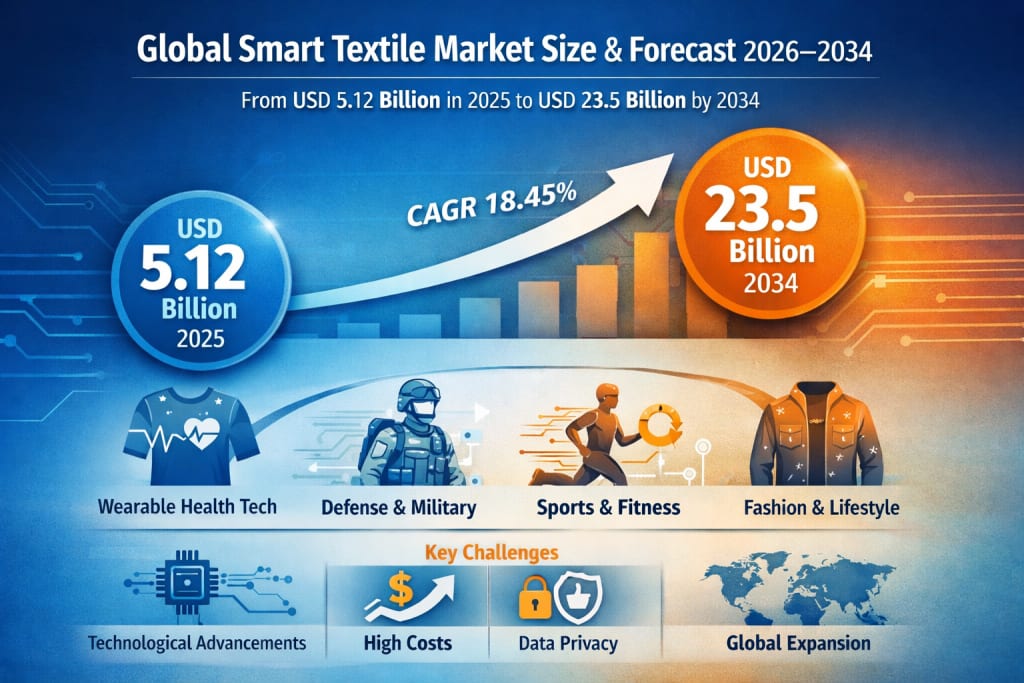
The global smart textile market is entering a transformative decade. According to Renub Research, the Global Smart Textile Market size is anticipated to escalate from USD 5.12 billion in 2025 to USD 23.5 billion by 2034, expanding at a remarkable CAGR of 18.45% between 2026 and 2034.
This sharp growth trajectory reflects a broader technological convergence—where textiles, electronics, material science, and connectivity intersect to redefine how fabrics function. No longer limited to comfort and aesthetics, fabrics today can sense, respond, and even adapt to environmental and physiological changes.
From smart healthcare garments to military protective uniforms and interactive fashion, the smart textile industry is moving from niche experimentation to mainstream commercialization.
Global Smart Textile Market Outlook
Smart textiles—also known as intelligent fabrics or e-textiles—are embedded with advanced technologies such as sensors, conductive fibers, microelectronics, and wireless communication systems. These fabrics can detect and respond to stimuli such as body temperature, heart rate, pressure, motion, moisture, and even chemical exposure.
Smart textiles are typically categorized into three types:
Passive Smart Textiles: Detect environmental or physiological changes
Active Smart Textiles: Detect and respond to changes
Ultra-Smart Textiles: Detect, respond, and adapt autonomously
What differentiates smart textiles from traditional wearables is integration. Instead of attaching a device to clothing, the technology becomes part of the fabric itself—offering comfort, flexibility, and long-term usability.
Globally, rising interest in health monitoring, wearable devices, industrial safety, and performance optimization is driving demand. Additionally, improvements in material science and miniaturized electronics are enabling durable and washable smart fabrics suitable for daily use.
Growth Drivers of the Global Smart Textile Market
1. Rising Adoption of Wearable and Health-Monitoring Technologies
The explosive growth of wearable technology is a primary catalyst. Consumers increasingly demand continuous, non-invasive biometric monitoring—tracking heart rate, respiration, body temperature, sleep patterns, and movement.
Unlike conventional wearable gadgets, smart textiles provide seamless integration without compromising comfort. This makes them particularly attractive in healthcare settings.
For instance, Samsung Electronics announced in June 2025 its plan to develop a digital health hub enabling users to transmit real-time health information directly to physicians. Such developments strengthen the ecosystem for smart health-monitoring garments.
In healthcare, smart textiles are being deployed for:
Remote patient monitoring
Elderly care and fall detection
Post-surgery recovery garments
Smart bandages and bedding
The shift toward preventive healthcare and telemedicine further accelerates adoption.
2. Technological Advancements in Materials and Electronics
Rapid progress in flexible electronics, conductive fibers, and micro-sensors has significantly enhanced durability, washability, and comfort.
Miniaturization of components ensures seamless integration without affecting the look and feel of garments. Wireless communication and energy-harvesting capabilities enable real-time data transmission and self-powered fabrics.
In 2023, Schoeller Textil AG introduced its sustainable "Re-Source" collection, incorporating recycled materials and bio-based spandex fibers. This reflects a dual trend: technological sophistication combined with sustainability.
Manufacturing techniques are also evolving to support scalable production while maintaining quality control—an essential factor for commercial viability.
3. Expanding Applications Across Defense, Sports, and Fashion
Beyond healthcare, smart textiles are gaining strong traction in defense, sports, and fashion industries.
In March 2022, Indian Institute of Technology Delhi partnered with Troop Comforts Limited to develop smart protective clothing for Indian security forces deployed in high-altitude regions like Siachen Glacier. These garments aim to enhance thermal protection and integrate sensors for performance monitoring.
Key application areas include:
Defense & Military: Soldier tracking, fatigue monitoring, environmental sensing
Sports & Fitness: Performance tracking, injury prevention, temperature regulation
Fashion & Lifestyle: Interactive clothing, illuminated garments, customizable designs
Industrial Safety: Monitoring exposure to hazardous environments
The blending of design and technology is attracting tech-savvy consumers and institutional buyers alike.
Market Challenges
High Cost and Limited Commercial Scalability
Despite strong growth prospects, high development and production costs remain a barrier. Integrating sensors and electronics into textiles involves complex manufacturing processes.
Until economies of scale are achieved, pricing remains higher than conventional textiles, limiting mass-market penetration.
Durability, Washability, and Data Privacy Concerns
Smart textiles must withstand repeated washing and physical stress without losing functionality. Ensuring long-term durability remains a technical challenge.
Additionally, since these fabrics collect sensitive biometric data, cybersecurity and data privacy are critical concerns. Secure transmission and storage systems must accompany technological innovation.
Segment Insights
Active Smart Textile Market
Active smart textiles not only sense environmental stimuli but also react. Applications include:
Rehabilitation garments
Posture-correcting clothing
Compression wear
Adaptive temperature-control fabrics
Advances in flexible actuators and conductive threads are pushing active textiles into mainstream healthcare and athletic markets.
Smart Textile Sensing Market
Sensing textiles monitor physiological and environmental parameters such as:
Heart rate
Respiration
Body temperature
Pressure and movement
Air quality
Their non-invasive and continuous monitoring capabilities make them superior alternatives to traditional wearable devices in certain applications.
Smart Textile Thermoelectricity Market
Thermoelectric textiles can generate electricity from body heat or provide active heating and cooling.
These are increasingly used in:
Military uniforms
Outdoor performance gear
Heated medical garments
Extreme climate apparel
As demand for self-powered wearables rises, thermoelectric fabrics represent a promising niche segment.
End-Use Industry Analysis
Defense & Military
Governments worldwide are investing in smart textiles for enhanced soldier survivability. Applications include life-sign monitoring, adaptive camouflage, and chemical hazard detection.
In May 2022, the Intelligence Advanced Research Projects Activity (IARPA) under the U.S. Office of the Director of National Intelligence launched a program to develop sensor-integrated garments capable of recording audio, video, and location data while maintaining washability and flexibility.
Transportation
Smart textiles are being integrated into vehicle interiors, especially in electric and autonomous vehicles. Applications include:
Seat occupancy detection
Stress and posture monitoring
Personalized cabin temperature control
Such innovations enhance safety and passenger comfort.
Architecture
Smart fabrics in architecture include adaptive curtains, façades, and shading systems that respond to light and temperature.
These fabrics improve energy efficiency and support green building initiatives, aligning with global sustainability goals.
Regional Market Insights
United States
The United States leads in innovation and commercialization, driven by strong R&D investments and collaboration between universities, defense agencies, and tech firms.
Companies like Google LLC and Texas Instruments Incorporated contribute to advancements in flexible electronics and sensor integration.
The digital healthcare ecosystem further supports adoption in remote monitoring applications.
United Kingdom
The UK market benefits from expertise in material science and sports science innovation. In April 2023, researchers led by the University of Cambridge introduced next-generation smart textiles embedded with LEDs, sensors, and energy storage components.
The country’s focus on sustainability also drives eco-friendly smart textile development.
India
India’s vast textile manufacturing base provides a strong foundation for growth. Government initiatives such as the Tex-RAMPS scheme (approved in November 2025 with an outlay of ₹305 crore) aim to enhance innovation and data-driven competitiveness.
Collaborations between research institutions and defense agencies further stimulate smart textile innovation.
Saudi Arabia
Saudi Arabia’s smart textile market is emerging under broader digital transformation and economic diversification strategies. Investments in smart cities, healthcare, and climate-responsive clothing create new opportunities.
While domestic production is still developing, partnerships with international technology providers are accelerating market entry.
Competitive Landscape
The global smart textile market features both technology companies and textile innovators. Key players include:
Adidas AG
DuPont de Nemours Inc.
Gentherm Incorporated
Google LLC
Texas Instruments Incorporated
Toray Industries Inc.
Ohmatex A/S
Schoeller Textil AG
Companies are focusing on R&D, sustainability, partnerships, and product portfolio diversification to strengthen market position.
Final Thoughts
The global smart textile market is transitioning from innovation-driven experimentation to large-scale industrial adoption. With revenues projected to grow from USD 5.12 billion in 2025 to USD 23.5 billion by 2034, the industry is poised for substantial transformation.
Healthcare monitoring, defense modernization, sustainable architecture, and interactive fashion are reshaping the value proposition of textiles worldwide. While cost, durability, and data privacy remain challenges, technological advancements and supportive government policies are steadily addressing these barriers.
About the Creator
Sakshi Sharma
Content Writer with 7+ years of experience crafting SEO-driven blogs, web copy & research reports. Skilled in creating engaging, audience-focused content across diverse industries.
Keep reading
More stories from Sakshi Sharma and writers in Trader and other communities.
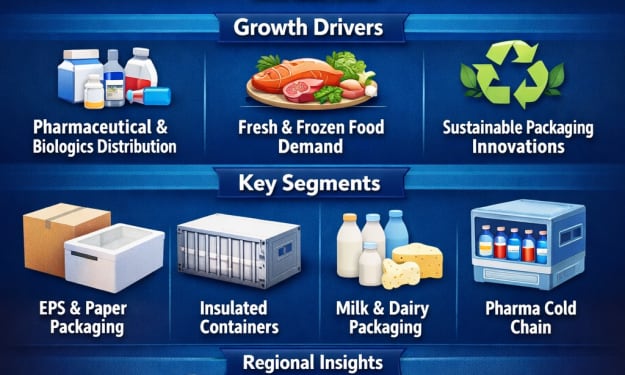
Cold Chain Packaging Market Size & Forecast 2026–2034
The Global Cold Chain Packaging Market is entering a transformative decade. According to Renub Research, the market is projected to grow from US$ 31.73 billion in 2025 to US$ 75.56 billion by 2034, expanding at a strong CAGR of 10.12% from 2026 to 2034.
By Sakshi Sharmaa day ago in Trader
DUOL Stock Today: February 27 — Growth Shift Sparks 20% Slide
Duolingo Inc., trading under the ticker DUOL on the NASDAQ, experienced a sharp 20% slide on February 27, 2026, as market participants reacted to signals of a growth shift in the company’s core business. The drop reflects investor reassessment of revenue momentum, strategic priorities, and overall market expectations for the edtech platform.
By Hammad Nawaz4 days ago in Trader
Tesla Inc.: A Stock Built on Vision, Disruption, and Long-Term Conviction
Tesla Inc. is not a typical automotive company, and its stock does not behave like one either. For many investors, Tesla represents a belief in the future—electric mobility, clean energy, and autonomous technology. For others, it is a volatile stock driven by bold promises and aggressive expectations. Understanding Tesla as an investment requires looking beyond car deliveries and focusing on the company’s broader mission and disruptive strategy.
By Hammad Nawaz6 days ago in Trader
REEEEEEEEE!
I'm on a low road right now. There are a literal million things to do and not one of them worth my time. I would rather sit in place and burn but the orbit takes me on its inevitable route 'round the center; and I a center in my own right, around which others orbit, and so on and so forth, ad infinitum, ad nauseum.
By C. Rommial Butlerabout 22 hours ago in Poets



Comments
There are no comments for this story
Be the first to respond and start the conversation.