
Dark Chocolate Market Size and Forecast 2026–2034
Health-Driven Indulgence and Premium Innovation Powering a US$ 91.69 Billion Opportunity

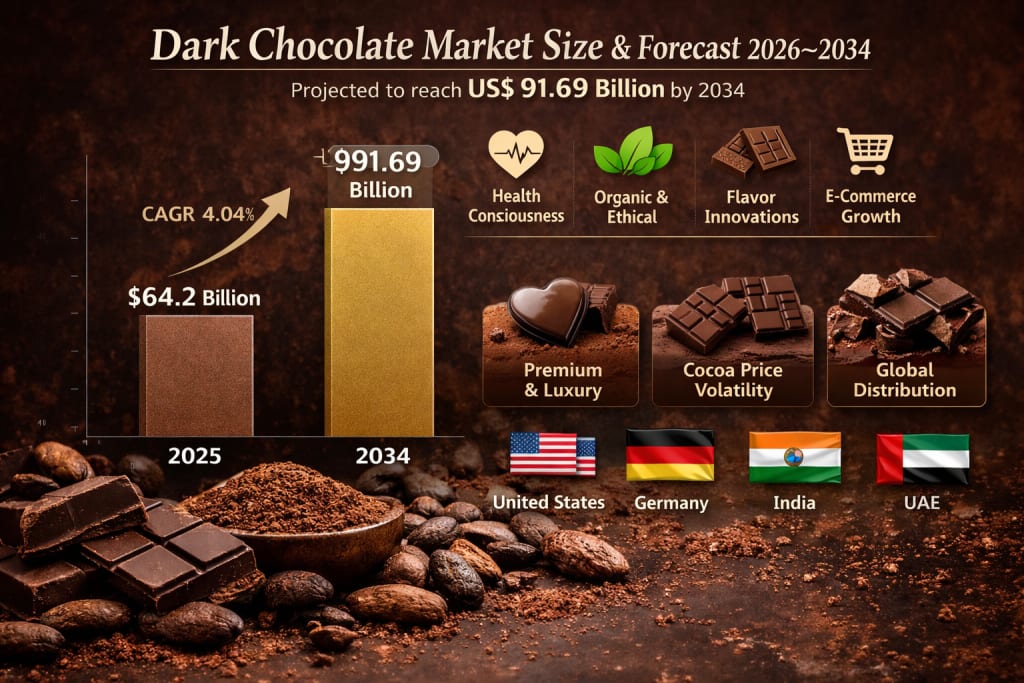
The global Dark Chocolate Market is entering a transformative decade. According to Renub Research, the market is projected to grow from US$ 64.2 billion in 2025 to US$ 91.69 billion by 2034, expanding at a CAGR of 4.04% between 2026 and 2034. This steady growth reflects a powerful shift in consumer behavior: indulgence is no longer just about taste—it is about wellness, sustainability, authenticity, and premium experiences.
Dark chocolate has evolved from a niche confectionery product into a mainstream health-oriented indulgence. With rising health awareness, demand for organic and ethically sourced products, innovative flavor launches, and strong retail as well as e-commerce penetration, the industry is witnessing structural expansion across both developed and emerging economies.
Dark Chocolate Industry Overview
The dark chocolate industry has experienced significant growth over the past decade, driven by consumer awareness of its potential health benefits. Unlike milk chocolate, dark chocolate contains a higher percentage of cocoa solids, which are rich in antioxidants and flavonoids. These compounds are often associated with cardiovascular health, cognitive support, and anti-inflammatory benefits.
As global consumers increasingly seek “better-for-you” indulgences, dark chocolate has gained traction among health-conscious buyers, fitness enthusiasts, and older demographics focused on nutritional value. Millennials and Gen Z consumers, in particular, are drawn to the bold and intense flavor profiles of high-cocoa-content chocolate.
The industry is also defined by continuous innovation. Manufacturers are experimenting with:
Single-origin cocoa sourcing
Organic and fair-trade certifications
Exotic inclusions like chili, sea salt, matcha, berries, and nuts
Sugar-free and plant-based variants
Premiumization has positioned dark chocolate as a luxury item rather than a simple snack. Elegant packaging, artisanal branding, and limited-edition launches enable brands to command higher margins.
Technological advancements in roasting, conching, tempering, and packaging have improved flavor consistency and shelf life. Meanwhile, e-commerce platforms allow direct-to-consumer sales, subscription boxes, and international distribution.
However, the industry also faces risks. Cocoa price volatility, climate change, supply chain disruptions, and competitive intensity remain key concerns. Despite these challenges, dark chocolate’s positioning as a functional and premium indulgence ensures resilient long-term growth.
Growth Drivers of the Dark Chocolate Market
1. Rising Health Awareness and Functional Benefits
Health consciousness is one of the strongest growth drivers in the market. Dark chocolate, particularly variants with 70% or higher cocoa content, is widely promoted for containing antioxidants and flavonoids.
Consumers increasingly associate dark chocolate with:
Heart health support
Improved mood and mental clarity
Reduced sugar consumption compared to milk chocolate
Clean-label ingredients
Manufacturers leverage these perceptions by highlighting cocoa percentage, minimal additives, and organic certifications. As global awareness of lifestyle-related diseases increases, dark chocolate benefits from being perceived as a “guilt-free indulgence.”
2. Premiumization and Flavor Innovation
Premiumization continues to reshape the market. Consumers are willing to pay more for high-quality cocoa, sustainable sourcing, and unique flavor combinations.
Brands are introducing:
70%, 75%, 80%, and even 90% cocoa variants
Single-origin cocoa from Africa, Latin America, and Asia
Fusion flavors such as chili-mango, sea salt-caramel, and espresso
Luxury packaging and gifting solutions further enhance perceived value. In urban markets and developed economies, dark chocolate is often positioned as an affordable luxury item.
3. E-Commerce Expansion and Global Distribution
Digital transformation has significantly supported market growth. Online retail allows access to imported and niche chocolate brands that may not be available in physical stores.
Benefits of e-commerce include:
Wider product selection
Subscription services
Personalized recommendations
Global brand accessibility
Emerging markets are witnessing increased online chocolate sales due to rising smartphone penetration and digital payment adoption. Efficient cold-chain logistics and improved packaging technologies also ensure product quality during shipping.
Challenges in the Dark Chocolate Market
Cocoa Price Volatility
Cocoa production is concentrated in regions vulnerable to climate change and political instability. Weather fluctuations, crop diseases, and supply chain disruptions can cause significant price swings. This directly impacts manufacturing costs and profit margins.
Brands relying on premium cocoa sourcing face additional pressure to maintain ethical and sustainable procurement standards.
Intense Competition and Price Sensitivity
The market includes multinational corporations, regional players, and artisanal chocolatiers. Differentiation requires investment in branding, innovation, and sustainability certifications.
In emerging economies, price sensitivity can limit adoption of premium dark chocolate products. Balancing affordability and quality remains a strategic challenge.
Country-Level Insights
United States Dark Chocolate Market
The United States represents a mature yet expanding market. Consumers increasingly view dark chocolate as a functional snack aligned with wellness trends.
Premium and organic offerings from companies such as The Hershey Company and Mondelez International, Inc. cater to affluent and health-conscious buyers.
E-commerce and specialty stores play a crucial role, while sustainability and transparent labeling influence purchasing decisions. The U.S. market continues to grow steadily due to innovation and strong retail infrastructure.
Germany Dark Chocolate Market
Germany is one of Europe’s most sophisticated chocolate markets. Consumers prioritize quality, ethical sourcing, and high cocoa percentages.
Premium brands such as Chocoladefabriken Lindt & Sprüngli AG enjoy strong demand. Organic and fair-trade certifications significantly influence buying behavior.
Innovation in flavor combinations and gift packaging sustains growth in this mature market.
India Dark Chocolate Market
India’s dark chocolate segment is expanding rapidly, supported by rising disposable incomes, urbanization, and Western lifestyle influence.
Traditionally dominated by milk chocolate, the market is witnessing growing acceptance of darker variants. Domestic players like AMUL Industries Pvt Ltd are expanding their premium chocolate portfolios.
Urban millennials and Gen Z consumers are key drivers, especially through e-commerce and modern retail chains.
United Arab Emirates Dark Chocolate Market
The UAE market benefits from high purchasing power and a strong gifting culture. Premium and imported brands are highly popular.
Consumers favor high-cocoa-content and artisanal chocolates. Sustainability, luxury packaging, and international brand reputation significantly influence purchasing behavior.
Recent Developments
The market continues to evolve through product innovation and strategic expansion:
May 2025: HU introduced wrapped Dark Chocolate Bites in flavors such as Creamy Coconut and Hazelnut Butter.
November 2024: Awake Chocolate launched Salted Almond and Salted Caramel Dark Chocolate variants.
March 2024: Cargill Inc. launched block chocolates and cocoa powder products under its NatureFresh Professional brand.
January 2024: Nestlé S.A. introduced a 70% dark chocolate variant under the KitKat brand.
These launches highlight the growing emphasis on premium flavors and higher cocoa content.
Market Segmentation
By Type
70% Cocoa Dark Chocolate
75% Cocoa Dark Chocolate
80% Cocoa Dark Chocolate
90% Cocoa Dark Chocolate
By Application
Confectionery
Functional Food & Beverage
Pharmaceuticals
Cosmetics
By Distribution Channel
Convenience Stores
Supermarkets and Hypermarkets
Non-Grocery Retailers
Others
By Region
North America
Europe
Asia Pacific
Latin America
Middle East & Africa
Competitive Landscape
Leading companies shaping the global dark chocolate market include:
Nestlé S.A.
The Hershey Company
Mondelez International, Inc.
AMUL Industries Pvt Ltd
Meiji Holdings Co. Ltd.
Saputo Inc.
Chocoladefabriken Lindt & Sprüngli AG
Hotel Chocolat Group plc
Companies are evaluated across five key viewpoints: Overview, Key Persons, Recent Developments, SWOT Analysis, and Revenue Analysis.
Final Thoughts
The global dark chocolate market stands at the intersection of indulgence and wellness. With projected growth from US$ 64.2 billion in 2025 to US$ 91.69 billion by 2034, the industry demonstrates stable and sustainable expansion.
Health consciousness, premiumization, ethical sourcing, and digital distribution are transforming dark chocolate from a simple confectionery item into a sophisticated lifestyle product. While cocoa price volatility and competitive pressure remain challenges, innovation and strong consumer demand continue to create opportunities.
As consumers increasingly seek indulgences that align with their values and health goals, dark chocolate is well-positioned to maintain its upward trajectory through 2034 and beyond.
About the Creator
Despite tensions in the trade, investors flock to safe-haven metals, driving up silver prices by 6%.
As a hedge against global uncertainty, silver prices have recently surged significantly, surprising many market observers by outperforming gold and attracting significant investor interest. In late February 2026, silver climbed more than 6% in a short period, fueling speculation about whether the metal could continue its momentum and potentially test new price milestones in the months ahead. The surge reflects a combination of geopolitical tensions, shifts in supply-demand dynamics, and renewed focus on precious metals as risk-off assets.
By Raviha Imran3 days ago in Trader
Australia Fitness App Market Set to Surge Over 5× by 2034 on Health & Digital Adoption
In 2025, the Australia fitness app market was valued at approximately USD 70.1 million and is projected to expand to USD 401.5 million by 2034, reflecting a strong compound annual growth rate (CAGR) of 21.40% between 2026 and 2034. This robust growth forecast underscores the rapid adoption of digital health solutions and the increasing role of mobile technology in supporting everyday fitness and wellness goals across the Australian population. Fitness apps — mobile and tablet-based platforms focused on exercise routines, nutrition guidance, activity tracking and personalised health insights — are becoming integral tools for consumers seeking convenience, flexibility and tailored fitness experiences.
By Rashi Sharma5 days ago in Trader



Comments
There are no comments for this story
Be the first to respond and start the conversation.