
Crude Oil Price After the Iran-Israel War
What Happens Next to Gas and Global Markets?

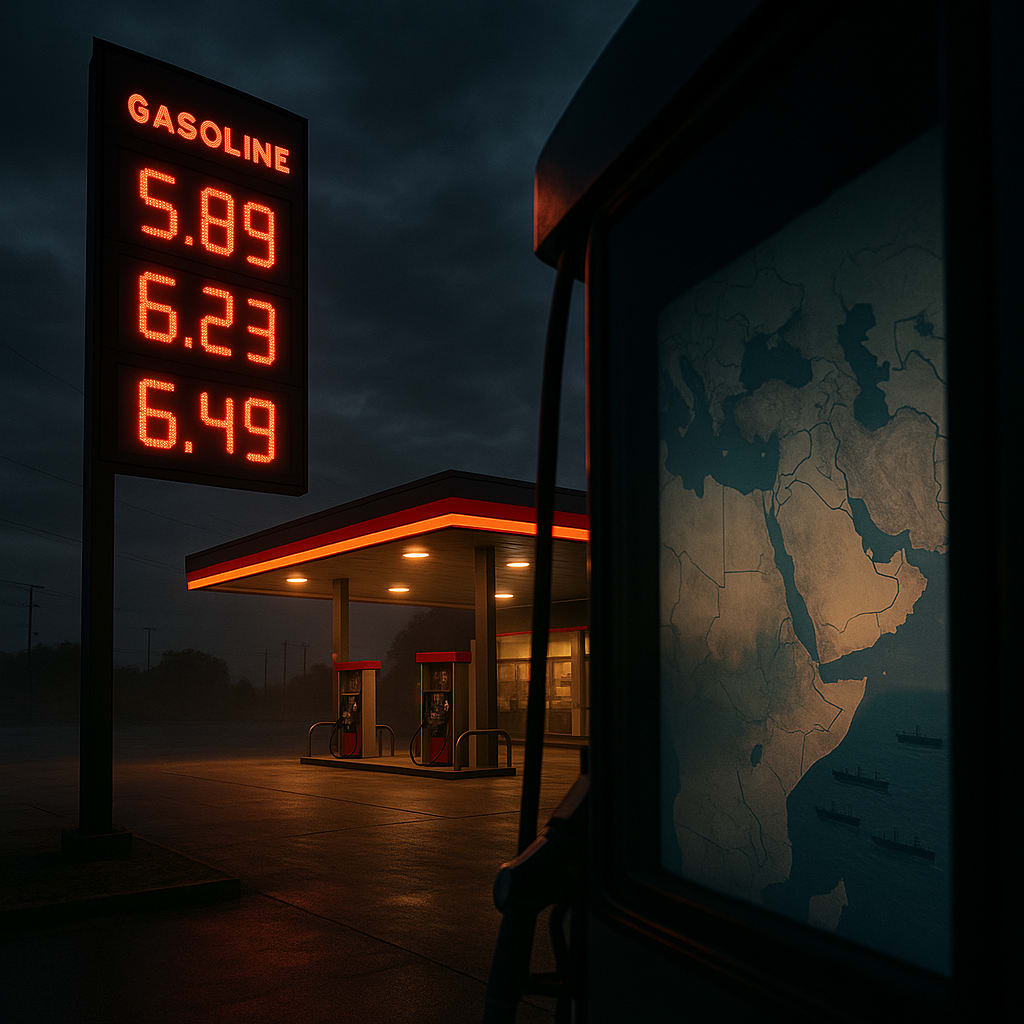
The war might be half a world away, but it’s about to show up on your gas receipt
The first time I felt a war I wasn’t in was at a gas station off a highway outside Chicago.
It was during the early days of Russia’s invasion of Ukraine. I remember watching the numbers on the pump spin faster than I’d ever seen. A guy at the next pump cursed under his breath, then louder, then finally shouted something like, “Why the hell am I paying for a war I didn’t start?”
That feeling is back.
Only this time, it’s not Russia and Ukraine. It’s Iran and Israel, and the question hanging over every gas station, every shipping lane, and every trading floor is ugly and simple:
What happens to crude oil and gas prices after this war—and how much worse does it get before it gets better?
Why a regional war can hit your wallet harder than a local recession
If you’ve never had a reason to care where the Strait of Hormuz is on a map, you do now.
Roughly a fifth of the world’s crude oil flows through that narrow blue throat of water between Iran and Oman. That means a conflict between Iran and Israel isn’t just a regional grudge match. It’s a loaded gun pointed at a choke point the entire global economy depends on.
When missiles fly in the Middle East, the world doesn’t wait to see what happens.
Oil traders don’t sit calmly and say, “Well, let’s see if tankers actually get blocked before we adjust prices.” They move on fear, risk, and worst-case scenarios. Futures markets spike on whispers, not just realities.
So even if no pipeline explodes and no tanker is sunk, crude prices can jump simply because the possibility exists.
You don’t need an economics degree to understand what follows:
Higher crude prices
Higher refinery costs
Higher gas prices
Higher transportation costs
Higher prices on almost everything that moves by truck, ship, or plane
You feel a “regional conflict” in the price of strawberries, plane tickets, Amazon deliveries, heating bills.
That’s the uncomfortable truth: war over there shows up as inflation over here.
The three futures crude oil is staring at right now
Markets hate uncertainty, but they love scenarios.
Behind the headlines about airstrikes and ceasefires, there are basically three paths people who trade and forecast oil are arguing over. None of them are guaranteed. All of them are expensive in their own way.
Scenario 1: Contained conflict, elevated prices
In this version, the Iran–Israel war stays mostly between them, with a lot of violence but also a lot of “red lines” quietly respected.
No sustained closure of the Strait of Hormuz
No direct attacks on major Gulf export terminals
No massive, long-lasting disruption to physical oil flows
Crude prices in that world don’t stay calm—they hover in a nervous, elevated range.
You see days where Brent and WTI spike $5–$10 a barrel on rumors, then fall back when someone says the word “de-escalation.” The spikes are sudden; the relief is always slower.
What that means for you: gas prices stay uncomfortably high but not apocalyptic.
You grumble at $4.50 a gallon instead of screaming at $8. Airlines quietly raise fares. Grocery prices creep—not surge—upwards as transport costs stay sticky.
The damage here is subtle and grinding: a conflict tax built into your cost of living.
Scenario 2: Regional spillover, real shortages
This is the scenario traders pretend not to believe in—and then hedge like crazy against.
Maybe Iran doesn’t fully close Hormuz, but there are enough attacks, mines, or drone harassment to scare insurers and ship owners. Suddenly, shipping a tanker through that stretch costs a lot more and takes longer.
Or maybe proxy groups hit pipelines in Iraq, Syria, or Saudi Arabia. Maybe refineries near the Gulf get targeted. The physical flow of oil is not cut off, but it’s choked, rerouted, delayed.
Now you’re looking at crude jumping sharply, and staying high for longer.
In this world:
Oil can shoot past recent highs and hang there
Strategic petroleum reserves might be tapped again
OPEC+ is forced into awkward decisions it didn’t want to make
Some countries quietly hoard fuel, worsening shortages elsewhere
At the pump, this is when you start to adjust your life around gas prices again.
You think twice about weekend trips. Delivery apps add “fuel surcharges.” Companies tack on “energy adjustments” to invoices. You see the war in your Uber receipt and your electricity bill.
Inflation turns from a “we’re getting it under control” story back into a “why is this happening again?” story.
Scenario 3: Full-blown crisis in the oil arteries
This is the nightmare the world will do almost anything to avoid.
Picture a sustained, deliberate disruption to oil infrastructure:
The Strait of Hormuz effectively blocked, even partially, for weeks or months
Major Gulf production sites damaged
Tankers hit in a way that shakes global confidence, not just a single day’s headlines
In that world, crude prices don’t just rise. They roar.
Governments stop pretending everything is normal. Rationing, “temporary” subsidies, emergency energy packages—those boring-sounding words turn into police lines at gas stations and politicians sweating under bright lights.
Do we get all the way to that scenario? Nobody sane wants that.
But here’s the catch: markets don’t need it to fully happen to start pricing like it might.
If the probability goes from “almost zero” to “maybe 10–20%,” that alone pushes crude and gas higher right now.
Why gas prices jump instantly but fall as slowly as a bad apology
There’s a little quiet scam that plays out every time there’s an oil shock.
You’ve probably felt it without having the words for it.
The pattern goes like this:
Crude oil futures jump on war news
Retail gas prices at your local station jump almost immediately
Weeks later, crude prices ease… but your gas station barely budges
You start asking, “Wait, weren’t those war headlines last month? Why is my gas still this high?”
Part of this is mechanics:
Gas stations price based on replacement cost—the cost of the next delivery—not what’s literally sitting in their underground tanks. Refineries and distributors lock in supply based on futures markets, not last week’s spot prices.
But part of it is less noble.
Once a higher price feels “normal,” there’s a strong temptation all along the chain—traders, refiners, transporters, retailers—to keep as much of that margin as they can for as long as they can.
War gives cover.
No one wants to be the one lowering prices aggressively in the middle of “geopolitical uncertainty.” It feels safer to stay a bit high and blame “instability” than to cut prices fast and risk being caught out if something else flares up.
So yes, this war could end or cool down, and you’d still be stuck with “war-adjacent” prices months later.
The awkward truth: the oil market isn’t just about barrels, it’s about fear
You can measure barrels.
You can’t measure fear—but you can see it in the charts.
Options on crude oil, freight rates for tankers, insurance premiums for ships in the Gulf, gas futures in Europe and Asia… they all act like anxiety monitors for the global energy system.
Here’s what usually happens in a conflict like Iran–Israel:
Volatility explodes: Prices swing more in a single day than they used to in a month.
Risk premiums swell: Traders demand extra return to hold oil-related assets when everything feels explosive.
Correlation rises: Suddenly, oil is moving in lockstep with stocks, currencies, and bonds because fear bleeds into everything.
The brutal part is this: even if physical oil supply doesn’t drop by a single barrel, the price of that oil can still soar, purely because the market is bracing for what might happen.
We pay not just for what is, but for what we’re afraid could be.
That’s why when people say, “But production hasn’t actually fallen that much,” it doesn’t bring much comfort.
Peace moves slowly. Fear trades instantly.
How this war could rearrange the energy map for years, not months
Wars have a way of solidifying trends that were already quietly in motion.
The last big shock—Russia invading Ukraine—didn’t just raise prices for a while. It re-wired who buys from whom, how, and at what political cost.
Europe scrambled away from Russian gas and paid through the nose for LNG. The U.S. became even more central as an oil and gas supplier. New pipelines, new contracts, new alliances.
The Iran–Israel war could do something similar in the oil world:
More “friend-shoring” of energy: Countries that can afford it will try to rely more on politically friendly suppliers, even if that means paying extra.
Faster push into renewables and EVs: Not out of pure climate virtue, but because people are tired of their lives being yanked around every time missiles fly near an oil field.
More weight on U.S. shale: Love it or hate it, American shale producers become a kind of “swing buffer” when OPEC+ is constrained by politics or conflict.
New shadow markets: If Iran faces tighter sanctions, more oil flows in the dark—on untracked ships, with murky contracts, at discount prices—distorting official data even more.
The point is, this isn’t just about how much you’ll pay at the pump in the next month.
It’s about whether the world decides—finally—that tying so much of modern life to a few fragile routes in a volatile region is a bad long-term bet.
What you’re not being told when people say “the market will adjust”
There’s a phrase that gets thrown around a lot in times like this: “The market will adjust.”
It’s technically true. Markets eventually do adjust. Trade routes shift. Producers ramp up. New supplies come online. Demand responds to higher prices.
But here’s the part that gets quietly skipped:
Adjustments hurt.
The “adjustment” might mean:
You driving less and giving up trips you care about
Small businesses folding under the weight of higher energy and delivery costs
Low-income households choosing between heating and groceries
Entire countries spending precious budgets on fuel instead of schools or hospitals
When analysts say “demand destruction,” they mean real people forced to cut back.
When they say “rebalancing,” they mean somebody, somewhere, is going to carry the cost while the system reshuffles.
The market will adjust.
The question is: who pays for that adjustment?
In an Iran–Israel war environment, the answer is: almost everyone, but not equally. Wealthy countries grumble. Poorer countries break.
So what should we expect next—from prices, and from ourselves?
From a purely practical standpoint, here’s the uncomfortable but honest expectation:
Crude oil will likely trade with a permanent layer of war risk baked in as long as Iran and Israel remain in open or simmering conflict.
Gas prices will rise faster than they fall and may settle into a “new normal” that feels unfairly high compared to a few years ago.
Global inflation may get sticky again, not because central banks failed, but because bombs do not care about interest rates.
But there’s another layer here, beyond numbers.
Every time there’s an oil shock, we all go through the same tired cycle:
Shock → anger → blame → adaptation → forgetting.
We swear we’re going to “get serious” about energy independence, renewables, efficiency. Then the crisis fades and we drift back to business as usual until the next war blows through a pipeline we thought would always be safe.
Maybe this time, in the shadow of an Iran–Israel war, we don’t forget so fast.
Maybe we notice that it’s insane for the stability of our daily lives—our commutes, our food, our heating—to depend so heavily on a handful of sea lanes and political relationships that can unravel overnight.
Maybe we’re finally honest enough to say: this is not just a gas price problem. It’s a design problem.
The takeaway that lingers long after the headlines don’t
Somewhere tonight, an analyst is staring at three screens full of charts, trying to guess whether crude will jump another $10 if a single tanker is hit.
Somewhere else, a family is staring at their budget, wondering if they can afford to keep their old truck and still pay rent if gas goes up another fifty cents.
Those two scenes are more connected than either side usually admits.
What happens to crude oil after the Iran–Israel war isn’t just about geopolitics or traders’ nerves. It’s about how fragile our “normal life” really is when one region’s war can show up as a higher bill in a place where nobody fired a shot.
The most honest thing we can say about what comes next is this:
Yes, prices will move. Yes, markets will adjust. Yes, we will adapt.
But if the only lesson we take from this is “I hope gas goes back down soon,” we’ll be right back here the next time a missile gets too close to a shipping lane.
The real question isn’t just, “How high will oil go after this war?”
It’s, “How many more wars are we willing to feel at the gas pump before we decide we’re done living at the mercy of them?”
That question will outlast this conflict.
And whether we like it or not, we’re all going to help answer it.
About the Creator
abualyaanart
I write thoughtful, experience-driven stories about technology, digital life, and how modern tools quietly shape the way we think, work, and live.
I believe good technology should support life
Abualyaanart
Keep reading
More stories from abualyaanart and writers in Trader and other communities.
The USD 185.1 Billion Opportunity: How the Biosimilar Market Is Transforming Global Healthcare
Imagine a world where life-saving biologic treatments for cancer, autoimmune disorders, and chronic diseases are no longer limited by high costs. That transformation is already underway — and it has a name: the Biosimilar Market.
By James Smitha day ago in Trader
A Historic Declaration
We the People of the Husbands of the United States of America, in Order to form a more perfect Union, and I mean you...with me...establish Justice, insure domestic Tranquility, provide for the common defence, promote the general Welfare, and secure the Blessings of Liberty to ourselves, after Puberty, do ordain and establish this Declaration of Co-Dependence.
By Gerard DiLeo5 days ago in Humans



Comments
There are no comments for this story
Be the first to respond and start the conversation.