
What a 1968 Mouse Experiment Tells Us About Society
The Haunting Legacy of Universe 25

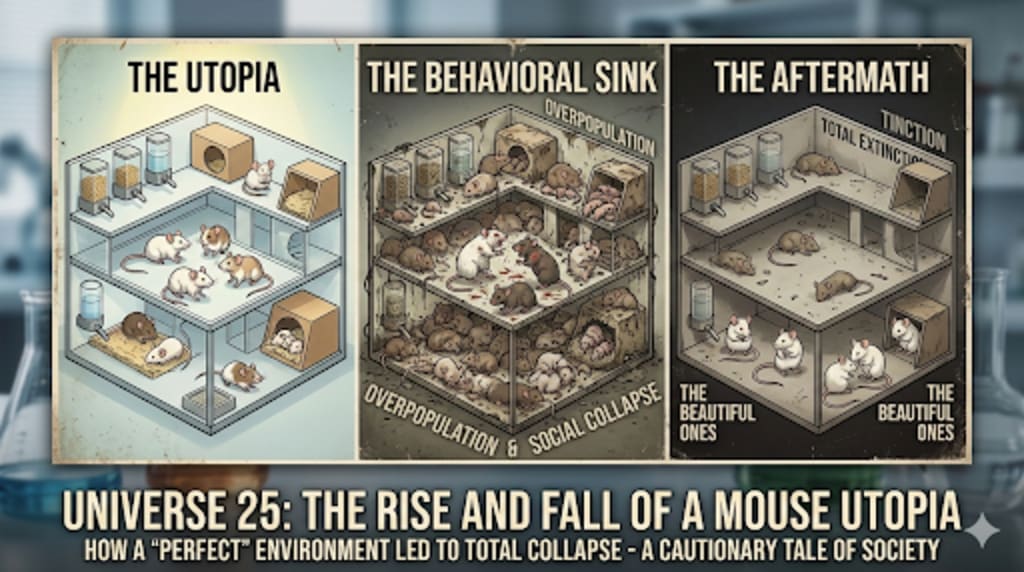
In 1968, while the human world was preoccupied with space races and social revolutions, a behavioral scientist named John B. Calhoun was building a "utopia" in a laboratory in Maryland. This utopia wasn’t for people, but for mice. Known as Universe 25, this experiment would become one of the most famous—and chilling—studies in the history of behavioral science.
Decades later, Universe 25 remains a staple of late-night internet rabbit holes and high-level sociological debates. But what actually happened inside that enclosure, and why are we still talking about it in 2026?
Building a Mouse Utopia: The Setup of Universe 25
Calhoun’s goal was simple: What happens to a species when every physical need is met, and all survival pressures are removed? He designed an environment that was, for a mouse, a literal paradise.
The enclosure featured:
* Unlimited Resources: Constant access to food and water.
* Safety: Zero predators and a climate-controlled temperature.
* Hygiene: Rigorous cleaning to prevent disease.
* Space: Enough nesting boxes to theoretically house nearly 4,000 mice.
Calhoun started the experiment with four breeding pairs. For the first few months, it was a success story of exponential growth.
The Four Phases of Collapse
The experiment didn't fail because of a famine or a plague. It failed because of a "social breakdown." Calhoun tracked the progression of Universe 25 through distinct phases:
1. The Strive Period (Day 1–104)
The initial eight mice adjusted to their new home and began to reproduce. This was the "pioneer" phase where social roles were established and the population thrived.
2. The Exploit Period (Day 105–314)
The population exploded, doubling every 55 days. However, as the density increased, the mice began to congregate in specific areas despite having plenty of empty space elsewhere. This led to the first signs of social friction.
3. The Equilibrium Period (Day 315–560)
This is where the "utopia" turned into a nightmare. Calhoun coined the term "Behavioral Sink" to describe the total collapse of normal social behavior.
* Aggression: Random acts of violence became common.
* Parental Neglect: Mothers began abandoning their young or even attacking them.
* Social Withdrawal: The hierarchy shattered, leaving many mice "socially autistic," unable to interact or mate.
4. The Die-out Period (Day 561+)
Birth rates plummeted. The few remaining pups rarely survived to adulthood. Eventually, the population stopped replacing itself entirely, leading to total extinction despite the bins still being full of food.
The Rise of "The Beautiful Ones"
Perhaps the most famous takeaway from Universe 25 was the emergence of a group Calhoun called "The Beautiful Ones." As the social environment became too chaotic, these male mice withdrew from society entirely. They didn't fight, they didn't mate, and they didn't protect territory. Instead, they spent their days eating, sleeping, and grooming themselves. They were physically pristine—hence the name—but they were "socially dead." They had lost the capacity to perform the complex social tasks required for the species to survive.
The "Behavioral Sink": Why It Matters Today
Calhoun’s conclusion was profound: Social death precedes physical death. He argued that when a population is deprived of meaningful roles and the "struggle" required for development, the social fabric disintegrates.
In our modern era, many people draw parallels between Universe 25 and current societal trends:
* Urbanization and Crowding: The psychological toll of living in high-density environments.
* The Paradox of Abundance: How "comfort societies" might inadvertently lead to a loss of purpose.
* Social Isolation: The rise of "hikikomori" (extreme social withdrawal) and declining birth rates in developed nations.
* Digital Disengagement: The idea that we are becoming "The Beautiful Ones"—physically cared for but socially and emotionally detached through screens.
Fact vs. Fiction: Is Universe 25 a Prediction?
It is tempting to look at Universe 25 as a crystal ball for human civilization, but modern scientists urge caution. Humans are significantly more complex than mice for several reasons:
* Innovation: Humans can reinvent their environments and create new "spaces" (like the digital world).
* Culture and Ethics: We have institutions, laws, and moral frameworks that guide behavior in ways mice cannot conceive.
* Migration: In the experiment, the mice were trapped in a cage. In the real world, humans migrate to find new opportunities and alleviate density.
Universe 25 is better viewed as a metaphor rather than a mathematical certainty. It warns us that a species needs more than just calories to thrive; it needs structure, challenge, and connection.
The Takeaway: Beyond Survival
The legacy of John Calhoun’s experiment reminds us that abundance alone is not a guarantee of success. If we remove the "why" behind our actions—the roles we play in our families and communities—we risk a different kind of poverty: a poverty of spirit.
To thrive, a society needs to balance its material wealth with mental health support, meaningful community engagement, and a sense of individual purpose.
What do you think? Does the "Behavioral Sink" feel relevant to today's world, or was it just a flawed experiment on rodents?
About the Creator
Omasanjuwa Ogharandukun
I'm a passionate writer & blogger crafting inspiring stories from everyday life. Through vivid words and thoughtful insights, I spark conversations and ignite change—one post at a time.
Keep reading
More stories from Omasanjuwa Ogharandukun and writers in Journal and other communities.
Scary Movie 6 Leaks Ands All You Need To Know
The horror-comedy genre is officially back in the spotlight, and this time it arrives with a self-aware twist worthy of its legacy. Scary Movie 6 is already generating massive buzz — not only because it marks the long-awaited return of the Wayans creative force, but because Marlon Wayans decided to “bootleg” his own trailer before its official wide release.
By Omasanjuwa Ogharandukun4 days ago in Journal




Comments
There are no comments for this story
Be the first to respond and start the conversation.