
French Love Letters
👉 “She Thought He Forgot Her — Until the Letters Were Found.”

By Stephen McClure
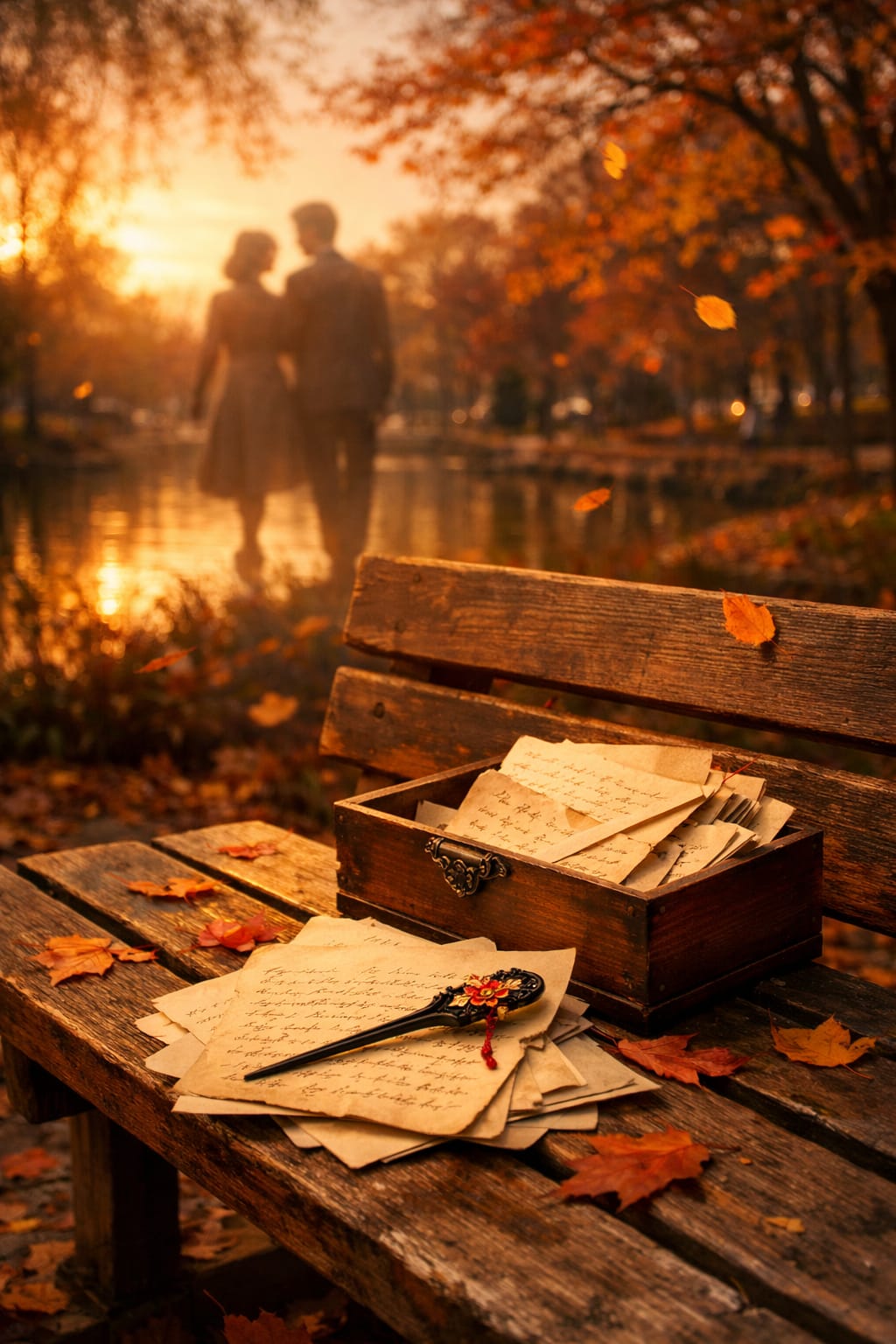
On a crisp October afternoon, I was sitting on a bench beside the pond in Zenpukuji Park, admiring the gold and crimson leaves shimmering against a blue sky. The water reflected autumn like a moving tapestry. I sipped canned coffee and breathed in the cool air.
Then a voice interrupted my quiet reverie.
“Est-ce que vous parlez français?”
I turned to see an elderly Japanese woman in a wheelchair, accompanied by a younger woman. She repeated the question, and I answered in hesitant French that I spoke a little.
Her name was Atsuko Endo. Years ago, she told me, she had studied French — and on this very bench, in the autumn of 1955, she had met a young Frenchman named Paul. He had approached her with the same question.
What began as a language exchange quickly turned into romance.
Recently, while cleaning her house, she had discovered a lacquered box filled with old letters written in French. She could no longer read them easily. Would I translate them for her?
Curiosity — and her generous offer of payment — persuaded me.
The following week, seated in her traditional home near the park, I began reading Paul’s first letter aloud.
It was dated September 29, 1955.
He wrote of their first meeting beside the pond, describing her in a golden kimono that matched the autumn leaves. He confessed he had been shy but had felt instantly certain she was his soulmate. He recalled their walks, their first kiss in a quiet garden, and his joy when she agreed to accompany him on a trip to Enoshima.
As I read, Endo laughed softly, occasionally blushing like a schoolgirl. The years seemed to melt away.
The second letter was even more intimate. Paul described their overnight stay at an inn in Enoshima — the beauty of the island, the sake they drank, and the passion they shared. He wrote of intellectual, spiritual, and physical union, of eternal love.
Endo listened with misty eyes, touching the lacquer hairpin in her hair — the same one Paul had once accidentally taken and mailed back to her.
But in the third letter, something changed.
Dated October 23, Paul gently asked why she had not replied to his previous letters. He assumed she must be busy. He longed to see her again.
In the fourth letter, his tone grew anxious. He wondered whether she had rejected him — or whether some calamity had befallen her. He wrote that he was unable to concentrate on teaching. Each day without her reply felt like eternity.
By the fifth letter, despair had consumed him. He admitted skipping classes, lying in bed, heartbroken and confused. He even tried to find her house but failed. He begged for just one word — even “sayonara” — to end his suffering.
Endo sat rigidly silent as I read.
The final letter was dated November 5, 1955.
Paul wrote that he was returning to France. His depression had cost him his job. Japan, he said, had broken his heart — though he would treasure the memory of her forever. Even if she had chosen to cut him off, he would never forget their love.
When I finished reading, the room fell into heavy silence.
Then Endo spoke quietly.
“There is something I haven’t told you,” she said. “I didn’t know these letters existed until a few weeks ago.”
She had discovered them hidden inside her father’s old correspondence box.
Her strict father had intercepted every letter.
For more than fifty years, she had believed Paul seduced her and abandoned her without a word.
And Paul had believed she rejected him.
Two hearts had broken — not from betrayal, but from silence.
Endo began to weep. Not softly, but with the raw grief of someone reliving a wound thought long healed. She stretched her arms outward as if to embrace a ghost, then clutched only empty air.
“I’m too old to have my heart broken again,” she cried.
I felt like an intruder in a sacred tragedy.
That evening, I returned to Zenpukuji Park. The bench by the pond was empty. The moon shimmered on the dark water, and the last autumn leaves clung weakly to bare branches.
I thought about Paul — a lonely young teacher writing desperate letters in a dormitory room. I thought about Endo — waiting for words that never came.
How fragile love is. How easily it can be destroyed by pride, fear, or interference.
A lifetime of happiness lost to unopened envelopes.
As I sat there in the quiet, I heard a voice behind me.
“Excuse me, do you speak English?”
I turned slowly.
And in that moment, I realized something profound:
love may be fragile — but life, like autumn, always offers another beginning.
About the Creator
Keep reading
More stories from imtiazalam and writers in Humans and other communities.
My Fake Girlfriend
I never thought one lie could change my life. It all started with a single text: "Hey… can you help me out?" I froze. My phone buzzed again. It was my best friend, Sameer, begging me to create a fake girlfriend for him. He was desperate — his parents were constantly asking about his love life, and he didn’t want to disappoint them. At first, I laughed. A fake girlfriend? That’s ridiculous. But the more he pleaded, the more I felt guilty saying no.
By imtiazalamabout 8 hours ago in Humans
Regulation at the Threshold
Author’s Note — Flower InBloom This series is part of my ongoing work exploring personal sovereignty through nervous system awareness and structural alignment. I write not to dramatize change, but to understand how the body organizes through it. When we learn to regulate at the threshold, endings stop feeling like collapse and begin revealing architecture.
By Flower InBloom5 days ago in Humans
Flower Bloom 369
FLOWER Bloom 2/25/26 Wednesday By Mariann Carroll Karen had been with Tony for 7 years. Tony started acting strangely after her surgery. He would mow the lawn in the rain and be on his cellphone. He started pushing Karen away. Tony came clean about seeing someone. Karen moved out two months later. Karen moved in with a friend. She felt betrayed.
By Mariann Carroll6 days ago in Fiction


Comments
There are no comments for this story
Be the first to respond and start the conversation.