
Book Review: "Word Watching" by Julian Burnside
5/5 - deeply interesting and utterly wonderful...

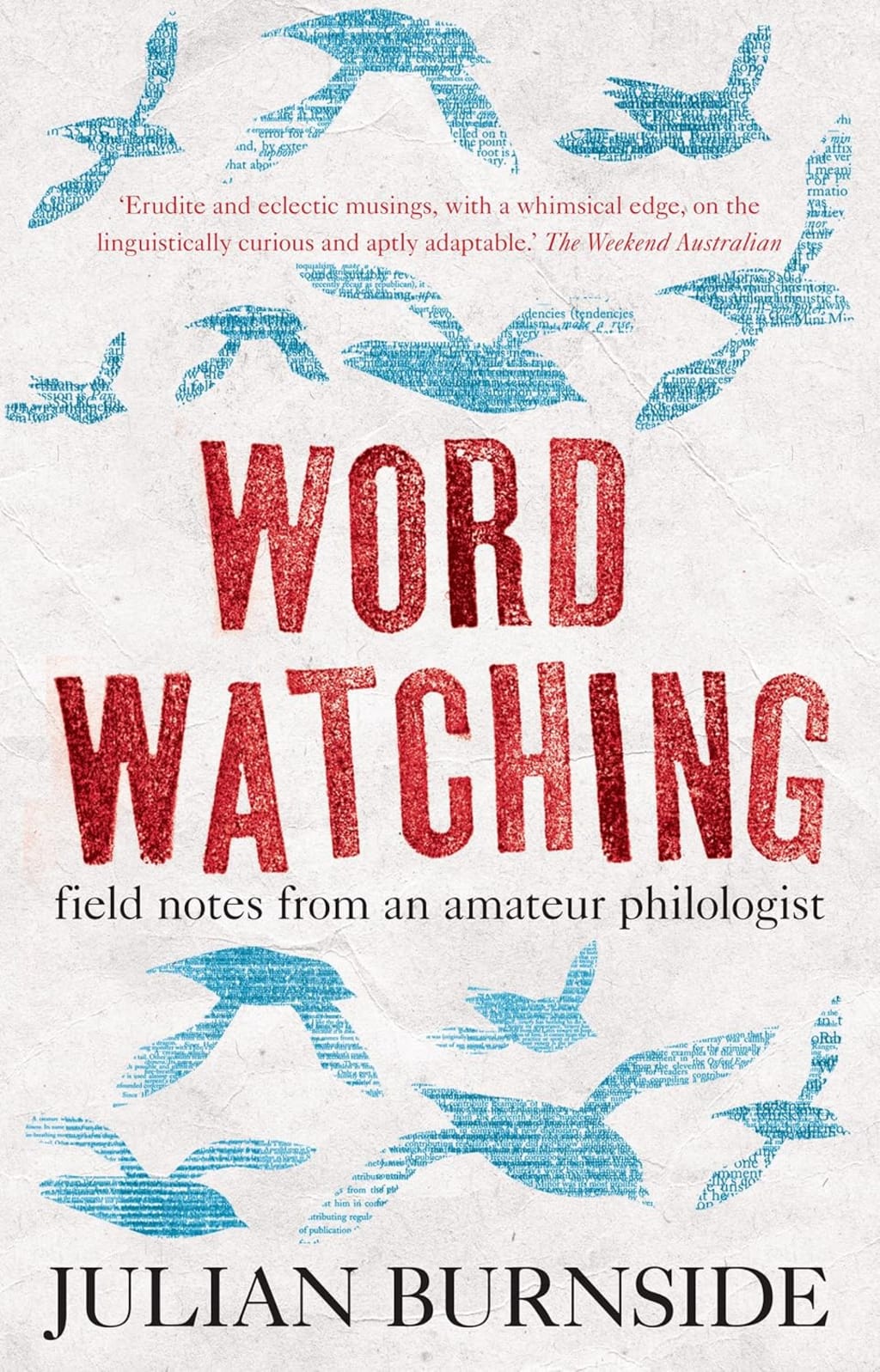
There's something about words that takes me into a whole new world. I love the idea of pouring over a word's meaning, etymology and how it came to be used - the more obscure the better. Our narrator describes himself as an 'amateur philologist' and yet, goes into fanatastic depth about individual words and phrases, showing us the backstories of how they've been used socially and culturally, as idioms and in their true forms. With the insertion of the OED and Dr Samuel Johnson's dictionary plus many more, he manages to show us how words have been defined differently over time. There is a lot in language to take issue with therefore. If you've read the book then you'll understand why I wrote 'issue' in italics.
One of the topics this book covers is the way in which Australia came into its own usage of English - that was quite interesting because throughout my own studies of the English Language I very rarely hear any talk or read anything of interest solely on Australian English. The author talks about how there were different events and changes in the political and cultural landscape that created Australian English as the Australians know it today. For example: there are the letters of Ned Kelly.
I personally would not have thought of Ned Kelly as someone who solidified the Australian English language if it had not been for this book. Kelly didn't write the letters, but he dictated them and I think there's agency there to show us how people of the day wrote and spoke. Were these letters an example of common folk speaking, or was it an example of their writing? I would say speaking and thus, the language is formed by a shared understanding.
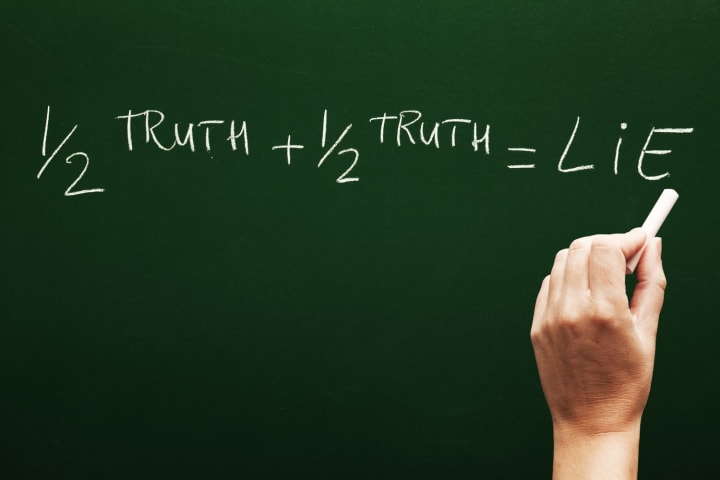
Another chapter I enjoyed was perhaps one that we are all too familiar with in our modern day: doublespeak. Formulated by George Orwell in his novel 1984 - doublespeak is the existence of speech which does not, in fact, answer the question at hand though 'seems' like it does so. Used by the media and politics, it is often deployed to hide true intentions and belief systems (for example: 'final solution' for 'killing Jews' in Hitler's political propaganda machine during Nazi Germany - a 'final solution' doesn't sound all that bad and doesn't tell you exactly what is going on - it is doublespeak). It is well-known that those further on the right wing are more likely to use doublespeak due to their lack of morals and sympathy when it comes to other people.
The author uses the example of the horrific treatment of 'illegals' in Australia. That by calling them 'illegals' automatically attaches a negative connotation to them though they are not actually criminals. The terrifying treatment (which could be considered against human rights) of these people (it also aligns itself somewhat with Nazi Germany if you look into it) is subdued with 'watered down language' which is more palatable for the native audience. It also stops anyone investigating and stops people being punished because it doesn't sound all that bad. It doesn't tell you what's going on, that's why.
There's also a chapter on the 'King's English' in which the author goes through the way in which the monarch of England might speak. He looks at a book which was written to describe the topic, stating that this English should favour using Anglo-Saxon words over the more flamboyant, romance languages. He uses the example of Winston Churchill's famous speech in order to show how this is more than likely, often understood one way but misunderstood in another. I personally enjoyed this chapter because of the things I was able to learn about the actual formations of the 'King's English'. It is not as simple as simplicity with pronunciation of very particular method. There are a whole host of rules that are applicable when it comes to this type of speech.
From looking at swear words to analysing all major ways from 400 to say 'rubbish', the author has definitely done his research when it comes to wordage. These are the types of books I absolutely love getting my teeth stuck into. We cover the fancy words, the ones that have fallen out of use and even the ones we have been using wrong the whole time. Julian Burnside's book is a must-read for anyone who wants a deeply interesting book about different ideas on language and why we use it.
About the Creator
Annie Kapur
I am:
🙋🏽♀️ Annie
📚 Avid Reader
📝 Reviewer and Commentator
🎓 Post-Grad Millennial (M.A)
***
I have:
📖 300K+ reads on Vocal
🫶🏼 Love for reading & research
🦋/X @AnnieWithBooks
***
🏡 UK
Keep reading
More stories from Annie Kapur and writers in Geeks and other communities.
Book Review: "The Night Guests" by Marina Scott
When our narrator's father dies, her mother retreats into solitude and writes constant letters to him. She is mourning and sad until the family members attend a seance together where the showman in front of them looks on with a confusion as he states that the father of the house has returned and confirms he has been receiving the letters. Our cynical narrator doesn't know how this man in front of them could've known her father's nickname without even asking any questions. The question is will the events of the following story turn a cynical woman into a believer in something more, something beyond? As her mother begins to take up her hobbies again, our narrator finds it strange and odd that there is a different air to her life now. A completely different air.
By Annie Kapur2 days ago in Geeks
A Knight of the Seven Kingdoms Series Review (Season 1)
As one of the biggest properties in fantasy, A Song of Ice and Fire remains immensely popular with audiences. After reaching far into the past with House of the Dragon, a second spin-off was on the cards. A Knight of the Seven Kingdoms serves up a bite-sized slice of action and drama, but it still claims a spot among the best small-screen titles.
By Robert Cain4 days ago in Geeks
Squatty Potty
How a small footstool sparked a global conversation about posture, digestion, and modern health In the world of wellness products, few items have sparked as much curiosity as the Squatty Potty. At first glance, it looks like a simple plastic or bamboo stool designed to fit around the base of a toilet. But behind that straightforward design lies a broader conversation about posture, digestive health, and how modern lifestyles have changed even the most basic human habits. While it may seem like an unconventional topic, bathroom posture has become a legitimate subject of interest in health circles. The Squatty Potty positioned itself not as a gimmick, but as a tool rooted in anatomy. The Idea Behind the Design The concept is based on the natural squatting position humans historically used for bowel movements. In many parts of the world, squat toilets remain common. Advocates of this posture argue that squatting straightens the rectum and reduces strain. Modern Western toilets, however, place the body in a seated position, which can create an angle that may require more effort during elimination. The Squatty Potty elevates the feet while sitting, mimicking a squatting posture without requiring a complete change in toilet style. Supporters suggest that this position can: Reduce straining Promote more complete elimination Help with occasional constipation Decrease pressure associated with hemorrhoids Though experiences vary, many users report improved comfort after adjusting their posture. From Household Product to Cultural Phenomenon The Squatty Potty gained widespread attention after appearing on the television show Shark Tank. Its founders presented the product as a simple yet practical solution to a universal problem. The appearance helped introduce the brand to a national audience and significantly boosted sales. Later, a humorous viral marketing campaign featuring a unicorn further propelled the product into mainstream conversation. The advertisement combined comedy with anatomical explanation, making an otherwise awkward topic more approachable. What set the Squatty Potty apart was its willingness to address a topic that many people are uncomfortable discussing. By combining lighthearted branding with educational messaging, the company turned a bathroom accessory into a widely recognized name. The Science Behind Squatting Medical professionals have long understood that body positioning affects bowel movements. When squatting, the puborectalis muscle relaxes more fully, potentially straightening the pathway for elimination. In a seated posture, this muscle may create a slight bend, requiring additional effort. While some studies suggest that squatting can reduce strain and time spent on the toilet, it’s important to note that results are individual. The Squatty Potty does not treat medical conditions, and people experiencing chronic digestive issues should consult healthcare providers. That said, posture adjustments are a low-risk lifestyle change. For many, it represents a simple experiment in comfort rather than a medical intervention. Why Bathroom Habits Matter Digestive health plays a central role in overall well-being. Constipation and straining are common concerns, often influenced by diet, hydration, stress, and physical activity. While fiber intake and water consumption remain foundational solutions, posture can be another factor. In recent years, there has been a growing openness about gut health. Conversations once considered private are now part of broader wellness discussions. Products like the Squatty Potty reflect this cultural shift—acknowledging that digestive comfort deserves attention without embarrassment. Practical Considerations Before Buying For those considering a Squatty Potty, several versions are available, including adjustable models and materials ranging from plastic to bamboo. The core function remains the same: elevating the feet to achieve a more natural angle. Before purchasing, consumers may want to consider: Bathroom space and storage Adjustable height preferences Ease of cleaning Household usage needs Some people choose to replicate the concept temporarily using a small step stool to determine whether the posture feels beneficial before investing in a branded product. Addressing Common Misconceptions One misconception is that a footstool alone will resolve all digestive issues. In reality, bowel health is multifaceted. Diet, hydration, exercise, stress levels, and underlying conditions all contribute to regularity. Another misconception is that using such a product is unnecessary or exaggerated. For some individuals, it may indeed feel unnecessary. For others, it can significantly improve comfort. Like many wellness tools, its effectiveness depends on personal experience. Importantly, there is no harm in adjusting posture in a safe and stable manner. The key is to use a sturdy platform and avoid instability. Cultural Perspectives on Squatting Globally, squatting is far from unusual. In many countries across Asia, Africa, and parts of Europe, squat toilets remain standard. In those contexts, the body’s natural posture is maintained without additional accessories. The popularity of the Squatty Potty in Western markets highlights how modern infrastructure sometimes diverges from traditional human movement patterns. It also reflects how innovation can bridge that gap without requiring structural changes. Rather than replacing existing toilets, the product adapts to them—offering a compromise between modern convenience and anatomical alignment. A Broader Reflection on Everyday Design The success of the Squatty Potty underscores how everyday objects can influence health and comfort. Often, the most impactful innovations are not complex technologies but simple design adjustments. By rethinking posture in one of life’s most routine moments, the product opened a conversation about how design shapes daily experiences. Whether one chooses to use it or not, the discussion itself has encouraged greater awareness of digestive health. In a culture increasingly focused on wellness, even small changes can feel meaningful. The Squatty Potty may not be revolutionary in appearance, but its message is clear: comfort and function matter—even in the bathroom. Ultimately, the decision to use a footstool comes down to personal preference. For some, it’s a helpful addition. For others, it’s unnecessary. What remains consistent is the reminder that health sometimes begins with the simplest adjustments.
By Saboor Brohi 5 days ago in Geeks
I wanted to title this something different, but worried that my chosen title might cause problems entering the United States in the future so this is the new title. It's the greatest title. No one has ever written a title better than this. (All titles unrelated to content).
Let me be honest. I am finding this difficult. Now, I like a challenge, a stretch, a bit of an obstacle course. “Write about the decline of the British Empire in the form of a narrative poem in which your protagonist is an artichoke” I read, and flex my fingers. “Write a haiku to evoke the sensation of sibilance using only the first half of the alphabet.” “Well”, I think to myself, “this should be fun.” But “write about a system that isn’t working”? A system that isn’t working? Now? In 2026? ONE system? My favourite system that isn’t working? The sexiest system that isn’t working? The one giving me the most angst day to day? The one giving me the most existential dread? I am, as I say, finding this difficult. I will own that I have contemplated writing a thousand words on why the steady “all on” setting on my fairy lights is the EIGHTH of seven options which must be sequentially activated to get there, because that is a system that some fool came up with and it definitely doesn’t work, and now who is paying the price, eh? But how can I write about my fairy lights when…. When…. When….
By Hannah Moore5 days ago in Humans


Comments
There are no comments for this story
Be the first to respond and start the conversation.