
Time Isn’t Fair
How Brains Keep Time Differently

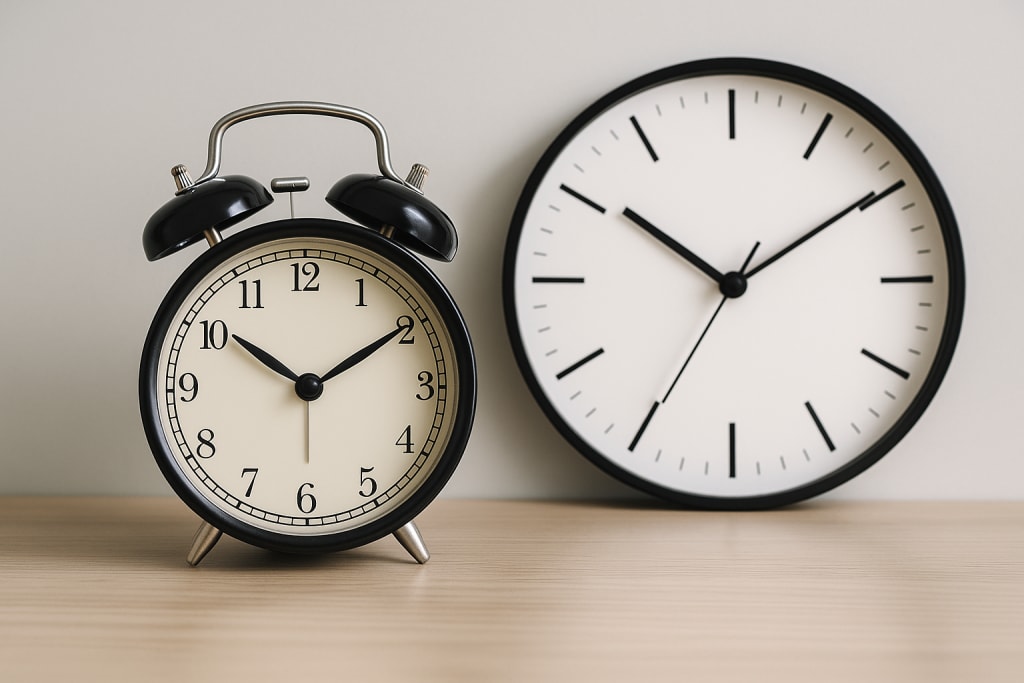
Punctuality is usually treated as a quiet scorecard even though it has almost nothing to do with personal values.
- People assume lateness is careless.
- People assume early arrival proves discipline.
I stopped believing any of that a long time ago. My fieldwork showed me that human timing is shaped by biology, attention, and lived conditioning far more than it is shaped by intention.
My own timing reflex came from crisis response on the streets of Phoenix in my early forensic mental health career. When a caller into our dispatch threatened to die "within the next 15 minutes," or when a scene required staff to react before a situation escalated, the clock was not neutral. It carried weight. My brain learned to track time in a way that placed survival at the front. Early arrival felt like a safety measure. It still does. What looks like organization to others is muscle memory built through trauma exposure and responsibility. The nervous system often keeps its old rules even when the danger is gone.
People who run late are usually dealing with an entirely different internal system. Research on timing shows that some brains compress duration. They believe a task will take 10 minutes even when it requires 20. Their confidence is not deceit. Their perception is off by a measurable margin. They move through tasks as if time gently stretches, which explains why 15 minutes can slip past them without a cue that says a shift is needed.
Attention patterns interfere with timing too. I have worked with people who track several stimuli at once. Their attention spreads rather than locks. When attention spreads too thin, the brain loses the sensation of time passing. They do not feel the drift. They are not ignoring commitments. The signal to stop or transition never fires loud enough.
Chronotype science confirms that people wake into the day with different cognitive rhythms.
- A morning-oriented brain reaches operational strength earlier. The timing system becomes accurate sooner.
- A night-oriented brain lags behind. Executive function is sluggish before full activation. When the brain is still heating up, sequencing is weak. Task transitions take longer. The person is not disrespectful. The person is still trying to form structure inside a system that is slow to engage.
Neurodivergence shapes timing from another angle.
- People like me on the Autism spectrum often protect themselves from sensory overload by arriving early. The extra minutes allow the environment to settle before demands begin. It prevents distress.
- People with ADHD experience time without strong boundaries. Minutes slide. The brain does not flag when a shift must occur. The absence of an internal bell makes lateness predictable even when the person cares deeply about the commitment.
Family patterns matter as well. Some homes enforced timing with severity. Others ran on improvisation. A child raised in a loose timing environment does not develop clear internal warning signals. They learn to function by external cues rather than internal ones. When those cues are not present, timing falters. It is a learned rhythm, not a moral stance.
Conflict often grows from misreading intent.
- The early person feels dismissed.
- The late person feels cornered.
Both are wrong about each other. Timing differences are almost never personal. They are mechanical. Bodies and brains do not track minutes the same way. People assume they do because clocks show the same numbers to everyone. The brain is the true timekeeper, and it does not operate with that level of uniformity.
The ethical question is simple.
Are we judging timing or judging intent?
When we shift from the moral frame to the mechanical frame, the tension drops.
- A person who runs late often lacks the internal marker that prompts change.
- A person who runs early may be managing an old threat system.
Neither pattern reveals integrity. Both patterns reveal wiring.
The systems that regulate time perception sit at the center of attention, memory, sleep biology, and the brain’s internal pacing. When those systems differ, timing behaves differently. Expecting universal punctuality assumes a uniform brain. I have never met a uniform brain. I have only met brains shaped by history, biology, stress, fear, and whatever pattern helped them survive their early environments.
Time is unfair. Some clocks run fast. Some drift. Some anticipate danger. Some refuse to signal transitions. Judging people for the clock they were handed helps no one.
Understanding the pattern gives everyone a better chance of functioning together without resentment.
Sources That Don’t Suck
American Psychological Association. (2019). Attention, timing, and executive function. APA Publishing.
Harvard Medical School. (2020). Sleep and chronotype research. Harvard University Press.
National Geographic Society. (2024). Human time estimation and behavioral timing patterns. National Geographic Publishing.
Parker, J. A. (2018). Neural mechanisms of time perception. Oxford University Press.
Wearden, J. (2016). The psychology of time: A behavioral review. Cambridge University Press.
About the Creator
Dr. Mozelle Martin
Behavioral analyst and investigative writer examining how people, institutions, and narratives behave under pressure—and what remains when systems fail.
Keep reading
More stories from Dr. Mozelle Martin and writers in FYI and other communities.
Texas Data Centers
At the edge of town, the building looks like any other industrial warehouse. Concrete walls. No windows along most of the structure. Substation hardware fenced off to one side. Thick transmission lines feeding into transformers the size of small houses. There is no sign that says “cloud.” There is no sign that says “AI.” But inside, racks of servers are running nonstop. Every second, data moves through them. Financial transactions clear. Medical files are retrieved. Social feeds refresh. Court records upload. Algorithms calculate.
By Dr. Mozelle Martin10 days ago in FYI



Comments
There are no comments for this story
Be the first to respond and start the conversation.