
Game-Based Learning Industry Trends: AR/VR Adoption, Mobile Learning & Forecast 2034
How immersive AR/VR tools, mobile-first learning platforms, and gamified content are transforming engagement, skill development, and outcomes across the global education ecosystem

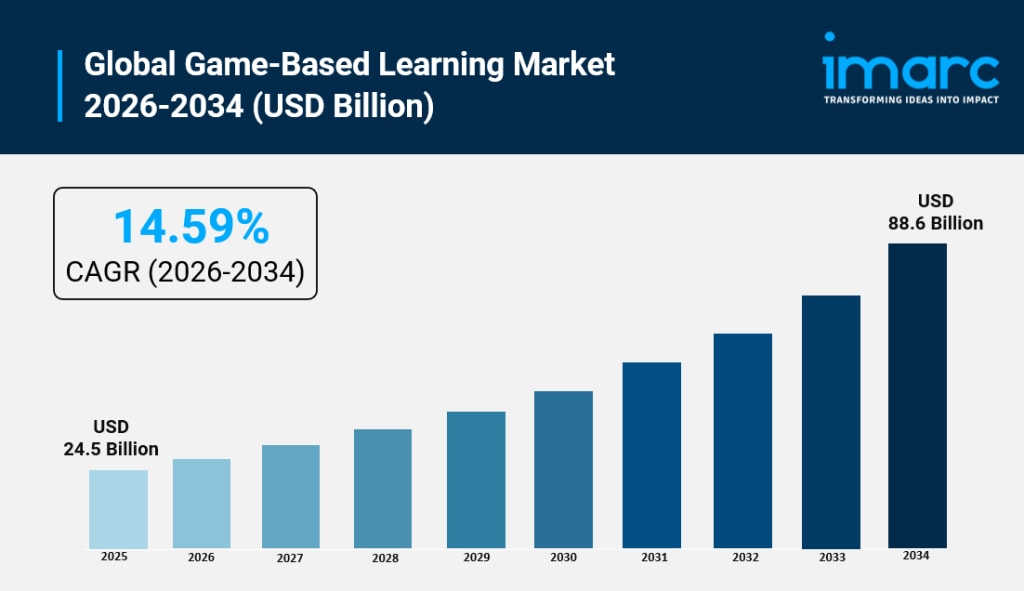
Global education sector is undergoing a massive shift as traditional rote learning is replaced by interactive, game-driven methodologies that prioritize engagement and skill retention. Once a niche tool for primary education, game-based learning has become a critical strategic asset for both K-12 institutions and corporate training programs worldwide. According to IMARC Group’s latest data, the global game-based learning market size reached USD 24.5 Billion in 2025. Looking forward, IMARC Group estimates the market to reach USD 88.6 Billion by 2034, exhibiting a CAGR of 14.59% during 2026-2034. North America currently dominates the market, supported by a highly developed digital infrastructure and the rapid adoption of advanced EdTech solutions in both schools and workplaces.
Game-based learning now represents a sophisticated multi-billion-dollar global industry, with the K-12 segment emerging as the largest end-user group. Demand is fueled by the need for personalized, student-centric experiences that cater to a generation of digital natives who respond better to interactive challenges than passive lectures. Major segments include online and offline platforms, with revenue models increasingly shifting toward subscription-based memberships and in-game purchases. Educators and enterprises alike are prioritizing platforms that offer real-time analytics, allowing for immediate feedback and the tailoring of content to individual learning speeds, ensuring that "no learner is left behind."
Game-Based Learning Market Growth Drivers:
- Escalating Demand for Engaging and Immersive Learning Experiences
Primary catalyst for market growth is the proven ability of game elements such as points, leaderboards, and branching narratives to significantly improve knowledge retention. Research indicates that game-based models can boost learner engagement by over 60% compared to traditional methods. By immersing students in dynamic, risk-free scenarios, these platforms encourage a "trial and error" approach that fosters deep conceptual understanding. For example, recent primary school initiatives like the "CyberSprinters" game by the NCSC utilize interactive play to teach complex cybersecurity concepts to children as young as seven, turning abstract digital safety rules into actionable, memorable skills.
- Massive Proliferation of Smartphones and High-Speed Connectivity
The widespread availability of affordable mobile devices has democratized access to educational content, allowing learning to happen "anytime, anywhere." In 2025, active smartphone users in major emerging markets like India surpassed 750 million, creating a vast cohort of mobile-native learners. This connectivity allows for "microlearning" through 3-5 minute game loops that fit into daily routines. Furthermore, the global rollout of 5G is eliminating device-specific hardware limits, enabling high-quality, cloud-based educational games to run smoothly on budget smartphones. This technological leap ensures that even students in remote areas can access the same high-caliber simulations as those in urban centers.
- Rapid Digitization of Corporate Training and Workforce Development
Large enterprises are increasingly abandoning dry compliance videos in favor of gamified simulations to address "competency gaps" in their workforce. Companies use these platforms for everything from onboarding new hires to complex leadership training and decision-making exercises. Because these games can simulate high-stakes real-world scenarios such as medical emergencies or financial crises in a controlled digital environment, they offer a safe space for employees to sharpen their problem-solving and analytical skills. Statistics suggest that organizations using gamified training report higher levels of employee satisfaction and a more measurable return on investment (ROI) in professional development.
Game-Based Learning Market Trends:
- Integration of Generative AI and Adaptive Learning Algorithms
Industry is moving toward "neuro-adaptive" games that use Artificial Intelligence to adjust difficulty levels in real-time based on the learner's progress. Instead of a fixed curriculum, AI-powered platforms analyze performance data to offer personalized paths that keep students in the "flow state" where the challenge perfectly matches their skill level. By 2026, it is estimated that 20% of new educational games will disclose the use of AI to generate topical and novel content. This trend allows for the creation of vast amounts of specialized learning material at a fraction of the traditional cost, making highly niche subjects commercially viable for developers.
- Surge in Immersive AR and VR Educational Experiences
Augmented Reality (AR) and Virtual Reality (VR) are redefining the boundaries of the digital classroom by bridging the gap between theory and practice. These technologies create "spatial" learning environments where students can perform virtual chemistry experiments or explore historical sites in 3D. The "Simulation-based Learning" segment is currently one of the fastest-growing categories, with a projected growth rate exceeding 20%. This is particularly vital in fields like medical training and engineering, where hands-on practice is essential but physically difficult or expensive to provide. These immersive tools enhance situational awareness and experiential recall, leading to superior learning outcomes.
- Shift Toward Direct-to-Consumer (D2C) and Subscription Models
A significant shift is occurring in how educational games are distributed, with developers moving away from third-party app stores to create their own "custom storefronts." This D2C trend allows creators to capture first-party data to understand exactly how people learn and what drives engagement, leading to hyper-personalized recommendations. Furthermore, subscription-based models are becoming the industry standard, providing a steady revenue stream that allows for continuous content updates and unified progression across different devices. In 2026, alternative payment channels and direct distribution are among the fastest-growing revenue streams, allowing developers to invest more in high-quality, evidence-backed educational content.
Recent News and Developments in Game-Based Learning Market:
- February 2026: Leading industry players at the Global EdTech Summit showcased "Project Odyssey," a cross-platform VR ecosystem that allows students to collaborate on complex engineering puzzles in a shared virtual workspace.
- October 2025: IMARC Group reported that the global market has reached a new milestone, driven by the explosive growth of gamified STEM education and the increasing integration of "social gaming" elements in higher education curricula.
- September 2025: The National Cyber Security Centre (NCSC) expanded its "CyberSprinters" program, introducing new modules specifically designed to help primary school children navigate the ethical challenges of AI and deepfake technology.
- January 2025: A major consolidation occurred in the sector as a leading mobile gaming giant acquired a prominent K-12 learning platform for USD 1.2 Billion, signaling a strong move toward merging entertainment-grade graphics with academic rigor.
Note: If you require specific details, data, or insights that are not currently included in the scope of this report, we are happy to accommodate your request. As part of our customization service, we will gather and provide the additional information you need, tailored to your specific requirements. Please let us know your exact needs, and we will ensure the report is updated accordingly to meet your expectations.
About the Creator
Suhaira Yusuf
I specialize in Consumer Insights, focusing on transforming detailed market data into strategic business solutions that accelerate growth and improve customer engagement.
Keep reading
More stories from Suhaira Yusuf and writers in Futurism and other communities.
Crowdfunding Market Trends: Digital Capital Expansion & Growth Forecast to 2034
Rising digital adoption, the democratization of finance, and a growing appetite for alternative investment models are reshaping how startups, creators, and nonprofits raise capital. According to IMARC Group's latest research, the global crowdfunding market size reached USD 20.4 Billion in 2025. Looking forward, IMARC Group expects the market to reach USD 52.3 Billion by 2034, exhibiting a growth rate (CAGR) of 10.47% during 2026-2034. Europe currently dominates the market, holding the largest regional share, driven by its high consumer purchasing power, strong digital infrastructure, and harmonized regulatory environment.
By Suhaira Yusuf3 days ago in Futurism
The Quiet Engine Behind Modern Healthcare: Understanding the RCM Outsourcing Market
Patients likely leave the doctor's office thinking about the diagnosis, the prescription or the next step in their care․ Rarely do they think about what happens to the bill after the visit․ Beyond that one visit is a whole repertoire of administrative responsibilities: insurance verification, coding, billing, appeals, payment collection a process that may take weeks or months․
By Frank Morgan2 days ago in Futurism
Why Ice Cream Consumption Is Expanding Across Latin America?
Ice cream has long been a popular dessert across Latin America, enjoyed in homes, restaurants, and street-side parlors. In recent years, consumption patterns have evolved as consumers explore new flavors, premium ingredients, and innovative formats. The category now represents more than a seasonal indulgence; it has become a dynamic segment within the broader food industry.
By deepanshu Thakur8 days ago in Futurism
"Scream 7" (2026): Running out of Fresh Screams
This is the seventh time we’ve had a Ghostface crisis. Scream 7 is the latest edition of the Scream franchise. Sydney Prescott and her family are under attack by another anonymous killer dressed in a Ghostface costume. While having issues with her daughter, Tatum, they run from the bloody murders, trying to determine who is behind it all.
By Marielle Sabbag5 days ago in Horror




Comments
There are no comments for this story
Be the first to respond and start the conversation.