
The Silk and the Shrapnel
Behind the scent of expensive oud and the cut of the designed jacket, a battlefield memory was waiting for the right moment to surface.
History is a lazy and superficial artist. It loves straight lines, clear-cut motives, and people who fit neatly into the boxes someone else marked with a thick Sharpie a long time ago. In those boxes, a warrior is a stone-carved archetype: someone who smells of cheap tobacco, wears a low-slung baseball cap, and hasn't taken off a faded camo jacket in the decades since the last howitzers went silent in the distance. There is this unspoken, almost religious dictate that trauma must be visible, abrasive, and unkempt. If you don’t look broken on the outside, the world doesn’t believe you’ve ever seen the abyss on the inside. Society demands that your sacrifice be displayed like an exhibit in a museum of defeat, rather than your triumph in the form of elegance.
I think about Achilles often. The myths remember him as the most terrifying bone-grinding machine of his age, a demigod who sowed death beneath the walls of Troy. But those same myths, in their hurry to describe the bloodshed, rarely mention the hours that same bloodthirsty warrior spent deep in his tent, playing the lyre and composing verses while the simpler men around him sharpened their bronze and wiped the gore from their armor. There is this deep, almost desperate human need to escape into something absolutely beautiful after encountering absolute nothingness. Beauty isn't vanity; it’s the only remaining antidote for the smell of scorched earth that seeps into your pores and refuses to leave, even thirty years later.
It all started with my commander. He was a man who went through a darkness that the human mind can rarely process without snapping at the seams. Back in 1991, his unit was cut off, left to the mercy of an enemy that knew no mercy. He ended up in a camp, spending six months in damp concrete, preceded by rituals of torture that left deep furrows in his soul, even if his body somehow mended. He was a rock, but even rocks crack under the weight of a darkness that never truly ends.
When the war finally stopped, he started writing. It was a heavy, sticky confession of a man trying to heave the lead out of his chest. I helped him edit that text; it was my first real encounter with words that don't heal, but simply stop bleeding under the pressure of black ink on white paper. His book became a bestseller, a symbol of resistance and sacrifice, and it was during those book tours that I realized I had a gift. A gift for public speaking, for recognizing what an audience needs, for shaping someone else’s pain into something the world could actually grasp. While he went into construction after his military retirement, building walls you can touch and that provide safety from the outside world, I escaped into visual art. I became a director without a degree, with an eye that had seen too much to ever be satisfied with an average, gray frame again.
I was filming a documentary about people who had made an immense contribution, about warriors who had to learn to become human again after the battle, only to be left to find their own way back from the fog. I wanted their fates not to be forgotten, for people to see that incredible resilience that society so often ignores. I looked for those who had built new identities from the shards of war. In my letters to them, there were no grand words or posturing. There was only a quiet, professional request to let me record their new strength.
But that fragile bridge of trust would often wobble the moment they saw me in the studio, under the cold, merciless glare of the lights.
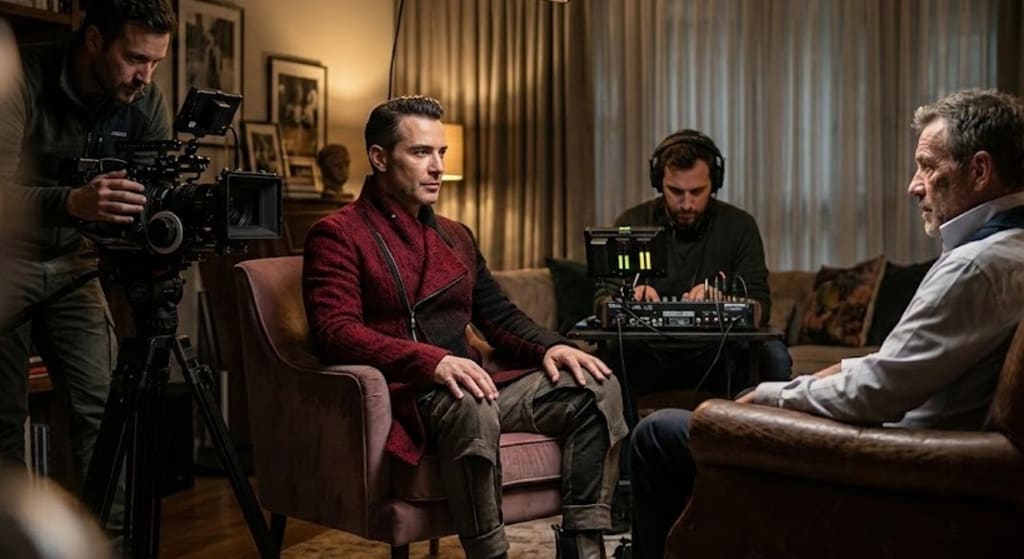
I sat in that soft armchair, dressed in an asymmetrical jacket that felt like butter, smelling of Tom Ford oud and dry tobacco. Like Achilles in his tent, I sought refuge in scents and fabrics. My presence was a silent insult to their perception of sacrifice. To them, I was an "artist," someone who looked too groomed, too avant-garde for a world that only recognizes raw testosterone and camouflage patterns. I hid my agony beneath layers of silk and fine manners. It was my way of escaping the mud that constantly tries to pull you back by the pant leg, into the trenches we were supposed to have left long ago.
During filming, I could feel their eyes dissecting me. Short twitches of the nose as they caught my perfume, raised eyebrows at my every precise movement, a suspicion that hung in the air like smoke after a firefight. What does this mannequin know about the hell we went through? – their posture asked, their stiffness in the shoulders. It hurt, deeply, but I clenched my teeth and stayed silent. They were the important ones here, not me. Their stories were heavy, charged with unspoken emotion that the camera could barely handle, and I listened to them with the kind of absolute attention possessed only by someone who knows how to recognize the sound of bones breaking in someone’s voice, even when that voice is deceptively calm.
Then he walked in. The last protagonist in the series. A high-ranking scout officer, a man who walked as if he could still feel mines beneath his boots—measured, quiet, and dangerous. We shook hands—firm, military style—but he sized me up with that familiar, cold contempt that was worse than any curse word. He saw my hair, my expensive perfume, my blood-cut jacket that didn't fit into his vision of veteranhood.
"Watch how you do this," he said quietly, while the cameraman was clipping the mic to his shirt. "Make it cinematic. The way Clint Eastwood or Mel Gibson does it. If you can even conceive of that kind of flesh... that kind of emotion. War isn't described, kid. It's recognized in the dark, by the smell of fear that never washes off."
I didn’t contradict him. I didn’t feel the need to defend myself. I just signaled the cameraman to start, and the room plunged into darkness, save for that one beam of light falling on his face, sharp and weathered like a rock face.
The story flowed slowly, like tar. He was an authority used to commanding, but under my lights, he slowly began to open up, layer by layer, as if peeling back an old bandage. We came to the moment that filled the room with a vacuum, the kind of silence that precedes a disaster.
"We were both badly wounded," he began, looking somewhere through the lens, straight into the autumn of 1991. "We were lying in that grass, about three feet from each other, on that open ground where you're just a target. The guy who was with me, a kid, younger than you are now—he first quietly treated his own wounds from his first-aid kit. His hand was shaking, but he knew what he was doing. Then he somehow crawled over to me. He patched the wounds on my back that I couldn't reach myself. He just kept saying that first aid was key, that the blood shouldn't get infected because that was our only chance to survive. Calmly, as if we were doing something ordinary. We shot ourselves with morphine at the same time and waited for eight hours. Eight hours of eternity."
He paused. His hand unconsciously sought the scar on his hip. In the studio, there was only the quiet hum of electronics and his heavy, intermittent breathing.
"He tore off a branch of a young beech tree," he continued hoarsely, his voice trembling. "Green leaves, the only living thing in that grayness of death. He tossed that branch to me and told me to wave it. Constantly. He said the flies were already gathering and they’d lay eggs in the open wounds if I stopped. That the maggots would eat us faster than the shrapnel. I waved that branch for over six hours over the two of us, until my arm went completely numb. We waited for that guy, Vilim, the one who later wrote the book. He broke through hell to get us out. But I wonder... did that kid survive? I never even learned his name in all that madness, and his face was just a mask of blood and mud."
A silence so deep fell over the studio it felt as if time itself had stopped. The cameraman slowly pulled his eye away from the viewfinder, unable to look through the lens anymore. I felt that old, dull shiver in my shoulder, exactly where the fine fabric of my jacket touched the skin that had never forgotten the coldness of metal and the smell of rot.
"I'm alive," I said.
The word dropped into the room like lead into still water. Without an echo, but with an infinite, devastating weight that shattered every prejudice in that room.
"I tore off that young beech branch for you to wave because the shrapnel was sticking out of your back, right next to your spine, and I was afraid you’d bleed out if I tried to move you," I added, not moving from my armchair. "I watched the back of your head while you waved those green leaves and kept the flies off the two of us. It was the most persistent hand I’ve ever seen in my life."
The officer slowly, painfully straightened up. His eyes, until then hard and armored, began to feverishly search my face, looking in my pupils for that open ground, that same grass, and that same morphine. He was looking for that riddled boy beneath the asymmetrical cut of my jacket and the scent of expensive perfume. He was looking for confirmation that the world hadn't completely fallen apart.
We looked at each other in that half-light for a long time. Without words. Without the need for me to explain that my aesthetic was, in fact, my final revenge against the war. He looked at my manicured hands, the same ones that had handed him that beech branch in the dark thirty years ago as his only hope.
"You..." he managed to say, while his voice broke in half for the first time in his life, stripped of all ranks, myths, and authority.
"We're alive," I answered quietly, and at that moment, it was the only truth that mattered in the entire universe.
We both teared up, but neither of us reached for a handkerchief. The cameraman turned off the lights one by one, leaving us in a silence that healed. In the air hung that same weight we had felt in the grass, only this time there was no fear in it, but some wild, indescribable recognition that transcends any story.
He walked out of the studio without looking back, walking slowly, as if after thirty years he was finally allowed to lower his shield and be tired. Some truths cannot be told to the end, because they are too raw for any frame the world tries to impose on them. Sometimes, a warrior doesn't wear camo. Sometimes he smells of oud and wears silk, not because he forgot who he was, but because it’s the only way he can remember what he survived without dying all over again under the shadow of a young beech branch.
Author’s Note
This story is deeply rooted in my personal journey as a war veteran. While some elements have been dramatized for the purpose of this challenge, the emotions, the struggle for dignity, and the aesthetic mask I wear are very much my reality. It is a tribute to those who found beauty as their final way to survive.
About the Creator
Feliks Karić
50+, still refusing to grow up. I write daily, record music no one listens to, and loiter on film sets. I cook & train like a pro, yet my belly remains a loyal fan. Seen a lot, learned little, just a kid with older knees and no plan.
Keep reading
More stories from Feliks Karić and writers in Fiction and other communities.
The 30 Percent Armor
My bathroom is a minefield I know by heart. Every tile under my bare feet has its own temperature, every bottle on the shelf its own weight and texture. This is my sanctuary, my little staging ground for practicing “normal” before I step out and put on the mask I’ve spent years carving. This morning is particularly rough. The fog in my left eye—the one that checked out years ago, a late-coming bill from a war injury that finally came due—has started bleeding into the right. A recent ablation did its job, but it left the world looking like a water-damaged oil painting. I see about thirty percent of reality. The other seventy? I fill that in with memory, gut instinct, and pure, raw spite.
By Feliks Karić3 days ago in Fiction
Lightning Never Strikes Twice
The distant rumble, the sudden deluge, the crescendo of sound, the flash of light, the explosive energy — it never gets old. I became an amateur storm chaser about two years ago. My wife, Cindy suggested it. Sort of. She said, "Alex, you know this cancer is killing me. I've come to terms with that, but you're smothering me. Go join a band, write a book, or become a storm chaser, for all I care. I love you, but you need a hobby."
By Julie Lacksonen4 days ago in Fiction
me, me, me
when i read back my poetry it screams “me, me, me” on my screen in bold letters and i can’t shut it up — most days, i cannot make any other words out; i want to throttle a thousand versions of the me gone by, i want to throw myself from a figurative balcony, i want to sink a sword into every pen i’ve held
By angela hepworth6 days ago in Poets

Comments
There are no comments for this story
Be the first to respond and start the conversation.