
The Language of Absence
A Study in the Anatomy of Loss
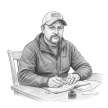
The stovetop ticked as the burner cooled, a rhythmic, cooling sound that bit into the silence of the kitchen. John didn’t move. He sat at the pine table, his fingers tracing the wood grain, waiting. He watched the steam curl toward the ceiling, a white plume turning grey in the dim morning light. Only when the heat had settled into a low, radiating warmth did his daughter, Mara, enter the room.
She walked with a soft, rolling gait, her eyes never rising above the level of the counter. She reached for the heavy pot on the stove, her movements fluid and smooth. She poured the hot water into two mugs, one blue and one chipped white, and set them down. She didn't look at John. She didn't look at the empty chair between them.
John reached for the blue mug. His hand shook, just a fraction, the ceramic clicking against the wood as he pulled it toward him. Mara sat, her gaze fixed on the steam rising from her own drink. They sat like that for ten minutes, the only sound the rhythmic ticking of the clock on the wall and the distant, muffled lowing of a cow in the south pasture.
When the clock struck seven, John stood. He took his mug to the sink, rinsed it, and placed it upside down on the drying rack. Mara did the same. Neither of them spoke. There was no "good morning," no "how did you sleep," and no mention of the weather. Words were heavy things, dangerous things, better left unsaid until the sun had cleared the ridge.
Outside, the air was crisp, biting at the edges of John’s coat. He headed toward the barn, his boots crunching on the frost dusted gravel. He saw Miller, his neighbor, leaning against the fence that separated their properties. Miller was a tall man; his face etched with the lines of seventy hard winters. He was looking out at the valley; his hands shoved deep into his pockets.
John stopped ten feet away. He didn't wave. He didn't call out. He simply stood, looking in the same direction as Miller. They stayed that way for a long time, two sentinels watching the mist burn off the creek. Finally, Miller nodded, a single, sharp jerk of his chin. John mirrored the gesture. It was enough.
In the barn, the work was a series of practiced motions. John moved among the cows, his touch firm but gentle. He spoke to them in low, wordless hums, a vibration in the chest rather than a sound from the throat. The animals responded, shifting their weight, their large, dark eyes tracking his progress. They understood the rhythm. They knew the cost of a sudden noise, a sharp exclamation.
Around noon, John walked into town. The main street was busy, but it was a quiet business. People moved with a focused intensity, their heads down, and their shoulders hunched. At the general store, Mrs. Gable was stocking shelves. A young boy, no older than six, was standing by the penny candy jars. He reached out, his hand hovering over a bright red sucker.
"Don't," his mother whispered, her hand closing over his wrist. Her voice wasn't angry, but it was taut, vibrating with a hidden urgency.
The boy looked up, his eyes wide. He pulled his hand back and tucked it into his pocket. He didn't ask why. He didn't whine. He simply stepped closer to his mother’s side, his gaze dropping to the floorboards.
John stepped up to the counter. He laid out a list written in a precise, cramped hand. Mrs. Gable read it, her lips moving silently as she gathered the items. She placed a bag of flour, a tin of coffee, and a box of nails on the counter.
"Fine weather," she said, her voice barely audible over the hum of the refrigerator.
John nodded. He pulled a leather pouch from his pocket and counted out the coins, laying them in neat rows on the wood. He didn't count them aloud. He didn't ask for the total. Mrs. Gable swept the coins into the register, her movements as careful as if she were handling blown glass.
"The ridge is clear," she added, her eyes looking toward the window.
John paused, his hand on the bag of flour. He looked out the window. The sky was a hard, brilliant blue, and the mountains were a jagged line of slate against the horizon. He nodded again, a slow, deliberate movement, and left the store.
On the way home, he passed the cemetery. It was a small plot, enclosed by a low stone wall. Most of the headstones were old, their inscriptions worn away by wind and rain. But in the far corner, near the ancient oak tree, was a fresh mound of earth. There was no stone, no marker of any kind.
John stopped at the gate. He didn't enter. He stood with his hat in his hands, his head bowed against the wind. He thought of the blue mug in the kitchen, the way the steam curled in the morning light. He thought of the empty chair. He felt a sudden, sharp ache in his chest, a pressure that demanded release. He opened his mouth, his breath hitching in his throat.
A bird flared out of the oak tree, its wings snapping against the air like a deck of cards being shuffled. John closed his mouth. He swallowed hard, the lump in his throat sticking like a dry crust of bread. He put his hat back on, adjusted the bag of flour on his shoulder, and continued walking.
That evening, the house was filled with the smell of roasting potatoes. Mara was at the stove, her back to him. John sat at the table, the blue mug refilled with tea. The shadows were long now, stretching across the floor like dark fingers.
A knock came at the door. It was three sharp raps, followed by a pause, and then one more.
John stood and opened the door. It was Miller. He was holding a small, wooden crate filled with apples. His face was unreadable, his eyes shadowed by the brim of his hat.
He held out the crate. John took it.
"The wind's shifting," Miller said.
John looked past him, at the dark line of the woods. The trees were swaying, their branches groaning under the weight of the breeze.
"Aye," John replied.
Miller lingered for a moment, his gaze drifting toward the empty chair inside. He looked back at John, his expression softening for a fraction of a second. He reached out, his hand hovering near John’s shoulder, before dropping back to his side.
"G'night then," Miller said.
"G'night," John whispered.
He closed the door and set the apples on the counter. Mara was watching him, her eyes bright in the lamplight. She picked up an apple, turned it over in her hand, and then set it down.
They ate in silence, the only sound the scrape of forks against ceramic. When they were finished, Mara gathered the plates. John stayed at the table, staring at the empty space across from him. He could almost see her there, the way she would tilt her head when she laughed, and the way she would hum under her breath while she worked.
The silence of the house felt different tonight. It wasn't the peaceful quiet of a long day’s end. It was heavy, expectant, a physical weight pressing down on his shoulders. He felt the urge again, stronger this time, a desperate need to say her name, to shout it into the rafters until the walls shook.
He stood up so abruptly that his chair scraped harshly against the floor. Mara froze at the sink, her shoulders tensing. John walked to the window and pressed his forehead against the cool glass. He looked out at the stars, thousands of tiny, cold lights scattered across the blackness.
He thought of the rules they lived by, the way they moved, the way they spoke, and the things they left unsaid. It was a language of absence, a code built on what was missing. It was how they survived. It was how they kept the world from falling apart.
If he said her name, the silence would break. And if the silence broke, everything else would follow. The walls would crumble, the sky would fall, and the void she left behind would swallow them whole.
He took a deep breath, the cold air filling his lungs. He held it for a moment, feeling the burn, and then let it out slowly, a long, silent exhale.
He turned away from the window. Mara was watching him, her face pale in the dim light. He walked over to her and placed a hand on her shoulder. He didn't say anything. He didn't have to.
She leaned her head against his arm for a brief second, a soft, fleeting pressure. Then she turned back to the sink, her hands moving through the soapy water.
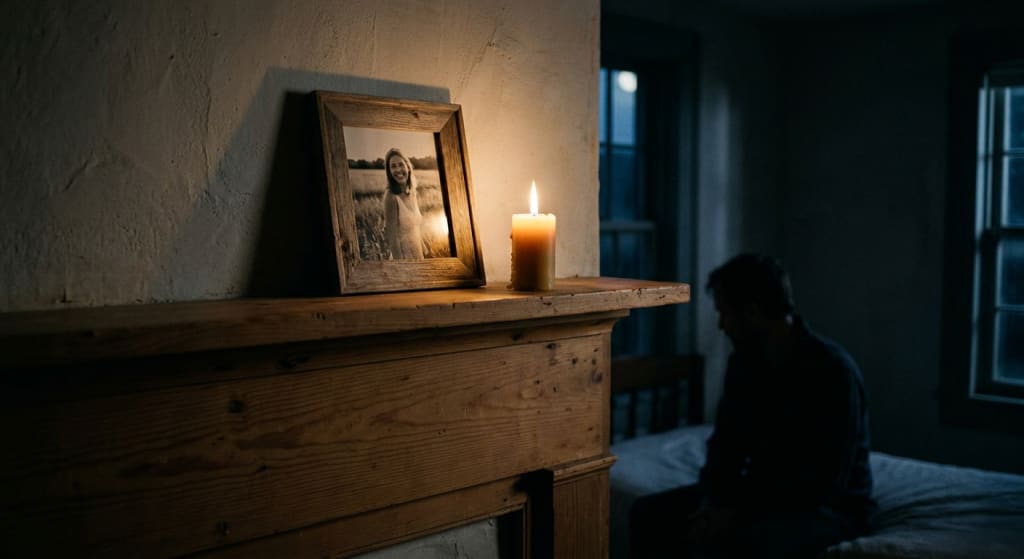
John went to the cupboard and took out a small, wooden box. Inside were several candles and a box of matches. He took one candle, lit it, and carried it to the mantelpiece. He set it down next to a small, framed photograph, the only one in the house. It showed a woman with bright eyes and a wide, easy smile, standing in a field of sunflowers.
He stood before the picture for a long time. He didn't speak. He didn't weep. He simply watched the flame flicker, the light dancing across the woman’s face.
The clock on the wall struck nine. John blew out the candle. The smoke rose in a thin, ribbon, curling into the darkness.
He walked to the doorway, pausing for a moment to look back at the room. Mara was already gone, her bedroom door clicked shut. The house was still, the silence absolute.
John went to his own room. He undressed in the dark, his movements slow and methodical. He lay down on the bed, pulling the heavy quilts up to his chin. He stared at the ceiling, listening to the wind outside. It was a low, mournful sound, a long-distance echo of something lost.
He closed his eyes. In the darkness, he could still see the woman in the photograph. He can see her smile, her bright eyes, and the way the sun caught the gold in her hair. He held the image in his mind, cradling it like a fragile bird.
He didn't say her name. He wouldn't. Not tonight. Not tomorrow. Not ever again.
The rule was simple. The rule was absolute.
You do not speak of the dead. You do not recognize the void. You simply live around it, moving through the spaces they left behind, until the silence becomes the only thing you have left.
John drifted off to sleep, his breath steady, a ghost in the silent house. Outside, the wind continued to howl, a wordless lament for all the things that could never be said.
About the Creator
Tim Carmichael
Tim is an Appalachian poet and cookbook author. He writes about rural life, family, and the places he grew up around. His poetry and essays have appeared in Beautiful and Brutal Things, his latest book.
Keep reading
More stories from Tim Carmichael and writers in Fiction and other communities.
Lightning Never Strikes Twice
The distant rumble, the sudden deluge, the crescendo of sound, the flash of light, the explosive energy — it never gets old. I became an amateur storm chaser about two years ago. My wife, Cindy suggested it. Sort of. She said, "Alex, you know this cancer is killing me. I've come to terms with that, but you're smothering me. Go join a band, write a book, or become a storm chaser, for all I care. I love you, but you need a hobby."
By Julie Lacksonen4 days ago in Fiction
The Inversion
March 30th, 2027: The Day the World Turned Inside Out No one screamed. That was the first strange thing. On March 30th, 2027, the sun rose in the west. Not dramatically. Not in a cinematic blaze. It simply appeared where it did not belong — quiet and confident, as if it had always preferred that direction.
By Flower InBloom2 days ago in Fiction
Review of 'Man on the Run'
My wife and I saw Man on the Run, a nearly 2-hour documentary on Amazon Prime, about Wings, Paul McCartney's group that flew around the world from shortly after The Beatles broke up in early 1970 to shortly after John Lennon was murdered at the end of 1980, making a Beatles reunion forever impossible.
By Paul Levinson4 days ago in Beat



Comments (1)
I love the very real feeling you create of a grief filled morning where “words are dangerous and heavy.”