
You underestimated your fluency level. Now what?
I guess it's my turn now.


As you may know, I'm now learning Korean by using two methods: a passive one, i.e. playing the videogame Lingo Legends, and an active one, namely writing sentences using specific grammar topics from Unit 1 of How To Study Korean.
Since the source materials for the active and passive sessions are different, the running order of the topics and its organization are not the same, but I don't mind having a taste of something new on Lingo Legend that I can eventually practice through writing.
I have also come across topics that I had already tackled when I first started learning Korean between 2018 and 2020, like the structure 아/어도 되다 (a/eo do dwi da), which is used to give and ask for permission.
One day, I browsed the website of How To Study Korean out of curiosity, to check how aligned it was with Lingo Legends.
I found that grammar construction well into Unit 2.
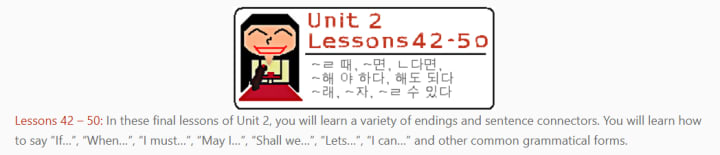
A question popped up in my mind: have I underestimated my level?
Such a situation is quite common among language learners, especially those who self-study. When you're in school, you have teachers grading you, and from their assessment you can see (more or less objectively) if you're ready to move on to the next topic or not. But if you're alone, it gets much harder to self-assess yourself.
However, as the overthinker that I am, I have tried to analyze the situation more in depth and find some more hidden reasons why this happens, focusing on Korean language.
It's hard to be ambitious with East Asian languages (if your mother tongue is an Indo-European language).
Korean is an Altaic language, meaning that it has a different origin than English, which is an Indo-European language, so it's obviously a very different language and one of the hardest to learn for English speakers.
To add more fuel to the fire, it's also the language with the largest vocabulary in the world, with more than a million words (including headwords). You're neither too lazy nor unintelligent, Korean is THAT hard.
However, I also think that there's another side to the coin. When looking at Italian university courses for East Asian languages, the expected level to be reached at graduation is low. According to them, you can reach A2 at best.
When looking for microcredentials and free online courses, we can notice a similar situation.
Now, this is just speculation so take it with a pinch of salt, but I think that such a scenario makes it easier for us to be "unambitious" when it comes to fluency. If you're an university student, then it's okay and even healthy for you to stick to your course's learning objectives, but if you're self-studying, then you really have no limit but the very goals you set for yourself.
Still, it's easier said than done. Sure, they're not easy languages, and you should not beat yourself up if you do not reach level C1 overnight, but it does not mean that you cannot reach a conversational level if you dedicate enough time and attention to them.
There's a positive side to it
Picture this: you're practicing Korean on an app, and you notice that you've been struggling with certain expressions or words, and you can't figure out why.
Then, you find out that those concepts are actually more advanced in comparison to the grammar you've been studying so far.
This is fantastic news for you: you're not stupid, you have just been practicing more advanced concepts!
If that is your case, then noticing the misalignment between the "course materials" of your app and the concepts from your grammar resources will save you a lot of frustration and self-doubt. It's not always a terrible thing!
How to fix it?
To be honest, I haven't had the time nor the energy to try to fix the issue yet. The most obvious solution is to catch up with the grammar concepts that I have already tackled on Lingo Legends, but it obviously requires some scheduling.
In the next few weeks, I'll try to figure out a solution and, eventually, I'll post a follow-up either on my Bluesky profile or with a longer post here on Vocal.
In the meantime, I'd like to hear your opinion: have you already experienced this issue? Have you solved it in another way? Let me know in the comments below, and consider subscribing to stay updated on my new articles!
About the Creator
Simona Rosso
She/her. I write about pop culture, and I love dissecting every single medium I come across.
Keep reading
More stories from Simona Rosso and writers in Education and other communities.
How I Minimized My Digital Shadow Without Disappearing From the Internet
A few months ago, I did something uncomfortable. I searched my own name. Not just on Google. I checked social media platforms, old forums, public directories, and even usernames I used years ago. I searched my email address. I searched my phone number. I wanted to see what someone else could see.
By Stephano kambeta5 days ago in Education
Discovering the Art of Fly Angling: A Complete Beginner’s Guide to Getting Started
Fly fishing is widely considered one of the most rewarding and artistic forms of fishing. Unlike traditional fishing methods that rely on heavy bait or lures, fly fishing uses lightweight artificial flies that imitate insects and other small aquatic creatures. The technique requires patience, rhythm, and a strong understanding of water conditions and fish behavior. For many anglers, learning fly fishing opens the door to a deeper appreciation of nature and the peaceful environments where fish thrive.
By Joe Sottolano4 days ago in Education


Comments
There are no comments for this story
Be the first to respond and start the conversation.