
Why the Sky Looks Darker in Deserts
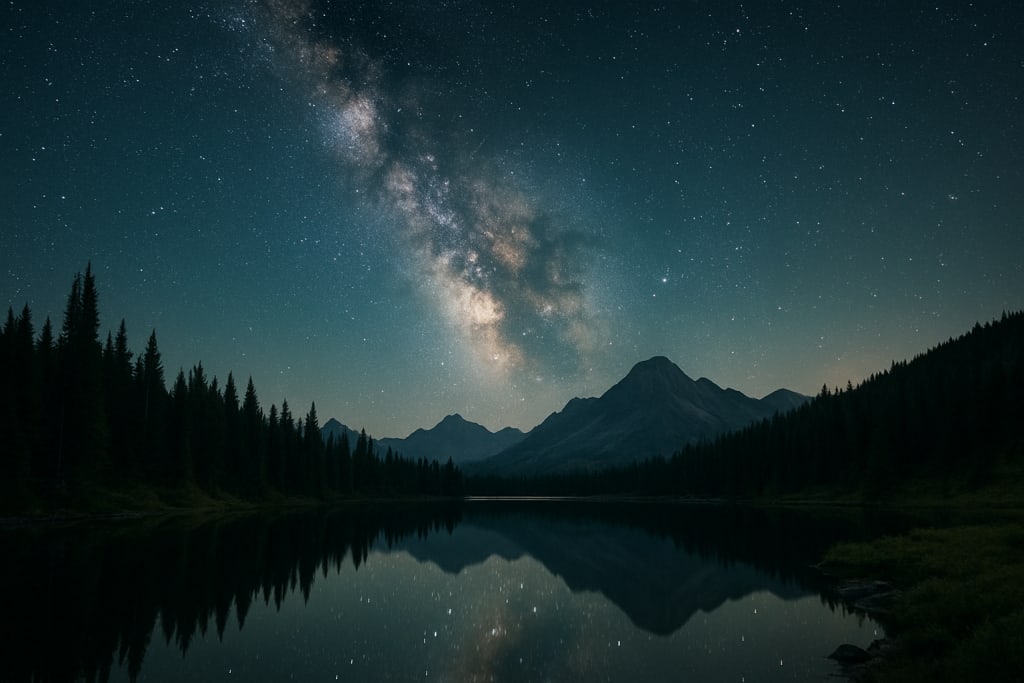
If you’ve ever traveled far from city lights into a vast desert landscape, you may have noticed something extraordinary: the sky appears dramatically darker, clearer, and filled with countless stars. In some desert regions, the Milky Way stretches vividly from horizon to horizon, and faint constellations become easily visible to the naked eye. But why does the sky look darker in deserts? The answer lies in atmospheric science, humidity levels, light pollution, elevation, and air stability

The Science of a Dark Night Sky
To understand why the sky looks darker in deserts, we first need to understand what makes the sky bright at night.
Even far from cities, the night sky is never completely black. It contains:
• Airglow (natural atmospheric emission)
• Scattered starlight
• Zodiacal light
• Light pollution
• Moonlight
What determines sky darkness is how much unwanted light gets scattered in the atmosphere. Deserts reduce many of the factors that cause scattering, resulting in darker skies.
________________________________________
Low Humidity: The Key Desert Advantage
One of the most important reasons deserts have darker skies is low humidity.
Water vapor in the atmosphere scatters artificial and natural light. The more moisture in the air, the more light spreads and creates skyglow.
Deserts are defined by very low annual rainfall and extremely dry air. Because water droplets and humidity particles are minimal:
• Less light is scattered
• The sky appears clearer
• Stars look sharper
• The Milky Way appears more detailed
In contrast, humid coastal or tropical regions often experience brighter skies due to atmospheric scattering.
________________________________________
Reduced Atmospheric Scattering
Light scattering occurs when light interacts with particles in the atmosphere. The two main types of scattering are:
• Rayleigh scattering (by small molecules)
• Mie scattering (by dust, pollution, and larger particles)
While deserts can have dust during storms, on calm nights the dry air typically contains fewer suspended particles than urban or humid environments.
The result?
Less scattering of artificial light and deeper contrast between stars and sky background.
________________________________________
Minimal Light Pollution
Another major factor is the absence of artificial light.
Deserts are usually:
• Far from large cities
• Sparsely populated
• Low in industrial activity
Light pollution is the biggest reason skies appear bright in urban environments. Cities emit enormous amounts of upward-directed light, which reflects off atmospheric particles and creates a glowing dome over metropolitan areas.
Desert regions often qualify as some of the darkest skies in the world, especially areas designated as International Dark Sky Parks.
For example, desert regions near observatories operated by organizations like European Southern Observatory are specifically chosen for their exceptional sky darkness.
________________________________________
High Elevation in Many Deserts
Many famous desert regions sit at higher elevations.
For example:
• Atacama Desert
• Mojave Desert
Higher elevation means:
• Thinner atmosphere
• Less air mass above you
• Reduced scattering
• Sharper star visibility
The less atmosphere light must pass through, the darker the sky appears.
This is one reason major observatories are built in desert mountains.
________________________________________
Stable Air and Clear Weather
Deserts typically experience:
• Low cloud cover
• Minimal storm systems
• Stable high-pressure conditions
Clouds reflect and scatter light, brightening the sky. In desert climates, clear skies are common year-round.
Consistent atmospheric stability also reduces turbulence, making stars appear steady rather than twinkling excessively.
________________________________________
Distance from Ocean Moisture
Coastal regions often experience:
• Marine layers
• Fog
• High humidity
• Aerosols from sea spray
Deserts are usually located far inland or behind mountain ranges that block moist air.
This rain-shadow effect reduces atmospheric moisture dramatically, contributing to darker skies.
________________________________________
The Role of Airglow
Even in the darkest deserts, the sky is not completely black. A faint natural glow called airglow occurs when atoms and molecules in the upper atmosphere emit light.
Airglow can vary based on solar activity and atmospheric chemistry. However, in deserts, the absence of competing light pollution makes natural airglow easier to observe.
Under very dark conditions, observers may see:
• Greenish bands
• Subtle atmospheric waves
• Zodiacal light
These faint phenomena are often washed out in urban skies.
________________________________________
Visibility of the Milky Way
One of the most striking features of desert skies is the clear visibility of the Milky Way.
The Milky Way is our home galaxy, officially known as Milky Way.
In cities, light pollution reduces contrast so severely that only the brightest stars are visible.
In deserts, the darker background allows:
• Star clouds to stand out
• Dust lanes to become visible
• Dense star clusters to be seen without optical aid
The galactic center region near constellations like Sagittarius appears especially vivid under desert skies.
________________________________________
Temperature and Thermal Effects
Deserts experience large temperature swings between day and night.
At night:
• Rapid cooling stabilizes lower atmospheric layers
• Convection decreases
• Turbulence reduces
This improves transparency and sharpness of celestial objects.
Astronomers call this “good seeing.”
________________________________________
Dark Sky Measurement: Bortle Scale
Sky darkness is measured using the Bortle Scale.
It ranges from:
• Class 1 (pristine dark sky)
• To Class 9 (inner-city sky)
Many desert areas qualify as Class 1 or Class 2 skies.
In such conditions:
• The Milky Way casts faint shadows
• Zodiacal light is obvious
• Even faint galaxies are visible to the naked eye
Urban centers rarely go below Class 7 or 8.
________________________________________
Observatories in Desert Regions
Some of the world’s most advanced telescopes are located in deserts.
Examples include:
• Paranal Observatory
• Mauna Kea Observatories
While Mauna Kea is not technically a desert, it shares key desert-like features:
• Dry air
• High elevation
• Minimal light pollution
The Atacama Desert, in particular, is considered one of the driest places on Earth and provides nearly unmatched sky clarity.
________________________________________
Reduced Aerosols and Pollution
Urban environments contain:
• Industrial emissions
• Vehicle exhaust
• Artificial particulates
These aerosols scatter light and brighten the sky.
Deserts typically have:
• Very low population density
• Minimal industry
• Clean air (except during dust storms)
On calm nights, this results in exceptional transparency.
________________________________________
Why Desert Dust Doesn’t Always Brighten the Sky
One might assume desert dust would brighten the sky.
However:
• Dust settles quickly on calm nights
• Major dust storms are episodic, not constant
• Dry air prevents moisture from binding to particles
During dust storms, visibility drops dramatically. But outside these events, deserts often have clearer skies than humid regions.
________________________________________
Psychological Perception of Darkness
Another factor is contrast.
In deserts:
• There are fewer artificial lights nearby
• The horizon is open and unobstructed
• There are no reflective buildings
This enhances our perception of darkness and vastness.
Human eyes adapt better to darkness when there are no bright lights in peripheral vision.
________________________________________
The Role of Moon Phases
Even in deserts, the Moon significantly brightens the sky.
During a full Moon:
• The sky appears washed out
• Fainter stars disappear
During a new Moon:
• Desert skies reach peak darkness
• Deep-sky objects become visible
Astronomers plan desert observations around lunar cycles for this reason.
________________________________________
Why Deserts Are Ideal for Astrophotography
Astrophotographers prefer desert skies because:
• Long exposures reveal minimal skyglow
• Background noise is reduced
• Faint nebulae become visible
Objects like:
• Andromeda Galaxy
• Orion Nebula
appear dramatically clearer under desert conditions.
________________________________________
Climate Stability and Predictability
Deserts often have predictable weather patterns.
This means:
• Fewer cloudy nights
• Reliable observation windows
• Long-term astronomical research is feasible
This reliability makes deserts prime sites for multi-billion-dollar telescope projects.
________________________________________
The Global Importance of Desert Skies
As urban areas expand, dark skies are disappearing worldwide.
Deserts serve as:
• Scientific research hubs
• Educational astronomy sites
• Protected dark-sky reserves
Efforts to preserve dark skies help maintain access to pristine celestial views.
________________________________________
Conclusion: Why Desert Skies Are So Dark
The sky looks darker in deserts due to a powerful combination of factors:
• Extremely low humidity
• Minimal light pollution
• High elevation
• Stable atmospheric conditions
• Reduced aerosol scattering
• Clear, dry air
Together, these conditions reduce atmospheric scattering and increase contrast between stars and the sky background.
When you stand beneath a desert sky on a moonless night, you are seeing the universe with minimal interference from Earth’s atmosphere and human activity. The result is one of the most breathtaking astronomical experiences available on our planet.
Deserts remind us what the night sky looked like for most of human history—deep, dark, and filled with stars beyond counting.
About the Creator
Keep reading
More stories from shahkar jalal and writers in Education and other communities.
How AI-Powered Smart Intake Forms Improve Insurance Onboarding Efficiency
What Are Manual Intake Forms? Manual intake forms are the standard tools used for years in agencies. They come as downloadable PDFs, long online forms, or email attachments that clients are asked to fill out before the agency can begin processing a quote or policy. While straightforward in theory, these forms can be overwhelming in practice.
By Fusion Business Solution P Limited6 days ago in Education
Why Biotechnology Is Advancing Scientific Innovation Across the United Kingdom?
Biotechnology has become a cornerstone of scientific progress in the United Kingdom, supporting advancements in healthcare, agriculture, environmental sustainability, and industrial processes. By applying biological systems and living organisms to develop innovative solutions, biotechnology continues to reshape multiple sectors.
By deepanshu Thakur6 days ago in Education




Comments
There are no comments for this story
Be the first to respond and start the conversation.