
How to Distinguish Planets from Stars
When you look up at the night sky, most bright points of light appear identical at first glance. However, not all of them are stars. Some are planets within our own solar system, shining brightly against the cosmic background. Knowing how to distinguish planets from stars is one of the most rewarding skills in observational astronomy.

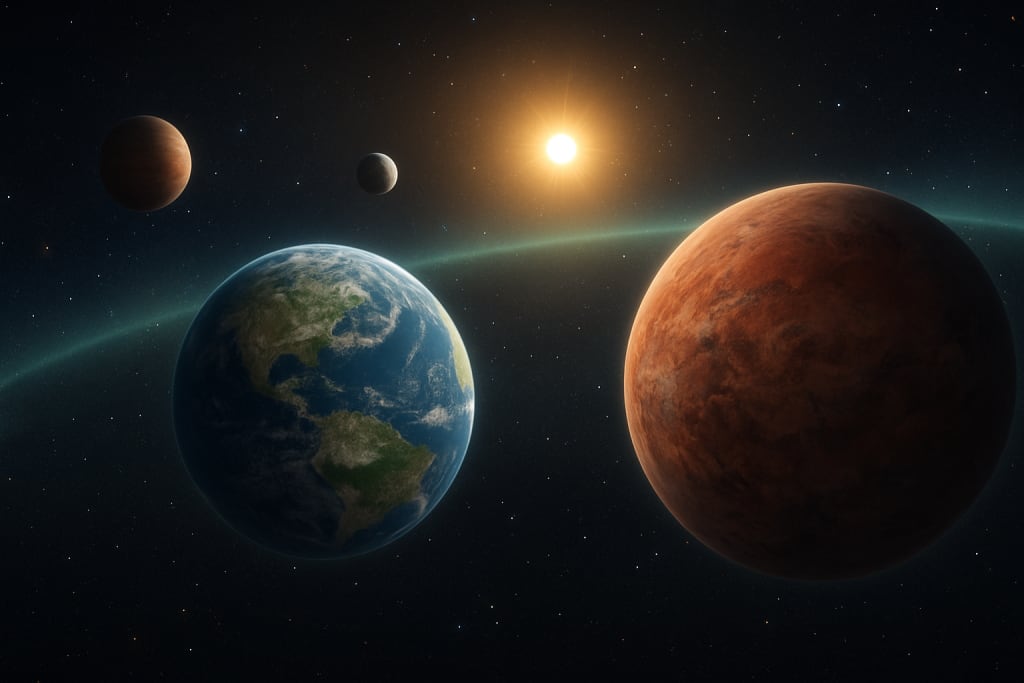
The Fundamental Difference Between Planets and Stars
The most important distinction is this:
• Stars produce their own light through nuclear fusion.
• Planets reflect light from a star.
For example:
• The Sun is a star that generates energy through nuclear fusion.
• Venus shines because it reflects sunlight.
Stars are enormous, distant spheres of hot plasma. Planets are much smaller bodies orbiting a star.
Despite this major difference, planets and stars can look very similar from Earth.
________________________________________
Why Planets Look Like Stars
Planets appear star-like because:
• They are far away.
• They appear as tiny disks too small for the naked eye to resolve.
• They shine brightly against a dark sky.
However, there are clear observational differences you can use to tell them apart.
________________________________________
1. Planets Do Not Twinkle (Much)
One of the easiest ways to distinguish planets from stars is by observing twinkling.
Stars twinkle because their light passes through turbulent layers of Earth’s atmosphere. This atmospheric distortion bends and refracts light randomly, causing brightness and color changes.
This effect is called scintillation.
Planets, on the other hand:
• Appear as small disks rather than point sources.
• Emit steadier light.
• Twinkle far less than stars.
For example:
• Jupiter usually shines steadily.
• Mars also appears relatively stable compared to nearby stars.
If a bright object in the sky is glowing steadily, it is likely a planet.
________________________________________
2. Planets Are Found Along the Ecliptic
Another key clue is position.
Planets orbit the Sun within roughly the same flat plane. From Earth, this appears as a path across the sky called the ecliptic.
The ecliptic passes through constellations of the zodiac.
If a bright object is located along this imaginary path, it could be a planet.
Constellations along the ecliptic include:
• Taurus
• Leo
• Scorpius
Planets never stray far from this band.
________________________________________
3. Planets Change Position Night to Night
Stars maintain fixed positions relative to each other. This is why constellations remain recognizable year after year.
Planets, however, wander slowly across the sky.
The word “planet” comes from a Greek term meaning “wanderer.”
If you track a bright object over several nights and notice it shifting position relative to nearby stars, you are observing a planet.
This movement occurs because planets orbit the Sun at different speeds and distances.
________________________________________
4. Brightness and Color Differences
Planets often appear brighter than most stars.
For example:
• Venus is often the brightest object in the night sky after the Moon.
• Jupiter shines prominently when visible.
Color can also be a clue:
• Mars appears reddish.
• Jupiter has a creamy white tone.
• Venus shines with a bright white glow.
Stars can also appear colored, but planetary brightness is often more intense and steady.
________________________________________
5. Planets Rise and Set at Predictable Times
Because planets orbit the Sun, their visibility changes throughout the year.
Some appear:
• Shortly after sunset.
• Before sunrise.
• All night long during opposition.
For example:
• Saturn may rise at dusk during certain months.
• Venus alternates between being a “Morning Star” and an “Evening Star.”
Tracking rise and set times can help confirm planetary identity.
________________________________________
6. Planets Show Detail Through Telescopes
With even a small telescope, planets reveal structure.
For example:
• Jupiter shows cloud bands and four large moons.
• Saturn reveals its rings.
• Mars may display polar caps.
Stars, even through powerful telescopes, remain point-like because of their immense distance.
If you see a tiny disk or surface detail, you are looking at a planet.
________________________________________
7. Planets Follow Retrograde Motion
Sometimes planets appear to move backward temporarily against the background stars.
This phenomenon is called retrograde motion.
It occurs when Earth overtakes an outer planet in its orbit.
Ancient astronomers found this puzzling until heliocentric models explained it.
Retrograde motion is a strong indicator that the object is a planet, not a star.
________________________________________
8. Planets Are Visible Only in Certain Seasons
Stars are visible in predictable seasonal patterns due to Earth’s orbit.
Planets, however, follow more complex cycles.
For example:
• Venus completes a cycle roughly every 19 months.
• Mars becomes especially bright about every 26 months.
Their appearance depends on orbital geometry rather than fixed stellar positions.
________________________________________
9. Using Star Charts and Apps
Modern tools make identification easier.
Sky maps and astronomy apps can show:
• Current planet positions
• Constellation boundaries
• Rise and set times
Comparing your observation with a star chart quickly confirms whether an object is a planet.
________________________________________
10. Distinguishing Planets from Satellites
Artificial satellites also appear as moving points of light.
However:
• Satellites move rapidly across the sky in minutes.
• Planets move slowly over days or weeks.
• Satellites do not remain fixed for hours.
The International Space Station, for example, crosses the sky quickly and disappears.
Planets remain visible in roughly the same location throughout a single night.
________________________________________
11. The Role of Magnitude
Astronomers measure brightness using magnitude.
Lower magnitude numbers mean brighter objects.
Venus can reach magnitude -4 or brighter, making it exceptionally luminous.
Most stars visible to the naked eye are fainter.
Brightness combined with steady light is a strong planetary indicator.
________________________________________
12. Commonly Visible Planets
Five planets are visible without optical aid:
• Mercury
• Venus
• Mars
• Jupiter
• Saturn
Each has distinctive brightness and movement patterns.
________________________________________
13. Why Planets Shine So Brightly
Planets appear bright because:
• They are relatively close compared to stars.
• They reflect sunlight efficiently.
• Some, like Venus, have thick cloud layers that enhance reflectivity.
Although stars are far more powerful light sources, their vast distances make them appear faint.
________________________________________
14. Historical Importance of Distinguishing Planets
Ancient civilizations carefully tracked wandering objects.
The unusual motion of planets led to:
• Development of early astronomical models.
• The eventual acceptance of heliocentrism.
Observations of planetary motion helped scientists like Galileo Galilei gather evidence supporting a Sun-centered solar system.
________________________________________
15. Practical Observation Tips
To identify planets:
1. Look for steady, non-twinkling light.
2. Check if the object lies along the zodiac path.
3. Observe position changes over several nights.
4. Use binoculars or a small telescope.
5. Compare with a current sky chart.
These steps reliably distinguish planets from stars.
________________________________________
Conclusion: Recognizing the Wanderers
Distinguishing planets from stars is both simple and deeply rewarding once you understand the clues. Planets shine steadily, move relative to background stars, and stay near the ecliptic. Stars twinkle more, maintain fixed patterns, and are scattered across the entire sky.
From the brilliant glow of Venus to the steady shine of Jupiter, planets connect us directly to our solar system’s dynamic structure. Learning to recognize them transforms casual stargazing into meaningful observation.
The next time you see a bright point of light that doesn’t twinkle and seems slightly out of place, you may not be looking at a distant sun—you might be witnessing one of our neighboring worlds traveling through the night sky.
About the Creator
Keep reading
More stories from shahkar jalal and writers in Education and other communities.
Crafted by Time: The Restoration and Enduring Spirit of the Sim Corder Mill
The Sim Corder Mill began as a testament to hard work, ingenuity, and a deep respect for craftsmanship. When it first operated, it stood as a vital engine of local industry, transforming raw materials into essential goods for the surrounding community. From the start, the mill reflected careful planning and skilled construction. Builders shaped every beam and fitted each mechanism with precision, knowing that the structure would carry both economic and personal significance.
By Grady Gaston2 days ago in Education
Review of 'Man on the Run'
My wife and I saw Man on the Run, a nearly 2-hour documentary on Amazon Prime, about Wings, Paul McCartney's group that flew around the world from shortly after The Beatles broke up in early 1970 to shortly after John Lennon was murdered at the end of 1980, making a Beatles reunion forever impossible.
By Paul Levinson3 days ago in Beat


Comments
There are no comments for this story
Be the first to respond and start the conversation.