
Whales should be protected!
An One-sided argument

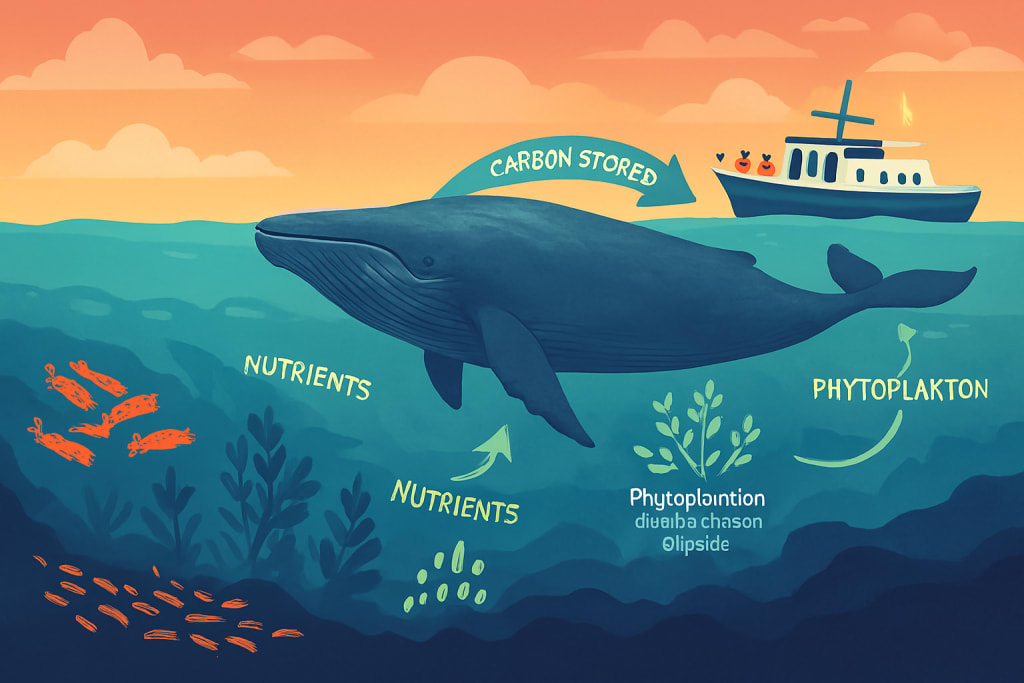
Carbon dioxide is one of the main gases responsible for global warming. When too much carbon dioxide builds up in the atmosphere, it traps heat from the sun and causes the Earth’s temperature to rise. If this problem continues without control, it could lead to serious environmental damage and may even make parts of the Earth difficult for humans and animals to live in. Therefore, it is important to find natural ways to reduce carbon dioxide levels. One surprising but very important solution is protecting whales, as they play a role in storing carbon in their bodies and supporting ocean ecosystems.
Whales are extremely large animals that can live for many decades. Because of their size and long lifespan, they are able to store large amounts of carbon dioxide in their bodies for a very long time. In fact, a single whale can store much more carbon than many trees. While trees also help absorb carbon dioxide from the atmosphere, whales hold the carbon in their bodies for many years as they grow and live in the ocean. This makes them an important part of the natural system that helps regulate the Earth’s climate.
Even after a whale dies, it continues to help the environment. When a whale dies naturally, its body sinks to the bottom of the ocean in an event known as a “whale fall.” The carbon stored in the whale’s body becomes part of the ocean floor sediment. This carbon can remain trapped there for hundreds of years before slowly returning to the atmosphere. Because of this process, whales help keep carbon out of the atmosphere for very long periods of time, which helps slow down global warming.
Whales are also very important for the health of ocean ecosystems. They help control the populations of krill, which are small shrimp-like creatures that many marine animals eat. By maintaining a balanced food chain, whales help keep the ocean ecosystem stable. In addition, whales help distribute nutrients throughout the ocean. When whales swim and feed at different ocean depths, they bring nutrients from deep waters closer to the surface.
These nutrients help tiny organisms called phytoplankton grow. Phytoplankton are extremely important because they absorb carbon dioxide from the atmosphere and produce oxygen through photosynthesis, similar to how plants on land work. In fact, phytoplankton are responsible for producing a large portion of the oxygen on Earth. When whale populations are healthy, phytoplankton growth increases because of the nutrients whales provide. This means more carbon dioxide is removed from the atmosphere and more oxygen is produced.
Another important reason to protect whales is that they contribute to scientific research and environmental understanding. Scientists study whales to learn more about ocean health, climate change, and marine ecosystems. By tracking whale movements, behavior, and population numbers, researchers can gather valuable information about how the ocean environment is changing. This information can help scientists develop better strategies to protect marine life and slow down the effects of climate change.
Whales also support human communities through responsible whale watching tourism. Whale watching has become a popular activity in many coastal regions around the world. When done carefully and responsibly, it allows people to observe whales without harming them. This type of tourism creates jobs for local communities, supports businesses, and boosts local economies. At the same time, it helps raise awareness about the importance of protecting whales and the oceans they live in.
Whale watching can also inspire people to care more about environmental protection. When people see these amazing animals in their natural habitat, they often develop a deeper appreciation for marine life. This emotional connection can encourage people to support conservation efforts and protect ocean ecosystems. Scientists also benefit from whale watching activities because they can collect valuable data on whale populations and ocean conditions.
Therefore, I believe that no matter what others may say, whales should be protected because they play a very important role in fighting global warming. By storing carbon, supporting phytoplankton growth, maintaining ocean ecosystems, and helping scientists learn more about the environment, whales are essential to the health of our planet. Protecting whales is not only important for marine life but also for the future of the Earth and the survival of many living species.
About the Creator
*+*+*~Teja~*+*+*
Hi! I am a 12-year-old girl still in school, and I wanted to tell the stories, poetries, and creations I write to the world! My name is Teja, I am in grade 6 currently and I hope that I don't get hate in my creations! <3
Keep reading
More stories from *+*+*~Teja~*+*+* and writers in Earth and other communities.
Should Children ALWAYS listen to Adults?
Many people believe children should always listen to adults because adults have more experience and knowledge about life. Adults have faced many situations and learned from their mistakes over time. Because of this, they often try to guide children and help them avoid problems. However, others argue that adults are not always right and that children should also learn to think for themselves. Children are individuals with their own thoughts and ideas, and sometimes they may see things differently from adults. This text will explore both sides of the argument to understand whether children should always listen to adults.
By *+*+*~Teja~*+*+*about 11 hours ago in Families
The Fiery Circle: Understanding the Pacific Ring of Fire
The **Pacific Ring of Fire** is not a literal ring of flames, but it is undoubtedly the most geologically volatile region on Earth. Stretching approximately 40,000 kilometers (25,000 miles) in a massive horseshoe shape, it traces the coasts of the Pacific Ocean—from the southern tip of South America, up along the coast of North America, across the Bering Strait, down through Japan, and into Southeast Asia and New Zealand.
By Irshad Abbasi a day ago in Earth



Comments
There are no comments for this story
Be the first to respond and start the conversation.