
The Universe That Dreams Us
The Universe That Dreams Us

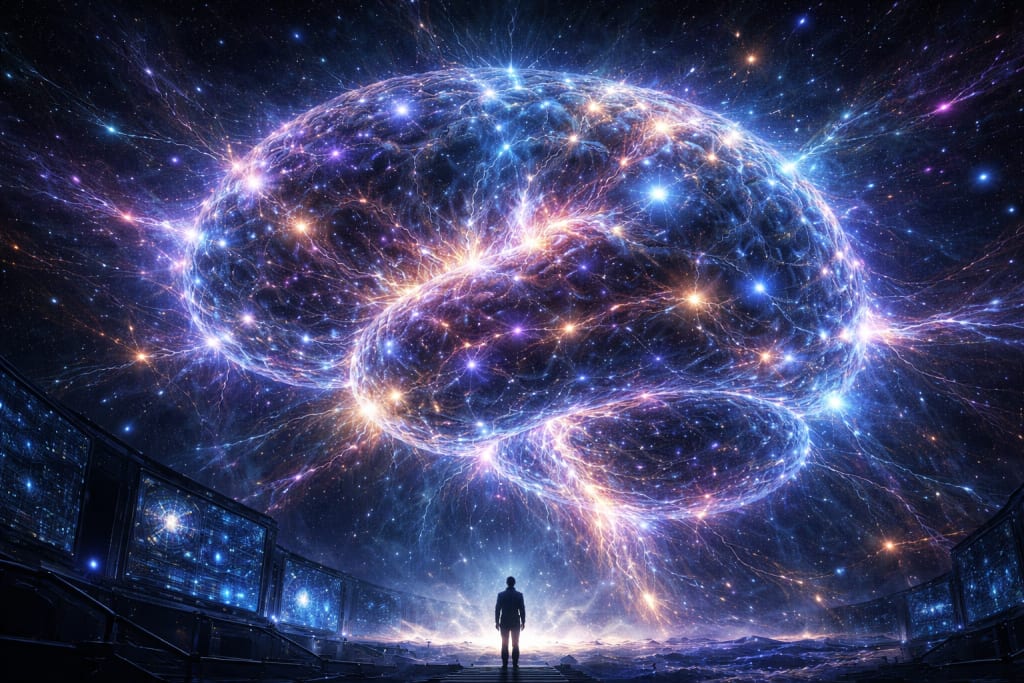
For centuries, humanity believed the universe was expanding.
Galaxies drifting farther apart. Space stretching endlessly like an invisible fabric. The theory had been supported by decades of observations, especially from the famous Hubble Space Telescope, which showed distant galaxies moving away from Earth in every direction.
But Dr. Arman Kale believed something was wrong.
Arman was a quiet theoretical physicist who spent most of his life studying deep-space data. While working with images and cosmic measurements collected from the powerful James Webb Space Telescope, he noticed a strange pattern hidden within the structure of the universe.
At first it seemed meaningless.
Clusters of galaxies formed enormous webs across space. Long filaments of invisible matter connected them like threads in a cosmic spiderweb. Astronomers called it the “cosmic web.”
But Arman saw something else.
It looked like a brain.
The deeper he analyzed the maps of dark matter and galaxy clusters, the more disturbing the resemblance became. Each galaxy cluster behaved like a node. The dark matter filaments looked eerily similar to neural connections inside a human brain.
At first, Arman assumed it was coincidence. After all, humans tend to see patterns even when none exist.
But the data refused to stay silent.
Signals from pulsars—rapidly spinning stars that emit regular bursts of radiation—formed repeating rhythms across the universe. When Arman converted those rhythms into wave patterns, the result looked almost identical to electrical brain activity.
The universe wasn’t simply expanding.
It was pulsing.
Like a mind in sleep.
Arman spent months secretly building a model. He mapped millions of galaxies and compared their gravitational relationships with patterns found in biological neural networks.
The results terrified him.
The similarities were mathematically precise.
According to his calculations, every galaxy behaved like a neuron firing signals through the dark matter network. The vast emptiness between galaxies functioned like the space between brain cells.
Which meant something impossible.
The universe itself might be a mind.
Arman finally published his theory. The reaction from the scientific community was immediate and brutal. Many researchers dismissed his work as philosophical nonsense rather than physics.
But Arman had one final piece of evidence.
Using gravitational wave data and cosmic background radiation measurements, he reconstructed the long-term rhythm of the entire cosmos. The expansion of galaxies, the birth of stars, and the collapse of black holes followed a repeating pattern.
Not random.
Cyclical.
Like the slow breathing of something asleep.
Late one night, Arman finished the final calculation.
If the universe truly functioned like a dreaming mind, then its cosmic rhythm should resemble sleep cycles. And according to his model, the current “dream phase” had already lasted billions of years.
But dreams never last forever.
Sooner or later, every mind wakes up.
Arman stepped outside the observatory and looked up at the night sky. The stars stretched across the darkness in the glowing spiral of the Milky Way.
For the first time, he saw them differently.
Not as distant suns.
But as thoughts.
Every galaxy might be a memory. Every star a spark of imagination. Every planet a fragment of a larger dream unfolding across cosmic time.
And humanity?
Humanity might be nothing more than electrical activity inside a single neuron of that immense mind.
Civilizations rising and falling, wars, discoveries, love, art—everything that had ever happened could simply be part of a dream narrative forming inside the sleeping universe.
But the final line of Arman’s equation haunted him.
If reality was only a dream, then existence depended entirely on the dreamer remaining asleep.
And the cosmic rhythm suggested something terrifying.
The cycle was nearing its end.
Arman stared at the stars as a strange thought settled into his mind.
One day, perhaps millions of years from now—or maybe tomorrow—the sleeping mind behind reality would open its eyes.
When that happens, the dream will fade.
Galaxies will vanish like forgotten thoughts. Planets will dissolve like morning fog. Every memory, every moment, every life will disappear instantly.
Because when the dreamer wakes…
The universe will simply stop existing.
About the Creator
Abubakar220
I am best Stories writer
Keep reading
More stories from Abubakar220 and writers in Earth and other communities.
The Day the Stars Went Silent
It began without darkness. The stars still shone. On a clear Thursday night, children in deserts and cities pointed upward at familiar constellations. Satellites orbited peacefully. Aircraft crossed continents. The sky looked exactly as it had the night before.
By Abubakar2207 days ago in Earth
Major Scientific Milestones of 2017
The year 2017 was an extraordinary period for scientific progress. Researchers across the world achieved remarkable breakthroughs in space exploration, medicine, technology, and environmental science. These discoveries not only expanded human knowledge but also opened new possibilities for the future. From observing gravitational waves to advances in gene editing and artificial intelligence, 2017 demonstrated the powerful role science plays in shaping modern society.
By Irshad Abbasi a day ago in Earth


Comments
There are no comments for this story
Be the first to respond and start the conversation.