
Seven Earth-Sized Planets Discovered Beyond Our Solar System
Astronomers uncover a remarkable planetary system that could reshape the search for life in the universe.

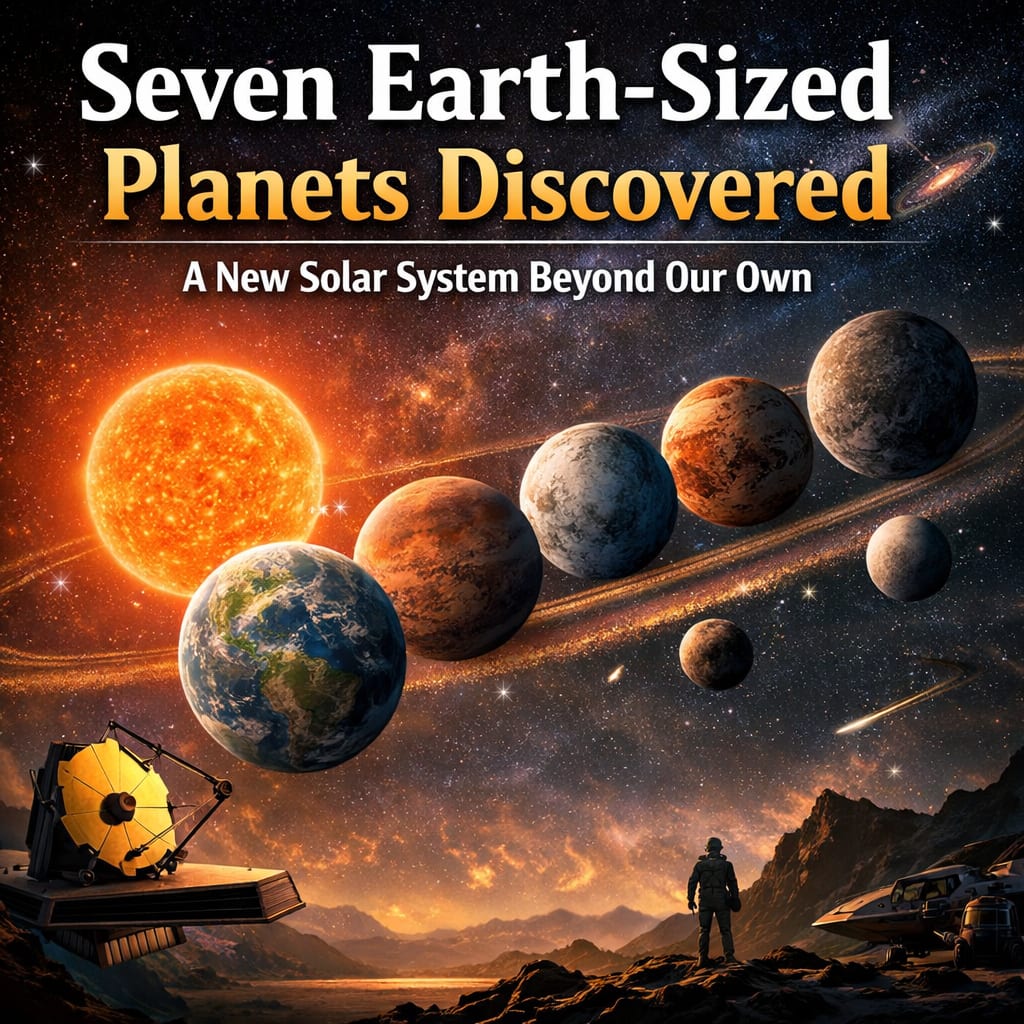
In one of the most exciting breakthroughs in modern astronomy, scientists have discovered a system of seven Earth-sized planets orbiting a distant star. This extraordinary finding has captured global attention because several of these planets exist in the “habitable zone,” where conditions may allow liquid water to exist. The discovery not only expands our understanding of planetary systems but also strengthens the possibility that life might exist beyond our solar system.
The discovery was made around the ultra-cool dwarf star TRAPPIST-1, located about 40 light-years away in the constellation Aquarius. Despite being much smaller and cooler than our Sun, this faint star hosts an incredibly rich planetary system. Astronomers detected the planets using a method known as the Transit Method, which observes tiny dips in a star’s brightness as planets pass in front of it.
The initial discovery was announced by an international team of scientists using observations from the TRAPPIST Telescope in Chile and later confirmed with the powerful Spitzer Space Telescope. These instruments allowed researchers to monitor the star for long periods and carefully analyze the light variations caused by orbiting planets.
What makes this discovery truly remarkable is that all seven planets are roughly similar in size to Earth. Scientists have named them TRAPPIST‑1b, TRAPPIST‑1c, TRAPPIST‑1d, TRAPPIST‑1e, TRAPPIST‑1f, TRAPPIST‑1g, and TRAPPIST‑1h. Their sizes range from about 0.75 to 1.1 times the radius of Earth, suggesting they are likely rocky planets rather than gas giants like Jupiter or Saturn.
Three of these planets — TRAPPIST-1e, TRAPPIST-1f, and TRAPPIST-1g — orbit within the star’s habitable zone. This region is the distance from a star where temperatures might allow water to remain liquid on a planet’s surface, a key ingredient for life as we know it. Although the presence of liquid water has not yet been confirmed, the possibility has sparked immense scientific interest.
Another fascinating aspect of this planetary system is how closely the planets orbit their star. All seven planets are much closer to TRAPPIST-1 than Mercury is to the Sun. In fact, some of them complete a full orbit in just a few days. Because the star is relatively cool and dim, however, the planets can still maintain temperatures that may be suitable for water under the right atmospheric conditions.
Scientists believe these planets are likely tidally locked, meaning one side of each planet constantly faces the star while the other side remains in darkness. This could create extreme temperature differences between the day and night sides. However, if the planets have thick atmospheres or oceans, heat could circulate around the planet, potentially creating more stable climates.
The discovery also provides an excellent opportunity to study the atmospheres of Earth-sized exoplanets. Using next-generation observatories such as the James Webb Space Telescope, astronomers hope to analyze the chemical composition of these planets’ atmospheres. By studying how starlight passes through their atmospheres during transits, scientists may detect gases like water vapor, carbon dioxide, methane, or even oxygen.
Detecting such gases would not automatically confirm life, but it could provide clues about the planets’ environments. In particular, certain combinations of gases may suggest biological activity. This makes the TRAPPIST-1 system one of the most promising targets for the ongoing search for extraterrestrial life.
The discovery of these seven Earth-sized worlds also challenges earlier assumptions about how planetary systems form. Previously, astronomers believed that systems with multiple rocky planets might be rare. However, findings like TRAPPIST-1 suggest that compact systems of Earth-like planets may actually be common throughout the galaxy.
Ultimately, the TRAPPIST-1 system represents a major step forward in humanity’s quest to understand the universe. Each new observation brings scientists closer to answering one of the most profound questions ever asked: Are we alone in the cosmos?
As telescopes become more advanced and exploration continues, the secrets of these distant worlds may soon begin to unfold, revealing whether planets like Earth — and perhaps life itself — are more common than we ever imagined. 🌍✨🚀
About the Creator
Irshad Abbasi
Ali ibn Abi Talib (RA) said 📚
“Knowledge is better than wealth, because knowledge protects you, while you have to protect wealth.
Keep reading
More stories from Irshad Abbasi and writers in Earth and other communities.
Evidence Suggests a Large Hidden Planet May Exist in Our Solar System
For centuries, scientists believed the major members of our Solar System were fully known. From the rocky inner planets to the gas giants and icy bodies beyond, astronomers thought they had mapped most of the significant objects orbiting the Sun. However, new research by American scientists suggests that a large, hidden planet may still be lurking in the distant reaches of our Solar System.
By Irshad Abbasi a day ago in Earth
Easy-Care Houseplants for Busy People: Plants That Thrive on Neglect
You want plants in your home. You love the idea of greenery softening corners, purifying the air, and bringing life to your space. But your life is full—work, family, travel, social obligations. You worry that plants will become one more thing to fail at, one more guilty reminder of good intentions unmet.
By Emma Wallace5 days ago in Earth


Comments
There are no comments for this story
Be the first to respond and start the conversation.