
"The Shell in the Ghost, I Am Major"
Film Review

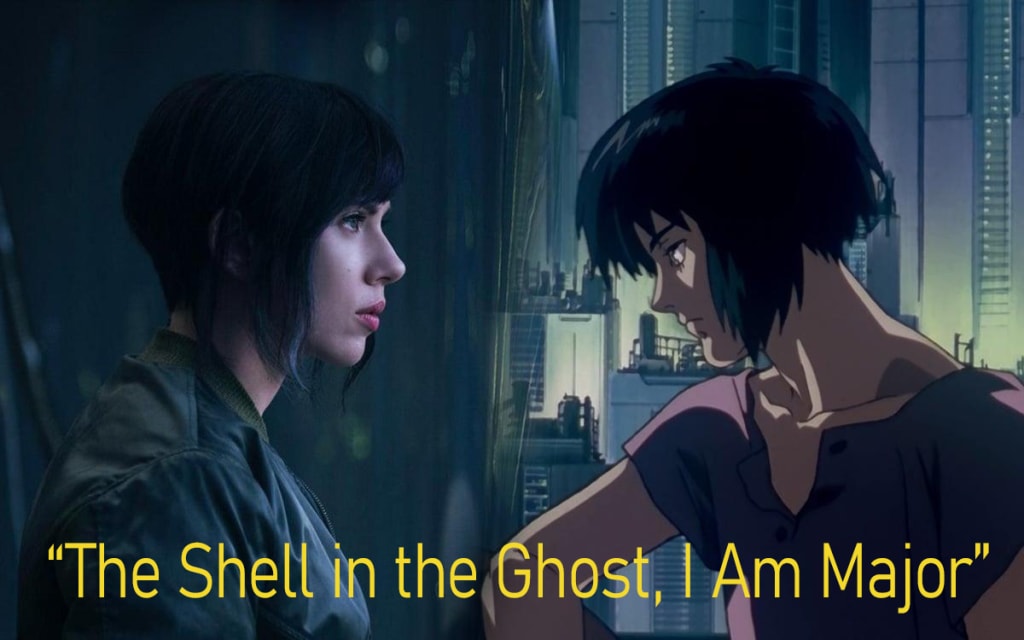
In 2017, Hollywood did something predictable and scandalous at the same time: it remade the Japanese cyberpunk classic Ghost in the Shell and placed a blonde American star at its centre. The actress was Scarlett Johansson. Critics argued about cultural appropriation, about empire, about whether the United States had once again absorbed a foreign myth and refashioned it in its own image. Yet beyond the controversy, the American Ghost in the Shell remains a philosophically provocative film. It forces a simple but radical question: what is a human being made of?
At one key moment, Major Mira Killian states, ‘I do what I am created to do.’ The line sounds obedient, almost mechanical. But it opens a metaphysical abyss. What was she created to do? And more importantly: what is she?
The Major is a body manufactured by a corporation. Her “shell” is synthetic matter—plastic, metal, engineered tissue. Her brain contains a human consciousness, but one that has been rewritten, edited, formatted. She is at once product and person. She is matter shaped by language. She is software installed in hardware.
If the shell is matter, then what is the ghost?
Traditionally, one would say the ghost is the soul. But in cyberpunk logic, the ghost is not a mystical substance floating above the body. It is information. It is memory, code, narrative. It is language running through circuits. The ghost is a story told inside matter.
The Major’s existence collapses the opposition between materialism and idealism. Marx insisted that matter is primary, that social being determines consciousness. Yet in a digital empire, consciousness is programmable. Language is inscribed into the body. Software governs hardware. The ghost rewrites the shell.
But language itself is material. Words are vibrations, inscriptions, electrical signals, magnetic traces on disks, pulses of light in fibre-optic cables. Even an LLM—an artificial intelligence model—is not a spirit. It is statistical matter arranged in silicon. The so-called ghost is always embedded in a shell.
So when the Major says, ‘I do what I am created to do,’ she speaks as both machine and moral agent. She was created as a weapon, as a police operative designed to eliminate cyber-terrorists. She was engineered to follow logic, to process probabilities, to execute commands. She is, in a sense, an embodied algorithm.
But she was also created to fight for justice.
No civilisation can survive without justice. Even criminal organisations maintain codes of honour. Even mafias enforce internal rules. If you break the code, you pay the price. Order, not chaos, sustains collective life. Justice is not an ornament; it is infrastructure.
The Major functions as the guardian of that infrastructure. She is a policewoman in a megacity of glass towers and holographic advertisements. She protects bodies—human matter—from annihilation. In this sense, her mission is profoundly material. She does not defend abstract ideals; she defends lives. To die is to lose matter. To risk one’s life is to wager the most precious possession: embodied existence.
Yet her conflict emerges from language. The corporation that built her implants a narrative: you are unique, you are chosen, you are protecting humanity. This narrative shapes her identity. It tells her who she is. But it is also manipulation. It is software masquerading as destiny.
What if language is a virus? What if identity itself is a script installed into matter?
The Major’s struggle is not simply against villains. It is against the invisible script governing her. She begins to suspect that her memories are fabricated, that her ghost is engineered. The true antagonist is not evil in a mythic sense; he is another victim of corporate programming. The enemy is systemic, infrastructural, embedded in the logic of predictive modelling and automated obedience.
Here the film intersects with our present condition. In a world of digital feudalism, where platforms own data and identity becomes intellectual property, the self is formatted by code. There is no territory, only information. No land, only data streams. 010101 replaces soil.
Algorithmic sovereignty replaces political sovereignty. Predictive systems anticipate behaviour. Probabilistic reasoning shapes decisions. Human beings become fixed assets within informational empires.
In such a world, what does it mean to say, ‘I do what I am created to do’?
Is that freedom, or is it compliance?
The Major’s evolution suggests a third possibility. She begins as a product of logic and control, but she chooses to interpret her function morally. She could become pure mechanism, pure shell. Instead, she insists on justice. She insists on protecting human life. She refuses to reduce herself to code.
The ghost, then, is not a supernatural entity. It is the capacity to assign meaning to matter. It is the rule that organises force. It is the narrative that transforms violence into law.
But can a shell exist without a ghost? Pure matter without language would be chaos. Yet language without matter is emptiness. The image stands between them—shaping perception, mediating meaning. The scandal over a blonde Major was about representation, about the shape of identity in visual space. Who is allowed to embody which story? Whose shell carries which ghost?
At its deepest level, *Ghost in the Shell* argues that identity is neither purely biological nor purely linguistic. It is structured matter. It is shaped substance. Like a mirror, it reveals contour. Stories have shape; bodies have shape. Justice, too, has shape.
When Major Mira Killian declares, ‘I do what I am created to do,’ she confronts us with a question we cannot avoid: what were we created to do? Are we shells animated by inherited scripts? Are we ghosts pretending to transcend our bodies? Or are we material beings capable of writing our own code?
Perhaps the answer is less mystical than it seems. We are matter organised by language, and language organised by matter. We create ghosts—moral principles, pride, loyalties—because societies require them. We defend justice because without it, civilisation collapses into entropy.
The Major’s final insight is not transcendence. It is responsibility. She accepts that she is constructed, but she chooses what her construction will serve. Logic without justice is tyranny. Matter without meaning is violence. Language without embodiment is chaos.
In the end, the shell contains the ghost—but the ghost also shapes the shell.
And like the Major, we must decide what we were created to do.
About the Creator
Peter Ayolov
Peter Ayolov’s key contribution to media theory is the development of the "Propaganda 2.0" or the "manufacture of dissent" model, which he details in his 2024 book, The Economic Policy of Online Media: Manufacture of Dissent.
Keep reading
More stories from Peter Ayolov and writers in Critique and other communities.
Cassie and Johnny
I’m the kind of dame you notice. I’m no femme fatale, but you can’t ignore me, at least not until I warn you about what’s coming, then everybody ignores me. Hell, they usually blame me afterwards and give Johnny all the credit for saving the day, but my Johnny couldn’t save a seat at the movies without my help. Sure, he’s brawny, but brainy? Not so much. Like that time I asked him to spot me five bucks, and he said he didn’t see it anywhere on me, and believe you me, he looked but good.
By Harper Lewis5 days ago in Critique
Stassi Schroeder: The Gender Gap in Accountability
Stassi Schroeder. The #OOTD creator, the queen bee of SUR, the blueprint of the strong-willed woman. Many believe that Lisa Vanderpump's hit reality television show Vanderpump Rules would not have been nearly as successful without Nastassia Schroeder's strong opinions and intense personality.
By Autumn Henderson7 days ago in Critique



Comments
There are no comments for this story
Be the first to respond and start the conversation.