
Why doesn't Iran target US bases in Turkey?
Iran Israel war US attack on Iran Turkey NATO role Iran Middle East conflict Incirlik air base Turkey Iran retaliation Middle East US military bases Middle East Iran Turkey relations Middle East war escalation Iran refugee crisi

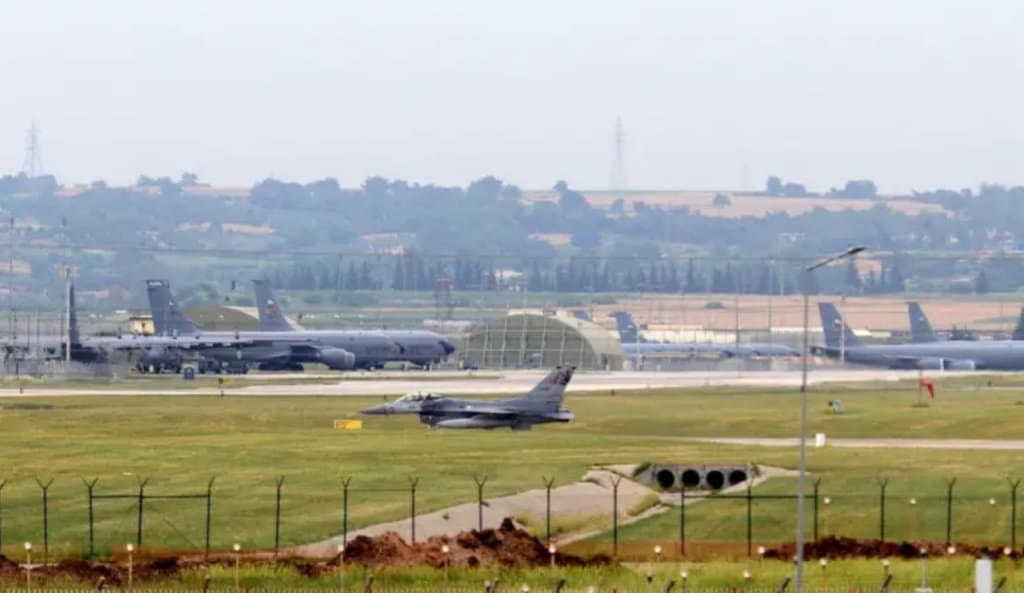
In the war that began on February 28 with attacks by the United States and Israel on Iran and continued with retaliatory strikes from Tehran, the intensity of casualties and destruction has been increasing every day.
Iran and militia groups affiliated with Tehran have so far targeted military bases and civilian infrastructure in Kuwait, Saudi Arabia, Oman, Bahrain, Qatar, Jordan, the United Arab Emirates, and Iraq, all of which host American bases. In addition, a British base in Cyprus has also been targeted.
In this war, which has spread from Turkey’s border neighbors to the Arabian Peninsula, Turkey is one of the few countries where air-raid sirens have not sounded.
Experts say that despite hosting U.S. forces, Turkey has not been targeted because of its membership in the North Atlantic Treaty Organization (NATO).
They emphasize that good relations between Ankara and Tehran also reduce the likelihood of any retaliatory action.
However, in its recent position, Turkey has criticized the attacks by the United States and Israel as well as Iran’s retaliatory actions.
Turkish President Recep Tayyip Erdoğan announced on February 28 that Ankara would increase its diplomatic efforts.
Mr. Erdoğan said:
“If rationality and wisdom do not prevail and no room is given for diplomacy, our region could be engulfed in widespread flames.”
He added:
“If Iran attacks Turkey, it will have to face all NATO countries.”
Sinan Ülgen, head of the Center for Economics and Foreign Policy Studies (EDAM), says that what distinguishes Turkey from other countries in the region targeted by Iranian attacks is its NATO membership.
He added:
“Such an attack would fully fall under Article 5 of NATO. Therefore, if Iran were to take such an action, it would effectively face all NATO member states.”
According to this fundamental NATO principle, an attack on any member state is considered an attack on all members, activating the alliance’s collective defense mechanism.
Sinan Ülgen believes that Iran will not expand the conflict by attacking U.S. bases in Turkey.
He said:
“Iran is not willing to open a new front in its immediate neighborhood by attacking Turkey. I see no possibility that it would want to provoke a country like Turkey, which has strong military power and impressive deterrence capability. Therefore, I consider the likelihood of a direct Iranian attack on Turkey to be very low.”
Mr. Ülgen also emphasized that the Incirlik Air Base in Adana was not used for attacks on Iran.
Ural Toğa, a researcher at the Center for Iranian Studies (IRAM), also considers it unlikely that Tehran would include parts of Turkey among its targets in retaliatory strikes.
He said:
“Unless a group inside Iran decides to act independently, which I also consider unlikely, Iran would not want to complicate the situation at this stage by opening a new front against a NATO member country.”
Mr. Toğa noted that Turkey and Iran, which share a 534-kilometer border, are mutually dependent in certain areas.
He said:
“Iranians, especially after the death of former President Ebrahim Raisi, have continuously sought to expand strategic cooperation with Turkey. I do not think they will reverse this trend or move relations in another direction.”
Incirlik and Kürecik
Turkey has announced that its airspace and air bases located on its territory that host U.S. forces were not used in U.S. or Israeli attacks against Iran.
A statement issued on February 28 by the Center for Combating Disinformation, which is affiliated with the Presidential Communications Directorate, emphasized that Turkey will not allow its airspace or related facilities to be used for operational purposes in any conflict or war in which it is not involved.
Another statement issued on March 2 by the same center denied claims of an attack on the Incirlik base, stating:
“There are no military bases belonging to any foreign country in Turkey. The air, land, and maritime space of the Republic of Turkey, as well as its military installations, are fully controlled and owned by the country. No attempt has been made to directly attack the country’s port. Portraying Turkey as a party to regional conflicts is a clear attempt to spread misinformation.”
The most important U.S.-related military bases in Turkey are the Incirlik Air Base and the Kürecik radar base in Malatya.
According to information published on the Incirlik Base website, construction of the military facility began in 1951 by a team called the American Engineering Group.
In 1954, an agreement was reached between the General Staff of the Turkish Armed Forces and the U.S. Air Force for the joint use of the base.
The use of the base is regulated through the Defense and Economic Cooperation Agreement (DECA), which was signed between the United States and Turkey in 1980.
The facility was initially called “Adana Air Base,” but in 1958 its name was changed to “Incirlik,” which is still in use today.
Turkey’s Ministry of Defense emphasizes that the base is under the command of the Turkish Armed Forces and owned by the Republic of Turkey.
The Kürecik radar base, located in the Akçadağ district of eastern Malatya province, is an early warning center established in 2012 and operates under NATO supervision.
The command center of this facility is located at the Diyarbakır Air Base, and its mission is to transmit data related to identifying and intercepting long-range aerial threats to the THAAD missile defense systems in Romania and Poland.
In 2011, the then-Iranian President Mahmoud Ahmadinejad criticized the establishment of the base, saying the installation was designed to protect Israel from possible Iranian missile attacks.
After the Hamas attack on Israel on October 7, 2023, and the subsequent Israeli military operations, pro-Palestinian activists claimed that both bases were being used to support Israel and held rallies demanding their closure.
Large-scale migration is very unlikely
One possible consequence for Turkey of a war between Iran and the United States and Israel is the risk of a wave of refugees from the Iranian border.
Turkey and Iran announced that they mutually suspended passenger crossings at their shared borders starting March 2.
Turkey’s Minister of Trade Ömer Bolat announced that both countries would allow their own citizens to return, and Turkey would also open its doors to third-country nationals currently in Iran.
According to Sinan Ülgen, head of the Turkish Center for Economics and Foreign Policy Studies, the worst-case scenario for Turkey would be instability in Iran. A situation similar to what happened earlier in Iraq and Syria could send a large wave of people toward Turkey’s borders.
He said that tightening border controls could be considered the first step in that direction.
However, Ural Toğa, a researcher at the Center for Iranian Studies (IRAM), emphasized that this measure should also be viewed from Iran’s perspective.
He said:
“Under the current circumstances, Iran prefers to focus on managing the situation inside the country rather than concentrating on controlling entry and exit at its borders.
Referring to comments and reports published on social media and in the media about the possibility of a refugee wave, he said:
“Right now, this is not an immigration issue, especially not large-scale immigration.
Mr. Toğa added:
“I do not expect a very large migration wave in the short or medium term. For that to happen, a civil war would have to begin. At present, the conditions for civil war do not exist in Iran. On the contrary, there is a kind of unity in the country.
About the Creator
Keep reading
More stories from Real content and writers in Chapters and other communities.
US CENTCOM Deploys LUCAS Drone Against Iran, Raising Questions Over Starlink Integration
The United States Central Command (CENTCOM) has announced that the US has used new long-range drones against Iran. Structurally, these drones resemble the Iranian “Shahed” drones.
By Real contenta day ago in Chapters
A More Human Vocal
When we launched Vocal nearly a decade ago, the world was a very different place. LLMs did not exist, and stories were created one at a time by people sitting down to write, revise, and share something personal. Many of our assumptions about publishing, trust, and participation were built for a world where effort and output were inseparable.
By Justin @ Vocalabout 4 hours ago in Resources



Comments
There are no comments for this story
Be the first to respond and start the conversation.