
“Boots” — The Hidden History of Gay Soldiers in the U.S. Military
From Silence and Secrecy to Service and Pride

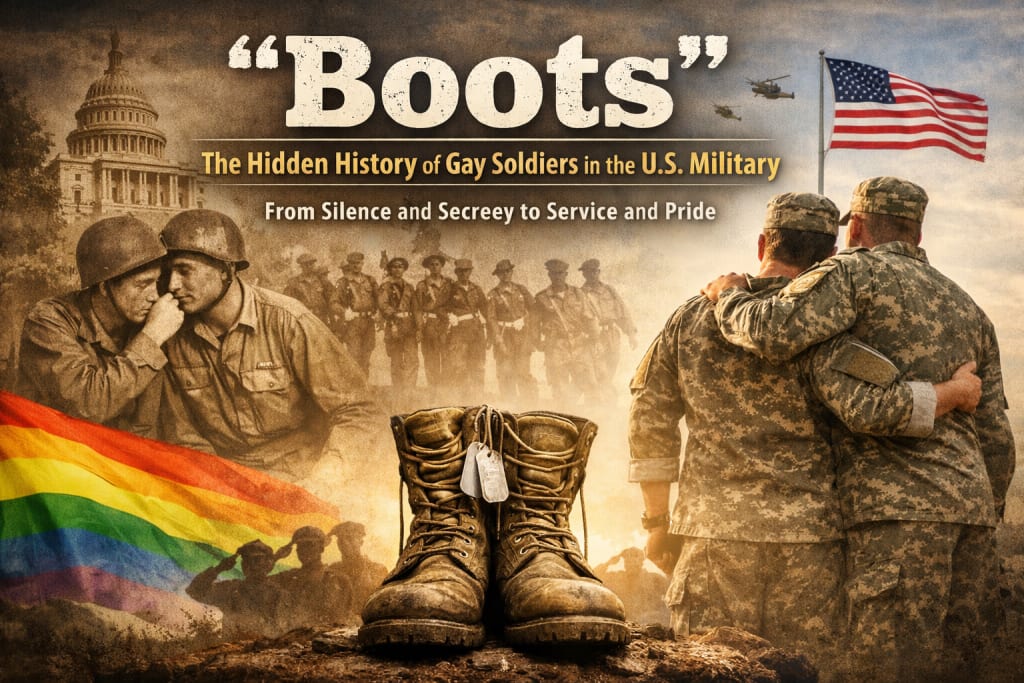
For much of American history, gay men and women have worn the uniform of the United States with courage and distinction — yet in silence. Their stories, often erased or deliberately concealed, form a powerful and complex chapter in the evolution of both the U.S. military and LGBTQ+ civil rights. From criminalization and dishonorable discharges to the controversial “Don’t Ask, Don’t Tell” policy and eventual full inclusion, the hidden history of gay service members reflects a broader struggle for dignity, recognition, and equality.
## Early 20th Century: Criminalization and Purges
In the early 1900s, homosexuality was officially considered incompatible with military service. During both World Wars, military regulations classified gay men and lesbians as mentally unfit or morally defective. Thousands were discharged under so-called “blue discharges,” a form of administrative separation that stigmatized veterans and denied them benefits.
During World War II, investigations intensified. Military officials actively searched for suspected homosexuals, often relying on rumors, entrapment, and invasive interrogations. Ironically, wartime mobilization also created spaces where many LGBTQ+ individuals met others like themselves for the first time, quietly forming communities within the ranks. Even under threat of punishment, they served as medics, pilots, intelligence officers, and infantry soldiers.
## The Cold War and the Lavender Scare
The postwar era did not bring relief. During the Cold War, homosexuality was framed as a national security risk. In parallel with the Red Scare, the “Lavender Scare” targeted LGBTQ+ individuals in government and military service. Officials claimed gay personnel were vulnerable to blackmail by foreign adversaries.
Under President Dwight D. Eisenhower, Executive Order 10450 (1953) formally banned homosexuals from federal employment, reinforcing the military’s policy of exclusion. Thousands of service members were investigated, interrogated, and expelled. Careers ended abruptly, medals were stripped of honor, and many veterans carried the burden of secrecy for decades.
Yet even in repression, resistance quietly formed. Former service members began speaking to one another, documenting experiences, and advocating for change. The seeds of later reform were planted during these difficult years.
## Vietnam and Shifting Cultural Attitudes
The social upheaval of the 1960s and 1970s began to challenge entrenched prejudices. The rise of the modern LGBTQ+ rights movement after the Stonewall uprising in 1969 influenced public debate about discrimination in all sectors, including the armed forces.
Still, official military policy remained clear: homosexuality was grounds for discharge. During the Vietnam War, some gay men were drafted and served honorably; others attempted to claim exemptions based on sexual orientation. The contradiction was stark — the military demanded manpower but maintained moral condemnation.
By the late 1970s and 1980s, advocacy groups such as the Servicemembers Legal Defense Network began to organize legal challenges. Public awareness grew as discharged veterans shared their stories in media interviews and congressional hearings.
## “Don’t Ask, Don’t Tell”: Compromise and Controversy
A pivotal moment came during the presidency of Bill Clinton. In 1993, his administration introduced the policy known as Don't Ask, Don't Tell (DADT). The compromise allowed gay men and lesbians to serve in the military — but only if they did not disclose their sexual orientation. Commanders were prohibited from asking, but service members could still be discharged if they were found to have “told.”
Supporters argued it was progress compared to outright bans. Critics contended it institutionalized silence and fear. Over the next 17 years, more than 13,000 service members were discharged under DADT. Many lost pensions, careers, and lifelong dreams simply for being honest about who they were.
Despite the restrictions, LGBTQ+ personnel continued to serve in every branch and in every major conflict, including operations in Iraq and Afghanistan. Their performance increasingly challenged the assumption that sexual orientation undermined cohesion or readiness.
## Repeal and a New Chapter
Momentum for repeal grew in the 2000s as public opinion shifted rapidly in favor of LGBTQ+ equality. Military leaders testified that ending the policy would not harm effectiveness. In 2010, Congress voted to repeal DADT, and President Barack Obama signed the repeal into law.
On September 20, 2011, the policy officially ended. Gay, lesbian, and bisexual service members could finally serve openly without fear of discharge. For many, it was a moment of vindication decades in the making. Veterans who had been expelled began campaigns to upgrade their discharge statuses and restore lost benefits.
The journey toward full inclusion has continued, including evolving policies regarding transgender service members. Though debates persist, the trajectory marks a dramatic transformation from the era of criminalization and secrecy.
## Legacy and Recognition
Today, historians and veterans are working to preserve this once-hidden history. Oral history projects, museum exhibitions, and academic research document stories that were long suppressed. Memorials now honor LGBTQ+ veterans who served with distinction even when their country denied their identity.
The story of gay soldiers in the U.S. military is not merely about policy change; it is about resilience. It is about individuals who laced up their boots, accepted risk and responsibility, and defended a nation that often refused to defend them in return.
From whispered conversations in barracks to open celebrations at Pride events on military bases, the transformation reflects broader societal change. The “boots” of LGBTQ+ service members have marched through discrimination, compromise, and ultimately toward recognition.
Their history, once hidden, is now an essential part of the American story — a testament to courage not only on the battlefield, but in the fight for equality itself.
About the Creator
Irshad Abbasi
Ali ibn Abi Talib (RA) said 📚
“Knowledge is better than wealth, because knowledge protects you, while you have to protect wealth.
Keep reading
More stories from Irshad Abbasi and writers in Chapters and other communities.
The Wicked Wife or the Secret Spy?
In the shadows of war, truth is often the first casualty. Few stories prove this more powerfully than that of Mata Hari — a woman who was branded a traitor, condemned as a seductress, and executed as a spy. To some, she was a wicked wife who betrayed loyalties for wealth and desire. To others, she was a secret agent who played a dangerous game among powerful men. Yet, more than a century later, historians still debate whether she was truly guilty — or simply a convenient scapegoat.
By Irshad Abbasi about 3 hours ago in History
How World War III Could Begin in Our Time
The First Sparks: How World War III Could Begin in Our Time World War III may not start with a single declaration or one massive attack. Instead, it could begin quietly, through a series of connected crises, misunderstandings, and power struggles already happening today. The world is more connected than ever, but that connection also makes global conflict easier to spread.
By Wings of Time a day ago in Chapters




Comments
There are no comments for this story
Be the first to respond and start the conversation.