
WHEN ANIMALS REIGN SUPREME
This is not fiction, but reality

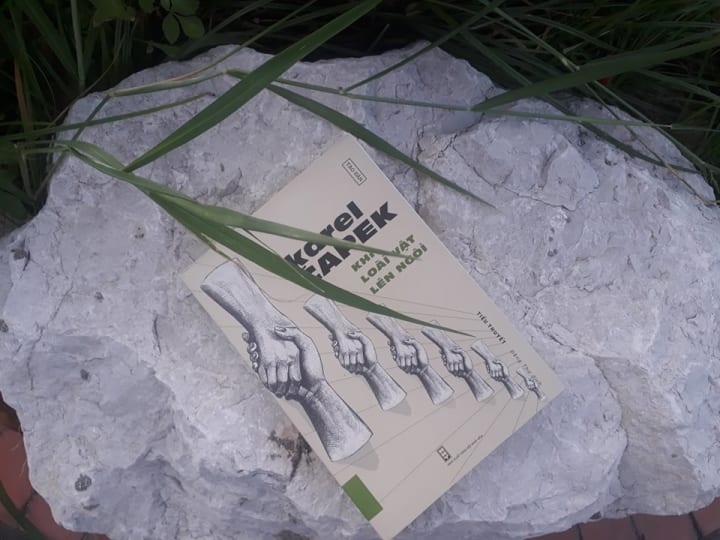
That's the preface to Karel Capek's novel, When Animals Reign Supreme, which perfectly encapsulates his ideas. In his work, Capek writes about a hypothetical scenario: the rise of a new salamander species just a few years after its arrival in the human world. His focus remains on the “reality” of the 1930s, the rise of fascism, the spark that ignited World War II, and the impending extinction of humanity. More than that, it serves as a prophecy for the future of humankind, a future that seems bleak if humanity remains consumed by greed, selfishness, bloodlust, and the illusion that humankind will forever stand at the top of the world.
FROM A “SAVAGE” SPECIES
Although When Animals Reign, as Karel Capek himself considers it a work of “realism,” before turning to reality, this novel is “science fiction.” This “science fiction” is founded on Karel Capek’s own observations of reality. He writes about an unrealistic species: a special salamander with the “scientific name” Andrias Scheuchzeri, yet it has an appearance and behavior quite similar to the amphibious salamanders in reality. It is black in color and can live both on land and in water. However, Andrias Scheuchzeri is larger than the common salamander, can walk on two legs on land, and can receive education from humans to communicate and work.
This species, originally, lived isolated from the human world on a secluded island. The people around knew of its existence but feared it as a surreal entity, beyond their comprehension. Although these creatures were harmless, small, and incredibly weak at the time, the Andrias Scheuchzeri salamander truly lived in a "barbaric" era, far removed from civilization, where all its activities and survival were purely instinctive.
Because of their weakness and lack of resistance to the forces of nature, their only way of survival was to reproduce prolifically to perpetuate their species. A truly primitive method. Their appearance was also only suitable for hunting plankton and small marine organisms. It seems that, in the process of evolution, nature forgot about this species, Andrias Scheuchzeri. And Andrias Scheuchzeri would likely have continued to live and die in such a "barbaric" era if not for human intervention.
Indeed, even though he wrote about a fictional creature, Karel Capek managed to make readers forget that Andrias Scheuchzeri is a product of imagination. Because he provided extremely comprehensive scientific documentation on their formation, development, and even fossil images. And also because, although Andrias Scheuchzeri the salamander is fictional, its evolutionary progression from "barbaric" to "civilized" is like a lens reflecting the development of humankind from prehistoric times and the Stone Age to the modern era.
TAKING THE FIRST TENTATIVE STEPS INTO THE WORLD OF "CIVILIZATION".
If we compare the development of the Andrias Scheuchzeri salamander to the development of humankind, then the time when Captain J. van Toch first encountered and discovered this species probably corresponds to the prehistoric period, the Stone Age, when salamanders could only survive and forage using extremely rudimentary methods and tools. After that time, it was the period when the Andrias Scheuchzeri species entered the world of "civilization," just as humans have gradually built the civilized society we see today. It's true that while humans built communities on land, amphibians like salamanders created their world and habitats in the sea by building dams, embankments, dikes, trenches, and intricate systems of transportation and underground tunnels on the seabed...
However, while the journey of humankind to the top of the food chain on Earth took thousands of years, the process by which the salamander Andrias Scheuchzeri became "civilized" occurred in just a few years. This was due to the assistance of humans themselves.
Humans first provided them with space to operate and tools for self-defense and labor so they could survive in the vast ocean with thousands of predators. Next, humans taught them the language and writing system of modern humans so the salamanders could communicate. Furthermore, humans also provided the salamanders with weapons of mass destruction. They taught this species about exchange and fair trade; they taught them equality and how to explore the world.
Through hard work and a sharp, intelligent mind, the Andrias Scheuchzeri salamander, from its humble beginnings, entered the world as mere entertainment for humans in zoos and circuses; as a slave, forced laborer for humanity in bays, coves, and coastlines… It gradually approached “civilization” and scientific advancement. It was as if human society was moving from a primitive communal form to a slave-owning society, skipping the intermediate stage and going straight to the “modern age.”
Andrias Scheuchzeri developed remarkably, yet no one seemed to care about a harsh reality: they understood humans and the human world very well, but humans had almost no understanding of their world. People studied their habits, population behavior, reproduction, and brain development, but they were completely unaware of the development of the entire aquatic salamander population. As is often the case, the dark ocean remains a mysterious world to humankind.
With limited understanding, yet tacitly ignoring and disregarding all warnings from the scientific community, people mock different species, cruelly, and even massacre weaker species out of selfishness, self-interest, or simply to satisfy their own vanity and bloodlust. Karel Capek's writing can be described as detached, nonchalant, and even cold; concise, balanced, and objective, like multi-faceted investigative reports. From there, the author presents the reader with multiple "doors" to view the same issue from various angles: the nation, businesses, science, social activists, smugglers, ordinary people, the salamander Andrias Scheuchzeri…
But no matter which door, all paths lead to one point: the reality of life hidden behind a story with a science fiction veneer. More specifically, in the 1930s, Western countries experienced a prolonged economic recession, each seeking different ways to revive its economy. Fascism emerged, threatening world peace. This situation seemed inevitable after an era of "civilization" built on selfishness, majority-minority divisions, and a host of extremist ideologies of modern man.
AND WHEN ANIMALS REIGN SUPREME
When Animals Reign Supreme is a truly exceptional novel. It's special not only in Karel Capek's storytelling style, constructing a work of fiction as a mirror reflecting human society, or the multiple perspectives in the narrator's narrative language. More importantly, this book brings together a variety of genres: narrative, journalism, news, science, etc.; thus leading to a highly diverse range of expression.
At first glance, readers might be overwhelmed by the sheer volume of knowledge and the diverse writing style of Karel Capek. But the deeper one delves into the work, the easier it becomes to see how the chapters and sections are logically interconnected. All of this aims to recreate the inevitable rise of the salamander species Andrias Scheuchzeri to power after the indifference, subservience, arrogance, self-importance, and insatiable greed of humankind at the top of the food chain, and the subsequent exploitation of salamanders for wealth, rivalry, and conflict.
As mentioned, author Karel Capek is always conscious of directing his writing towards reality: “[…] literature that does not care about reality and what actually happens in the world, that does not have strong reactions but only empty words, is not my literature.” Therefore, on at least three occasions, he interwoven his own observations about the relationship between salamanders and humans: “[…] Andrias Scheuchzeri, often called Andy, died as a consequence of fame. This shows that even salamanders can be corrupted by fame.”
And notably, in his novel *When Animals Take Over*, Karel Capek not only questioned but also desacralized, even satirized, a series of human illusions about the divine world. When humanity is constantly on the brink of annihilation by war, where are the gods? And is humankind the most beautiful creation, or merely an infinitely weak species burdened by greed, anger, and delusion, ultimately pushing itself to the brink of destruction?
*When Animals Take Over* is a work of science fiction, a reflection of reality, and also a prophecy by Karel Capek for the future world. Written in 1936, the novel foreshadowed a series of catastrophes humanity would face: World War II, population growth, weapons of mass destruction, epidemics, racial and ethnic discrimination that never ended but only deepened… “This is reality,” and also a somewhat dark and tragic future, if humanity continues to let its animalistic instincts prevail and animals take over.
About the Creator
HieuDinh
- Loves nature, likes to grow ornamental plants such as succulents, lotus (participates in volunteer activities to plant forests, protect forests in the locality)
- Loves dogs and cats (participates in local wildlife rescue activities)
Rachel Reviews: Lakefront Wolves by Joseph Deegan
Meet Finn. He's an 18 year old kid who has potential. He's bright with great school scores and he's also an athlete, a footballer of some prowess. He has it all going for him, it would seem, and yet, he's determined to send what could be a well-planned, stable existence firmly off the rails. He drinks, he smokes, he takes drugs, he has violent tendencies and he's in danger of losing not only his mind but all that he holds dear.
By Rachel Deeming3 days ago in BookClub
I Reread Harry Potter and the Order of the Phoenix—And Discovered a Lifehack for Overcoming Doubt and Authority
When I first read Harry Potter and the Order of the Phoenix by J. K. Rowling, I was struck by the darker tone, the political intrigue at Hogwarts, and the growing threats from Voldemort. At the time, I focused mostly on the drama and magical battles. But revisiting it as an adult revealed a hidden lifehack that applies far beyond Hogwarts: it’s a guide for handling doubt, navigating bureaucracy, and maintaining focus when authority, criticism, or external pressures try to derail you.
By Lukáš Hrdlička6 days ago in BookClub
Tatt~Master
— Assembly Line Tatt Machine ~ Impressions to Impress — As I begin to understand more about the Tattoo Phenomenon. I've written silly, yet verbatim, dating site anecdotes in 'Frazzled.' So let me ask you: Would you be More attracted to someone slathered with tattoos, or Less?
By Jay Kantor4 days ago in Humor


Comments
There are no comments for this story
Be the first to respond and start the conversation.